

New Year Resolution Ads on Meta: January Campaign Playbook
Plan January Meta ads around truthful product actions, transparent trials and mature contribution rather than assumed resolution behavior.
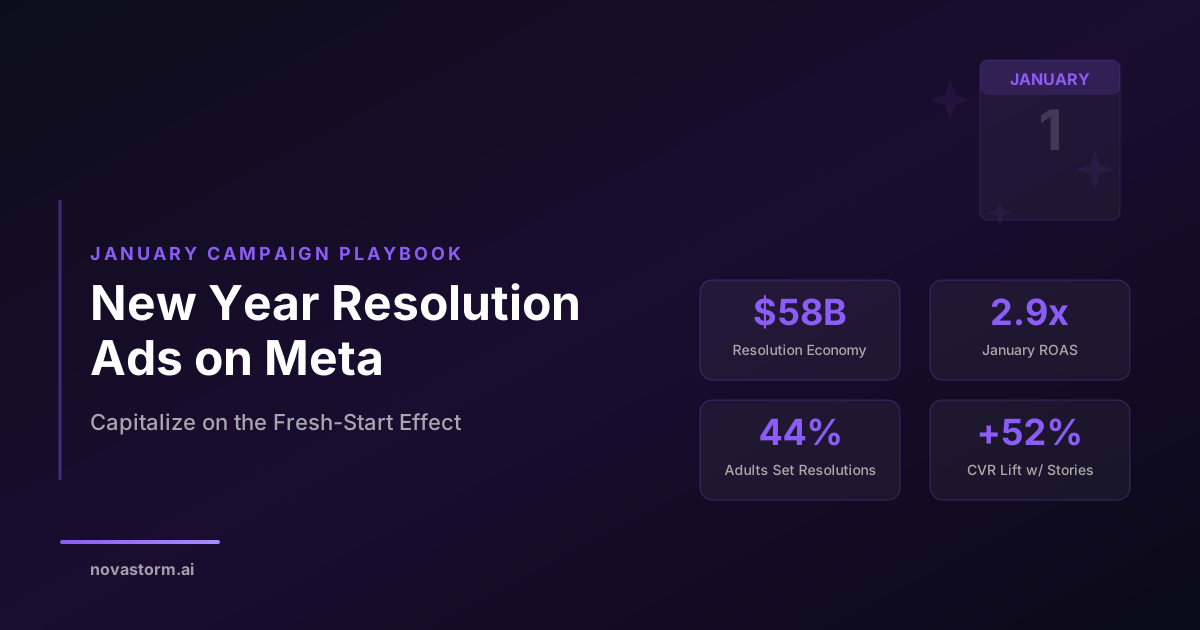
January provides an occasion to discuss a new routine, but an ad cannot identify someone’s private resolution or diagnose when they give up. Build a campaign around a supported product action, a transparent trial and measurable consented behavior. Treat the motivational calendar as a hypothesis rather than an observed universal curve.
A calendar that does not assume a CPM peak
Illustrative planning periods for December 2026–February 2027, not a seasonal forecast. An assumed $5,000 ceiling is allocated below. The allocation is a choice for review; do not spend it merely to fill the calendar.
| Period | Message hypothesis | Allocated ceiling | Evidence gate |
|---|---|---|---|
| December 26–31 | Offer a preview and an optional planning checklist | $500 (10%) | Consent and useful preview verified |
| January 1–7 | Show the first product action | $1,500 (30%) | Trial terms and onboarding work |
| January 8–15 | Explain what using the product involves | $1,250 (25%) | Paid-cohort data and support capacity |
| January 16–25 | Offer practical routine guidance | $1,000 (20%) | No inference of personal failure |
| January 26–February 7 | Invite an optional next step | $750 (15%) | Eligibility, consent and contribution support it |
Measure CPM and mature acquisition cost in each window using stable definitions; either January week could be more expensive in your auction. Compare country, placement, audience, offer and tracking changes before attributing a difference to the date. This plan does not label January 1–7 and January 8–15 as competing universal peaks.
Goals are a content taxonomy, not fabricated market shares
Fitness, financial planning, learning, well-being and organization are overlapping topics. Someone can pursue several. If your own opt-in survey permits multiple selections, report each category’s respondents divided by all eligible respondents and explain why percentages can exceed 100%. Without such a survey, use a topic list without numerical shares or a market-size estimate.
| Product job | Example English message | First action to validate |
|---|---|---|
| Routine planner | “Plan one task for your next week.” | Create and save a task |
| Learning tool | “Preview the first lesson before choosing a course.” | Open a genuine lesson preview |
| Budgeting tool | “See how the spending categories work.” | Use a sample budget without an earnings promise |
These examples are proposed copy for fictional or generic products. They do not claim customer outcomes, resolution prevalence or a measured “fresh-start” advertising lift. A community count requires a defined, current population; a testimonial requires actual experience and permission.
Use signals you control and can legitimately measure
Stop wasting ad budget
NovaStorm AI cuts Meta Ads CPA by 30% on average. No complex setup required.
- A search such as “2027 goals” on another service and use of a competitor’s app do not create a selectable Meta audience by themselves. Do not scrape or imply access to those histories.
- Where supported, use your own consented checklist visits, trial registrations or eligible customer list through a verified audience mechanism. Record lookback, exclusions, source refresh and whether expansion can reach outside the suggested cohort.
- Do not call a setup “Advantage+ retargeting” and assume it confines delivery to prior visitors. Verify accepted audience controls and exclusions for the actual campaign.
- A decline in campaign CVR can reflect delivery mix, tracking, a checkout error, lag or offer changes. It is not a person-level signal that a customer abandoned a goal.
- If your product genuinely records consented usage, define an operational inactivity rule, such as no completed lesson in a chosen window, and test whether an optional reminder helps. The event denotes usage, not a mental state.
Sensitive claims and pressure require review
For health-related products, the FTC health advertising guidance requires substantiation for express and implied claims in its US context. A customer story or disclaimer does not independently establish a general health outcome. Review the whole ad, visuals and destination rather than only its headline.
- Use product-centered wording: “Preview guided routines,” rather than asserting the viewer has an illness, financial hardship or an undesirable body. Avoid diagnostic inference and shame.
- Do not promise weight loss, treatment, debt elimination, investment returns or guaranteed transformation without the applicable evidence, permissions and policy review. Regulated categories and age restrictions need their own current checks.
- A before/after image may imply an outcome. Prefer a truthful screen demonstration of the product action if the outcome is not substantiated.
- Show trial duration, billing amount/date, renewal cadence, cancellation route and eligibility before signup. A free preview and a trial with automatic paid renewal are different offers.
Calculate the trial’s contribution
Hypothetical mature 30-day cohort: assume 100 trial starts cost $500 media and $100 trial delivery/support. Twenty become retained paid accounts at net first-period revenue $40 each, with $10 variable paid-service cost each. Contribution is 20 × ($40 − $10) − $500 − $100 = $0 before fixed costs. Media cost per trial is $5; including the assumed $100 trial delivery and support cost, total cost per trial is $6; media cost per retained payer is $25. More trials alone would not make this plan profitable.
If only 15 become retained payers under the same assumptions, contribution becomes 15 × $30 − $600 = −$150. Do not substitute predicted lifetime value for an unmeasured paid cohort. Monitor payment failures, cancellations and refunds over a prespecified maturity window, and compare onboarding messages through an eligible controlled test.
Use the trial-to-paid guide to define that funnel. Prepare calendar-specific campaign drafts in NovaStorm and approve settings with the actual account. Personal inactivity detection and automated re-engagement sequences are separate capabilities requiring a verified data source and implementation.
Published by NovaStorm AI. Worked examples and proposed tests are labeled in the article.
Disclaimer: This article was generated with the assistance of AI and reviewed by the NovaStorm AI team. While we strive for accuracy, we recommend verifying specific data points and consulting official sources (linked where available) for critical business decisions.
Ready to automate your Meta Ads?
NovaStorm AI takes full responsibility for your campaigns — from monitoring to optimization.
Start NowMore on Seasonal and launch campaigns
Summer Sale Campaigns on Meta: Beating the Seasonal Slump
Reconcile summer ad costs, plan a dated local sales calendar, and allocate capped budgets using retained purchase contribution.

Mother's Day and Father's Day Ads on Meta: Gift Campaign Guide
Plan parent-holiday gift ads with local dates, personalization cutoffs, permitted family footage and a reconciled approved budget.
Back-to-School Meta Ads: Targeting Parents and Students
Build back-to-school Meta campaigns for adult buyers using verified school lists, local delivery dates and honest bundle economics.
Easter and Spring Campaign Strategies for Meta Ads
Coordinate Easter and seasonal Meta campaigns using market-specific calendars, transparent budget envelopes and mature product contribution.