

Seasonal Budget Planning for Meta Ads: Annual Spend Strategy
Build an annual advertising envelope from seasonal contribution, stock capacity and cash reserves, then approve mature-result reviews with clear owners.

A seasonal budget is an exposure plan tied to your offer’s economics and ability to fulfill orders. Low impression cost alone does not make a month profitable. Build your own season-by-season contribution sheet and cash plan rather than assuming a universal January discount or a fixed quarterly split.
A complete illustrative annual envelope
This fictional business starts with $80,000 available cash, sets aside $20,000 for committed nonadvertising bills and reserves, and therefore permits at most $60,000 for the annual advertising envelope. The example deliberately assumes no future sales receipts when computing remaining cash. All stock and cost figures are planning assumptions to replace with actual finance and inventory records.
| Quarter | Saleable stock capacity | Contribution per retained order / media ceiling | Proposed media cap | Remaining advertising cash after cap | Review owner |
|---|---|---|---|---|---|
| Q1 | 500 orders | 32 contribution −12 nonmedia/profit reserve =20 | 10,000 | 50,000 | Finance and growth lead |
| Q2 | 700 orders | 38 −18 =20 | 14,000 | 36,000 | Commerce and growth lead |
| Q3 | 600 orders | 30 −10 =20 | 12,000 | 24,000 | Inventory and growth lead |
| Q4 | 900 orders | 42 −22 =20 | 18,000 | 6,000 | Finance and fulfillment lead |
Quarter caps total $54,000, leaving $6,000 uncommitted inside the $60,000 envelope. Stock capacity × the assumed $20 media ceiling bounds each cap; it does not predict that all stock will sell or that CPA will remain $20. Use distinct seasonal delivery, discount, return and product costs rather than copying one margin across months.
Derive the reserve from cash risks
The illustrative $6,000 reserve consists of $3,000 settlement-delay headroom, $2,000 uncertain refund/fulfillment exposure and $1,000 bounded creative-test allowance. This happens to equal 10% of the advertising envelope; the amounts arise from this hypothetical risk worksheet, not an industry 8–12% rule. Test allowance and loss protection serve different purposes, and committed protection is not automatically available to spend on a promising ad.
For your actual plan, estimate the longest plausible gap between supplier bills, ad charges and retained customer receipts. Reconcile the refund reserve with settled cohorts. Do not count pending revenue as cash or spend protection funds simply because a future retargeting pool might be cheaper.
Stop wasting ad budget
NovaStorm AI cuts Meta Ads CPA by 30% on average. No complex setup required.
One mature-result adjustment
Suppose an approved review of a fully observed cohort shows $2,500 spend, 100 retained orders and contribution before media of $20 per order. Media CPA is $25 and retained contribution is $2,000, leaving a $500 contribution shortfall before additional costs. That is a reason to investigate and constrain exposure, not proof that every budget should fall by 20%.
An owner might reduce the next approved tranche from $1,000 to $800, freeing $200, because the declared downside loss allowance or cash headroom requires it. That 20% is this decision’s result, not a universal response to seven days of high CPA. First check payment/refund maturity, tracking, inventory, price changes and delivery constraints. If a verified defect or loss limit requires a pause, act without waiting for a calendar rule.
Quarter, month and delivery checks
- Before each quarter, reconcile actual cash, saleable stock, lead times and the updated contribution ceiling. Name finance and fulfillment approvers for the cap.
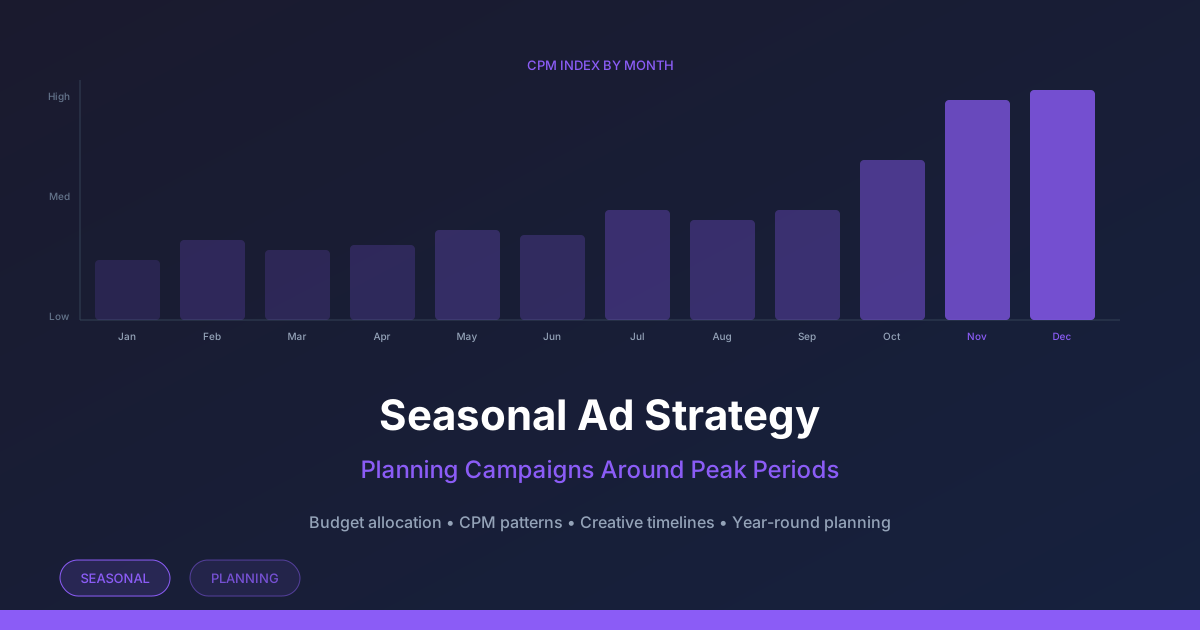
- Before a seasonal offer, confirm price, truthful deadline, returns and dispatch capacity. Treat expected demand or cheaper CPM as hypotheses; a higher CPM can coexist with better contribution.
- At a chosen monthly review, compare equal-age retained cohorts and full cost scope. Move only uncommitted funds, with the new owner, amount and reason recorded.
- During delivery, check spend pacing, rejected assets, tracking and stock availability. A fast operational check prevents further exposure but is not a mature performance verdict.
- Document every reserve release and its remaining balance. Do not spend the annual envelope early on the assumption that later sales will restore it.
Use a bounded experiment for an early awareness or audience-building campaign, with its own cost cap and later commercial follow-up. Cheap views do not establish incremental purchases months later, and remarketing credit cannot resolve that causal question by itself.
In NovaStorm, prepare seasonal offers and proposed campaign limits as paused campaign and local ad-set drafts for human approval. The cash/stock worksheet remains the authority for spending decisions; this article does not claim automatic seasonal reallocation. The monthly budget calculator and contribution ceiling guide help connect the plan to actual inputs.
Published by NovaStorm AI. Planning examples are illustrative assumptions, not measured customer results.
Disclaimer: This article was generated with the assistance of AI and reviewed by the NovaStorm AI team. While we strive for accuracy, we recommend verifying specific data points and consulting official sources (linked where available) for critical business decisions.
Ready to automate your Meta Ads?
NovaStorm AI takes full responsibility for your campaigns — from monitoring to optimization.
Start NowMore on Seasonal and launch campaigns

Product Launch Ads on Meta: Budget, Stock and Approval Plan
Plan a product launch with truthful stock and bonus terms, consented waitlists, paid-order economics and measurable approval or stop gates.

Black Friday Meta Ads Strategy: From Preparation to Execution
Prepare a Black Friday and Cyber Monday brief with discount economics, truthful materials, inventory limits and mature-result spending decisions.
Seasonal Ad Strategy: Planning Campaigns Around Peak Periods
Build a local seasonal campaign calendar from inventory, contribution, cash and delivery deadlines, then approve a bounded creative brief.

Holiday Season Meta Ads: Capturing Gift Shoppers Effectively
Build gift offers around the buyer’s decision, verified delivery and return terms, then compare price-tier creative by retained contribution.