

Storytelling Arcs in Sequential Meta Ads: Three-Act Structure
Write three self-contained ad acts, verify audience conditions and exclusions, and evaluate the complete sequence cost against mature purchases.
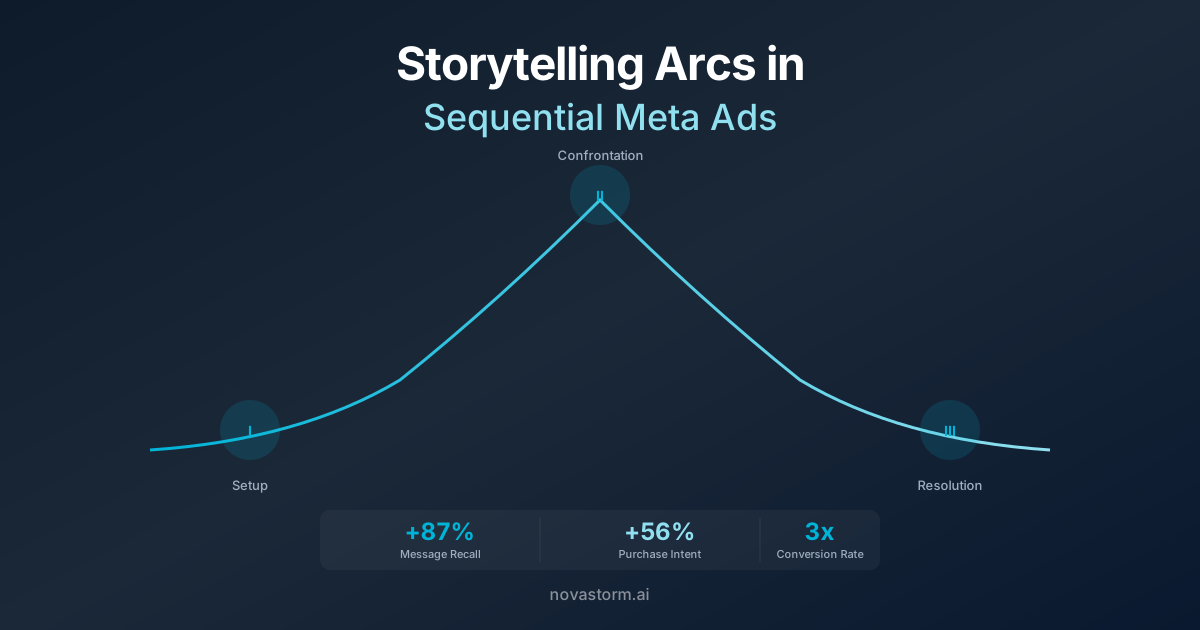
Three related ads can introduce a problem, explain a solution and invite an action. Audience conditions can support that plan, but engagement is not proof that a person understood the previous ad or that impressions will arrive in an exact order. Make each act useful on its own and measure the cost of the whole sequence.
A complete illustrative three-act script
Fictional product: a project planning app. These scripts describe a proposed creative concept, not a customer transformation or a verified product feature set. Replace the app actions with ones your actual product supports.
| Act | Self-contained script | Destination |
|---|---|---|
| I: Problem | “Tasks scattered across notes? List one project, its next action and its owner. See the planning example.” | Public planning example with product and brand explained |
| II: Solution | “Turn a project list into a plan: choose the next action, add its owner and check progress. Watch this example before deciding.” | Concrete demonstration of supported actions |
| III: Choice | “Ready to organize your next project? Review the plan options and create an account if they fit.” | Actual terms, price and signup path |
Every version identifies the product and contains enough context for someone seeing it first. Do not fabricate a before/after success or require exposure to Act I for Act III to make sense. A narrative callback is optional; comprehension and truthful promises are mandatory. See ad storytelling frameworks for writing an honest story.
Choose only audience conditions your setup exposes
In the actual audience builder, inspect which video source, watch-duration or completion condition and retention period are offered for your account and assets. Record the selected source video and rule. For example, if a 50% completion option is available, it is a chosen eligibility condition, not proof of attention or psychological readiness. A person may have watched different portions or encountered the brand elsewhere.
Meta’s public audience SDK exposes rule, retention and video-group fields. These fields do not establish universal UI options, account eligibility, per-person timers or guaranteed sequencing. Use the actual supported account settings and document their limitations. If you cannot isolate the intended audiences, use self-contained creatives without describing them as a controlled sequential delivery system.
An explicit inclusion and exclusion map
Stop wasting ad budget
NovaStorm AI cuts Meta Ads CPA by 30% on average. No complex setup required.
| Proposed stage | Eligibility to verify | Suppression to maintain |
|---|---|---|
| Act I | Permitted initial audience | Confirmed purchasers where the objective is first purchase |
| Act II | Selected eligible engagement with Act I | Purchasers; later-stage eligibility if the setup supports the intended exclusion |
| Act III | Selected eligible engagement with Act II | Purchasers and people who withdraw the relevant permission |
Reconcile overlaps and failed updates. A purchase before the next audience refresh can leave someone temporarily eligible. Record removal and processing evidence; do not promise immediate disappearance. A rolling video retention window is not an individual two-to-five-day delay between ads. Verify objective-specific frequency settings separately; an average frequency cannot tell you each person’s order of exposure.
Avoid selection bias in the narrative conclusion
People who watch more video can already be more interested. A high purchase rate among Act III viewers therefore does not prove that the storyline caused it. Counts of video plays can include repeat plays and differ from usable audience members; do not compute progression by dividing unrelated reports or compare engaged viewers with a cold audience as if randomly assigned.
- Assign eligible people before the initial exposure to a sequence strategy or an alternative strategy with the same total offer and permitted targeting. Use a valid randomized method and audit leakage.
- Keep a stable denominator of all assigned people, including people who never qualify for a later act. Record losses and delivery limits separately.
- Predefine settled purchases, contribution, observation period, returns maturation and an affordable maximum. Report uncertainty and any incomplete delivery.
- Include all three stages’ media, creative and operating costs; later-stage CPA alone omits the cost of producing that audience.
Hypothetical sequence spends USD 200 on Act I, USD 100 on Act II, USD 100 on Act III and USD 120 on production. With 20 settled purchases, fully loaded cost per purchase is USD 520 / 20 = USD 26. An alternative spends USD 400 on media and USD 60 on production for 20 settled purchases: USD 23. The sequence is more expensive in this assumed dataset despite an Act III media-only CPA of USD 100 / 20 = USD 5. Those 20 orders must also be uniquely counted, not summed as separate attributed purchases in every act.
Prepare the sequence for review
Prepare the three briefs and reviewed campaign drafts in NovaStorm, with the proposed eligibility and suppression map attached to your operating plan. Audience updates and experimental measurement require the external systems that implement them. No individual movement between acts, fixed exposure order or measured association/purchase-intent lift is established here.
Published by NovaStorm AI. Worked examples and test fixtures in this article are illustrative, not observed customer results.
Disclaimer: This article was generated with the assistance of AI and reviewed by the NovaStorm AI team. While we strive for accuracy, we recommend verifying specific data points and consulting official sources (linked where available) for critical business decisions.
Ready to automate your Meta Ads?
NovaStorm AI takes full responsibility for your campaigns — from monitoring to optimization.
Start NowMore on Ad copy and messaging
Urgency Copy in Meta Ads: Ethical Deadline and Scarcity Tactics
Write truthful deadline and scarcity copy with time zones, current inventory and expiration checks; distinguish faster purchases from additional sales.

The Curiosity Gap in Meta Ad Headlines: Intrigue Without Clickbait
Write curiosity headlines with an answer the page actually delivers, verify claims, and compare useful actions and customer costs rather than clicks alone.
Storytelling in Meta Ad Copy: Narrative Frameworks That Sell
Write traceable ad stories with fictional examples clearly labeled, real testimonial permission, accurate outcome arithmetic and a controlled test plan.
How to Write Meta Ad Copy for Different Awareness Levels
Research category and brand knowledge, draft five awareness message hypotheses and measure complete acquisition economics rather than assuming market shares.