

How to Write Meta Ad Copy for Different Awareness Levels
Research category and brand knowledge, draft five awareness message hypotheses and measure complete acquisition economics rather than assuming market shares.
Use awareness as a research question: what does this reader already know about the task, solution category and your product? The five labels below help draft hypotheses. They do not assign fixed market shares or reveal a person’s knowledge from a single ad impression.
Use Schwartz as a copy-planning source
The publisher’s guide to Eugene Schwartz’s Breakthrough Advertising identifies states of awareness as a central concept. Here, unaware, problem-aware, solution-aware, product-aware and most-aware are practical planning labels for different questions. The framework is not a measured distribution of your customers or a claim that each person moves through a fixed linear funnel.
Collect evidence of knowledge without leading respondents
- Ask unprompted: What are you trying to accomplish? What approaches have you considered? Which brands or tools come to mind? What would you need to know before choosing?
- After unprompted recall, show the actual category or brand only if the study needs recognition questions. Separate recall from recognition.
- Recruit across relevant buyers and nonbuyers, obtain consent and report recruitment, dates, question wording, response counts and unknowns. Existing customers alone cannot represent the whole prospect market.
- Record task knowledge, category familiarity, brand knowledge and current decision separately. A website visit is a behavior signal, not verified comprehension or readiness.
- Use interviews to improve message hypotheses. Do not publish population percentages from a convenience sample or fabricate quotes when interviews are unavailable.
Five finished message hypotheses
Invented DeskTrail teaching scenario: it saves and shares desk-layout plans for $12/month without a free trial. No actual interviews, customer counts or performance results are supplied. The suggested messages below are hypotheses, not classified live audiences.
| Planning label | Question to answer | Illustrative message |
|---|---|---|
| Unaware | Is layout planning relevant to a current task? | Before choosing furniture, compare two possible desk layouts. |
| Problem-aware | What can help discuss a layout clearly? | Save a layout plan so you can discuss the same arrangement with someone else. |
| Solution-aware | What does this tool actually do? | DeskTrail saves a desk-layout plan and lets you share its link. |
| Product-aware | What does the decision cost? | DeskTrail costs $12/month, with no free trial. Review the capabilities and billing terms. |
| Most-aware | What is the available next step? | If this planning workflow suits the task, review the subscription terms and proceed through the supported signup route. |
Do not agitate an unverified personal problem, invent a comparison advantage or add a deadline just because a stage label seems close to purchase. Actual price, signup, trial and refund terms must be approved before publication. The available CTA and visible text need placement review, not a stage-specific universal length rule.
Stop wasting ad budget
NovaStorm AI cuts Meta Ads CPA by 30% on average. No complex setup required.
Account for the cost of all stages
Hypothetical acquisition path: education media $500, comparison media $300, decision media $200, production $150 and follow-up labor $100. Total cost is $1,250. Ten mature retained customers at an assumed $150 contribution each provide $1,500 contribution, leaving $250 before other costs. Fully loaded acquisition cost is $125, not the $20 obtained by dividing only final-stage media by ten.
Deduplicate people and orders across touchpoints. Stage-level attribution totals may overlap and should not be summed as incremental customers. If five of the ten later refund, revise retained contribution and cost per retained customer under a predeclared window. Engagement and content consumption are diagnostics; they do not excuse unprofitable upper-funnel spend.
Validate the message and classification separately
Proposed test: within a research-defined eligible group, compare two approved messages with concurrent random assignment, unchanged offer, destination and measurement. Size the sample for a useful mature-customer effect and authorize the exposure before launch. If the category/brand knowledge is unknown, record unknown rather than labeling it automatically. A message test does not prove the stage label itself is correct.
Track suitable customers, retained contribution, full spend, refunds and equal follow-up across the complete acquisition plan. Keep stage diagnostics in a separate view; no universal CPA bands, market shares or promised fourteen-day improvement apply.
Prepare drafts for the reviewed hypothesis
Use NovaStorm to prepare the campaign structure as a draft, inspect saved fields and Paused status, and approve publication separately. Unpublished ad sets remain local drafts. Keep the research and classification record in your own approved workflow; no automatic awareness map is assumed. Use the feature-to-benefit worksheet to turn the chosen reader question into traceable copy.
Published by NovaStorm AI. Worked examples and proposed tests are labeled in the article.
Disclaimer: This article was generated with the assistance of AI and reviewed by the NovaStorm AI team. While we strive for accuracy, we recommend verifying specific data points and consulting official sources (linked where available) for critical business decisions.
Ready to automate your Meta Ads?
NovaStorm AI takes full responsibility for your campaigns — from monitoring to optimization.
Start NowMore on Ad copy and messaging
Benefit-Driven vs Feature-Driven Ad Copy on Meta
Translate features into supportable task benefits, draft three comparable versions and evaluate mature outcomes without guaranteed performance claims.
Urgency Copy in Meta Ads: Ethical Deadline and Scarcity Tactics
Write truthful deadline and scarcity copy with time zones, current inventory and expiration checks; distinguish faster purchases from additional sales.
Storytelling in Meta Ad Copy: Narrative Frameworks That Sell
Write traceable ad stories with fictional examples clearly labeled, real testimonial permission, accurate outcome arithmetic and a controlled test plan.
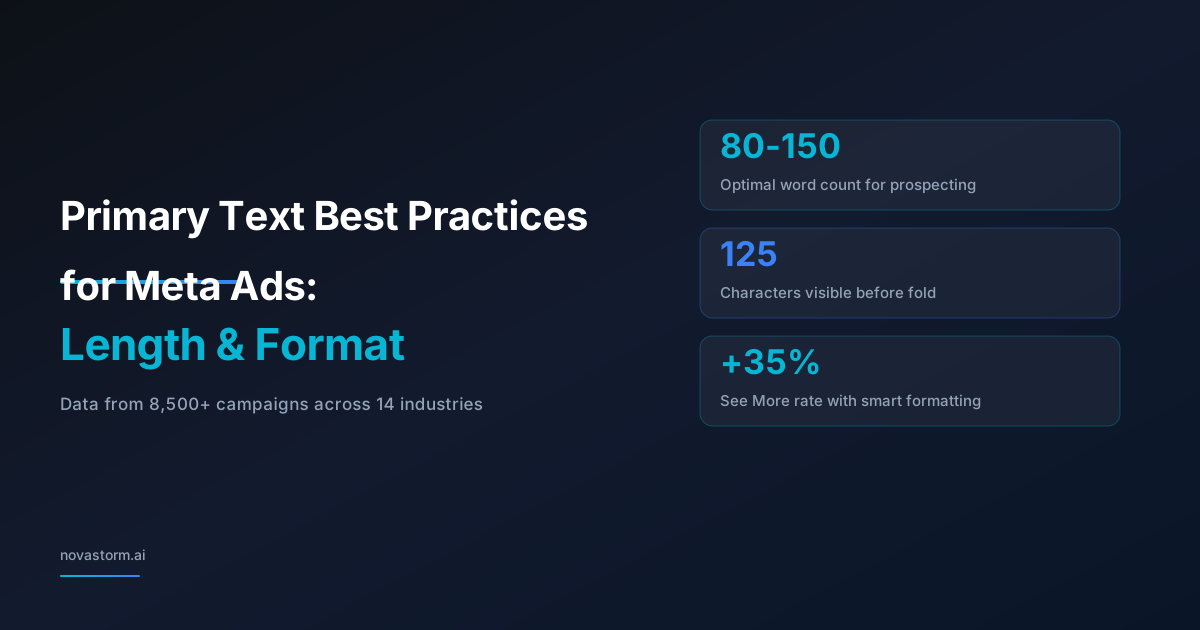
Primary Text Best Practices for Meta Ads: Length and Format
Prepare three traceable primary-text lengths, check openings and previews, then compare approved copy with funded sampling and mature outcomes.