

Shopify Profit Reports for Meta Ads: Calculate Variant-Level Allowable Bids
Learn how to reconcile Shopify variant profit reports, discounts, and fulfillment costs to calculate maximum allowable Meta ad bids (bid_amount) and margin guardrails.

AI-generated conceptual illustration; not a platform screenshot or customer result.
Prerequisites for Variant-Level Bid Reconciliation
Before calculating variant-level bidding guardrails for Meta Ads, verify that your e-commerce operations meet the following technical and financial baseline requirements:
- Cost per item populated in Shopify: Every active product variant must have an accurate, static unit cost recorded in Shopify admin under product details.
- Shopify Profit Margin report access: Ensure administrative access to view historical order, net sales, refund, and discount reporting across 30 to 90-day performance windows.
- Meta Ads Manager or Marketing API access: Permissions to create and update ad sets with manual bid constraints (
bid_amount) and designatedoptimization_goalsettings. - Documented non-inventory variable fees: Standardized unit picking and packing costs, carrier shipping rates, and payment gateway processing fees (e.g., credit card merchant percentages plus fixed transaction surcharges).
Understanding Shopify Gross Margin and Meta Auction Constraints
Setting a single blended acquisition target across an entire catalog often conceals negative contribution margins on lower-tier variants. In Shopify Analytics, variant-level profitability is tracked through explicit accounting relationships. Shopify calculates gross margin for each product variant as ([net sales - cost] / net sales) * 100 in the Gross profit by product variant report. Source. Scope: Shopify store with Cost per item populated on product variants before sales are recorded.
However, evaluating unit economics purely on initial catalog markup leads to bidding errors during promotional sales. Realized gross margin in Shopify profit reports is based on net sales, which incorporates discounts and refunds rather than the full regular catalog price. Source. Scope: Shopify orders subject to promotional discount codes, markdown pricing, or post-purchase customer refunds. If markdown vouchers or customer return rates escalate, the actual gross cash generated per conversion declines, compressing the margin available to fund paid advertising.
On the advertising platform side, ad set bidding limits directly constrain auction entry. The Meta bid_amount parameter specifies the maximum amount an advertiser intends to spend to acquire a result based on the designated optimization_goal. Source. Scope: Meta ad set configured with a manual bid constraint or cost cap under supported campaign objectives and optimization goals. Meta evaluates the bid strategy, bid_amount, and estimated probability of achieving the optimization goal to compute an effective bid in the auction. Source. Scope: Auction delivery evaluation across competing ad sets with defined bidding constraints. When advertisers feed unadjusted catalog margins into their bidding strategies, ad delivery may capture conversions at acquisition costs that exceed the variant\u0027s net realized contribution.
Step-by-Step Procedure: Deriving Variant-Level Allowable Bids
- Export Shopify Variant Profit Data: Navigate to Analytics > Reports > Profit Margin in Shopify and select the Gross profit by product variant report. Filter for a mature reporting period (such as the prior 30 to 60 days) to capture settled order values and return cycles.
- Calculate Realized Net Revenue per Unit: Divide total Net Sales by Net Quantity for each variant. This calculation captures the true selling price after promotional discounts and partial refund deductions.
- Aggregate Variable Fulfillment and Transaction Overhead: Add per-unit pick-and-pack labor, packaging materials, outbound shipping allowances, and merchant processing percentages to the Shopify recorded Cost (COGS).
- Define the Target Contribution Margin: Establish the minimum acceptable net profit dollar amount required per unit sold to cover fixed operational overhead.
- Derive the Maximum Allowable Bid: Subtract total variant COGS, fulfillment overhead, transaction fees, and the target unit profit from the realized net selling price to establish the maximum
bid_amountceiling.
Hypothetical Variant Unit Economics and Allowable Bid Calculation
Hypothetical example. All inputs are assumed for teaching purposes and are not customer results. Deriving variant-level maximum allowable Meta bids by subtracting cost per item, net discount and refund adjustments, picking and shipping overhead, payment processing fees, and target unit contribution margin from gross selling price. Assumed inputs: Variant retail list price = 50 USD; Shopify recorded cost per item = 18 USD; Average realized discount and refund impact per unit = 4.5 USD; Pick, pack, and shipping fee per unit = 5.5 USD; Payment gateway processing fee per unit = 1.75 USD; Target contribution profit buffer per unit = 6.25 USD; Derived maximum allowable Meta bid_amount ceiling = 14 USD. Period: 30-day teaching window. Scope: Hypothetical example. All inputs are assumed for teaching purposes and are not customer results. Fictional direct-to-consumer apparel SKU with variable fulfillment and payment processing overhead. Subtracting the baseline cost of goods sold from the list price yields the gross unit spread before downstream variable fees: Calculation: 50 - 18 = 32 USD. Period: 30-day teaching window.
Stop wasting ad budget
NovaStorm AI cuts Meta Ads CPA by 30% on average. No complex setup required.
In this hypothetical framework, once the average discount and refund deductions, fulfillment overhead, processing fees, and target profit buffer are accounted for, the allowable Meta acquisition cost ceiling contracts from the initial gross markup down to the derived bid ceiling. Setting an ad set bid cap above this threshold would risk operating below the store\u0027s required contribution target.
Variant-Level Bid Reconciliation Framework
| Variant SKU Attribute | Shopify Report Source | Calculation Role | Applied Example Impact |
|---|---|---|---|
| Retail List Price | Product details page | Gross starting price before promotions | Baseline revenue anchor |
| Cost per Item (COGS) | Gross profit by product variant | Direct manufactured or wholesale cost | Primary inventory deduction |
| Net Sales Adjustment | Shopify Profit Margin report | Incorporates discounts and refunded units | Realized revenue correction |
| Variable Fulfillment Fee | Internal 3PL / warehouse ledger | Pick, pack, and packaging materials | Post-sale fulfillment deduction |
| Merchant Processing | Payment gateway statements | Card processing % + per-transaction fee | Transaction overhead deduction |
| Target Unit Profit | Financial operating model | Required contribution margin buffer | Retained business margin |
| Allowable Bid Cap | Derived financial output | Maximum allowable bid_amount parameter | Meta auction constraint ceiling |
Campaign Implementation and Hypothesis Testing
Hypothesis: Constraining ad set bid ceilings to the strict net contribution margin of specific product variants isolates high-COGS SKUs from consuming ad budget when conversion rates fluctuate. No lift has been measured here. Scope: Hypothesis: Setting ad set bid_amount ceilings equal to variant-level contribution margins prevents unprofitable inventory delivery during high-discount promotional periods. No lift has been measured here. Testable by comparing net margin retention between bid-capped variant ad sets and blended target-CPA ad sets over a 14-day clearance sale. When deploying these calculated guardrails, advertisers can group catalog items with similar allowable bid ceilings into dedicated ad sets or utilize manual bid caps to enforce margin safety during clearance promotions.
To balance variant-level unit economics with overall campaign scaling, media buyers should evaluate total customer acquisition cost guardrails against their broader business targets. For a deeper breakdown of calculating margin-safe acquisition ceilings across diverse customer cohorts, review our break-even ROAS guide.
Verification, Failure Handling, and Operational Limits
- Discrepancies Between Sales and Profit Reports: If Shopify Net Sales totals do not match Profit report totals, inspect active variants for missing Cost per item entries. Shopify only reports profit metrics for items that had recorded cost data at the exact moment of sale.
- Static Cost Limitations: Shopify Cost per item data is static and does not automatically fluctuate with dynamic supplier pricing or foreign currency revaluations. If inventory batches change cost significantly, historical reports must be segmented by purchase receipt dates.
- Auction Underdelivery Handling: Setting a variant bid cap significantly below the market auction clearing price may cause ad sets to stall. If underdelivery occurs, verify whether ad relevance and conversion rates can be improved before expanding the bid ceiling.
- Delayed Returns and Webhooks: Meta conversion tracking does not automatically adjust historical conversion values when post-purchase refunds occur in Shopify. Media buyers must perform periodic reconciliation between Ads Manager reported metrics and Shopify net profit reports.
When designing multi-variant campaign workflows and reviewing manual bidding guardrails, media buyers can use NovaStorm to prepare and inspect Meta Ads configurations before publishing them to live production environments. Review the official Shopify profit reporting documentation and Meta Marketing API bidding reference to verify current platform mechanics.
Disclaimer: This article was generated with the assistance of AI and reviewed by the NovaStorm AI team. While we strive for accuracy, we recommend verifying specific data points and consulting official sources (linked where available) for critical business decisions.
Ready to automate your Meta Ads?
NovaStorm AI takes full responsibility for your campaigns — from monitoring to optimization.
Start NowMore on Budget and unit economics

Meta Ads for Startups: Budget-Friendly Scaling Strategies
Build a capped startup Meta Ads test with contribution sensitivity, a fictional acceptance journal, maturity checks and a paused campaign brief.
ROAS: The Complete Guide to Return on Ad Spend
Calculate ROAS and contribution after returns, reconcile duplicate channel credit and record comparable report scope before changing budget.
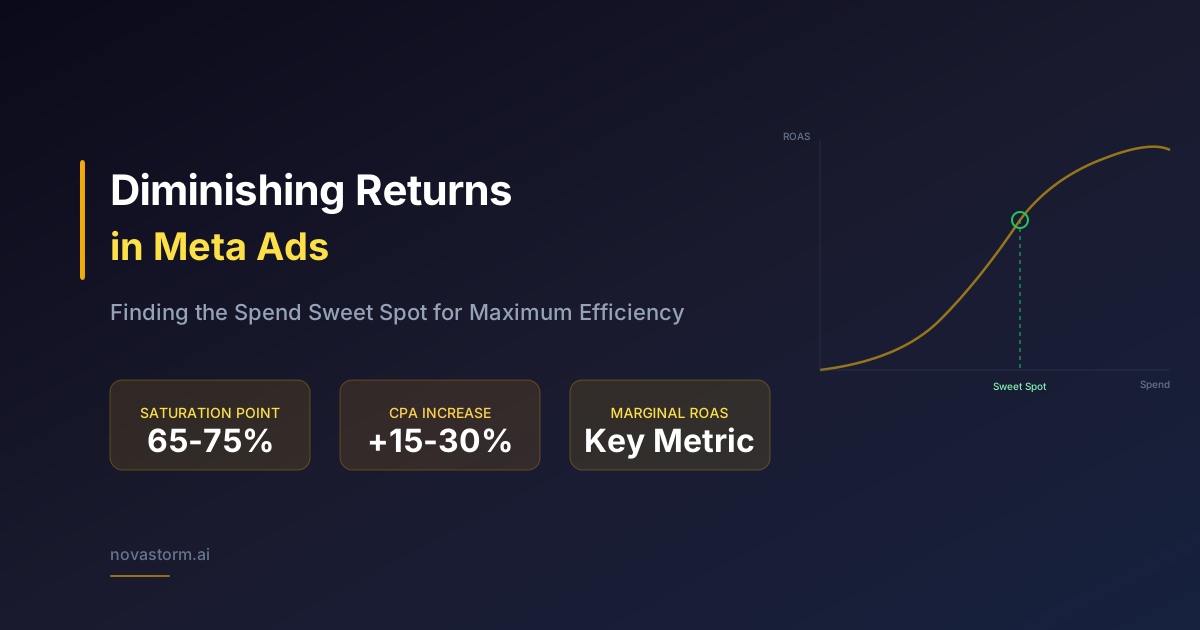
Diminishing Returns in Meta Ads: Finding the Spend Sweet Spot
Calculate a refund-adjusted marginal spending diagnostic, record confounders and propose a bounded budget test.
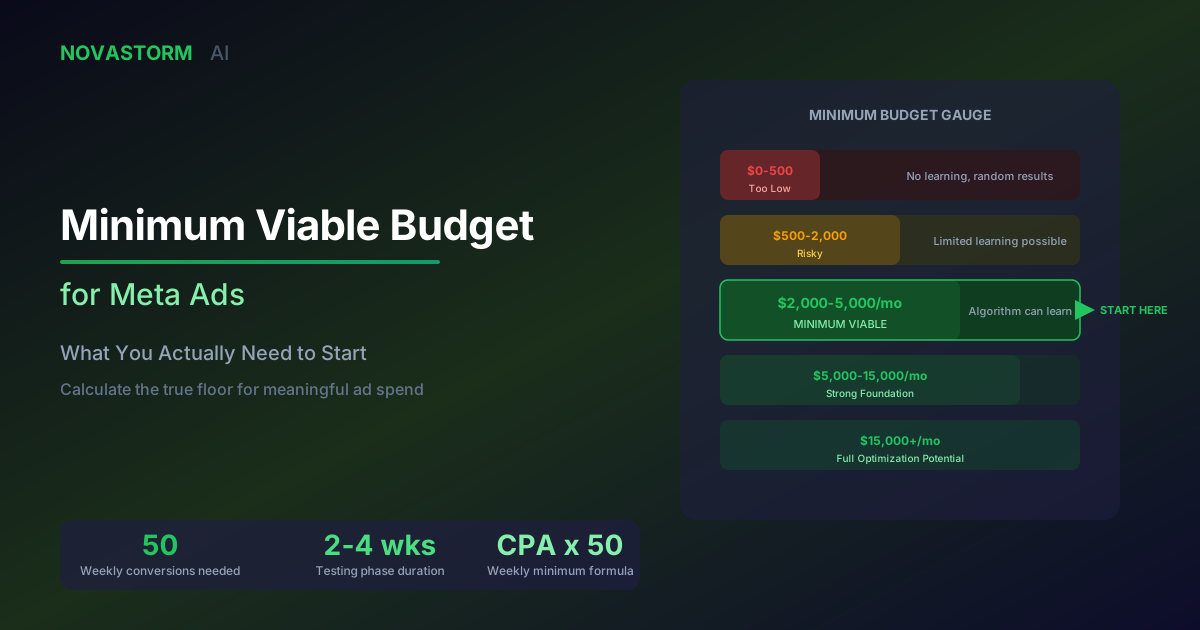
Minimum Viable Budget for Meta Ads: What You Need to Start
Judge what a small Meta ad budget can answer, verify tracking before spending, and close a capped test honestly with mature or inconclusive evidence.