

Audience Segmentation with RFM Model for Meta Ads Targeting
Calculate RFM from cleaned transactions, apply one reproducible scoring rule, export exclusive segments and test their future contribution.
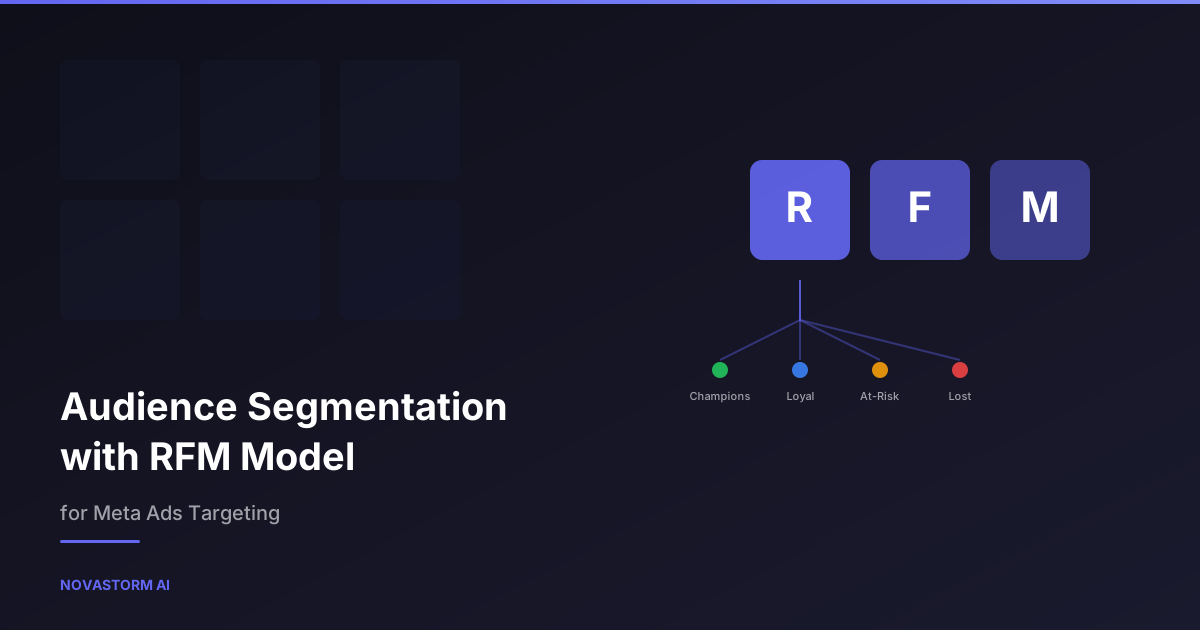
RFM summarizes recency, frequency and monetary history within a declared interval. It is not a direct measure of future profit. Start with cleaned paid transactions and a reproducible scoring method before creating audience hypotheses.
Clean the input and calculate R/F/M
Synthetic transactions, all USD, evaluated as of October 2, 2026 within January 1–October 1: A has orders A1 on August 1 for $40, A2 on September 1 for $80 and A3 on October 1 for $80; B has B1 on July 1 and B2 on August 1 for $40 each; E has E1 on July 1 and E2 on August 1 for $40 each; C has C1 on January 1 for $40; D has D1 on September 1 for $60, fully refunded. All are anonymized teaching records.
Deduplicate by stable order ID before summing. Exclude failed orders; subtract refunds from retained value and define whether a fully refunded order qualifies. Here, fully refunded D1 is excluded from R and F as well as M, leaving D without a qualifying purchase. For partial refunds, retain the order and its net value under this declared policy. Normalize currency before comparing customers.
R = calendar days from the analysis date to the latest qualifying purchase; F = count of distinct qualifying orders in the interval; M = sum of their retained values. Customer A therefore has R=1, F=3, M=$200. B and E have identical R=62, F=2, M=$80; C has R=274, F=1, M=$40.
Choose fixed thresholds, not mixed quintiles
| Score | R days | F orders | M retained USD |
|---|---|---|---|
| 5 | 0–7 | 5 or more | $200 or more |
| 4 | 8–30 | 4 | $150 to less than $200 |
| 3 | 31–90 | 3 | $100 to less than $150 |
| 2 | 91–180 | 2 | $50 to less than $100 |
| 1 | More than 180 | 1 | Less than $50 |
These fixed thresholds are illustrative, not population quintiles or a universal business cycle. Identical values receive identical scores; do not split B and E to force equal groups. Customers with no qualifying purchase remain outside the purchase-RFM segments, rather than receiving an invented recency.
Make segment assignment exclusive
Stop wasting ad budget
NovaStorm AI cuts Meta Ads CPA by 30% on average. No complex setup required.
Apply these rules in order: Champions if R score≥4, F≥3 and M≥4; otherwise Loyal if R≥3 and F≥2; otherwise At-risk if R≤2 and F≥2; otherwise Lost if R=1 and F=1; otherwise Other qualifying buyers. Here the inequalities refer to scores, not raw days or dollars.
| Customer | R/F/M scores | Assigned segment |
|---|---|---|
| A | 5/3/5 | Champions |
| B | 3/2/2 | Loyal |
| E | 3/2/2 | Loyal |
| C | 1/1/1 | Lost |
| D | No qualifying purchase | Excluded from purchase-RFM export |
Past revenue does not fund a new return
A former customer’s $200 historical revenue does not make a $30 reactivation acquisition profitable. Illustrative next order: $40 revenue minus $22 variable cost gives $18 contribution. Keeping a $6 reserve leaves at most $12 for acquisition before other campaign costs. Spending $30 to generate that order uses $18 more than this allowance. Future repeats may change the economics only under an explicit, uncertain contribution forecast—not by reusing past revenue.
Verify export and the audience experiment
- Save the analysis date, interval, currency, refund policy, threshold version and exclusive segment membership. In this tiny example the Loyal export contains exactly two distinct permitted customer IDs, B and E; reconcile that count to the ledger.
- Create a private destination-format export with only permitted matching fields. Validate unique customers, required formatting, permission, exclusions, upload results and observed match limitations. An accepted upload is not proof of complete matching or eligibility.
- If a 1% lookalike option is actually available and the source meets requirements, treat it as one candidate against a relevant purchaser seed or existing audience. Keep the offer, outcome window and comparison method aligned. Source scores do not guarantee superiority.
- Assess mature retained contribution, acquisition cost and uncertainty. Do not assume a monthly refresh is sufficient; update eligibility when purchases, refunds or permission change and verify downstream completion.
Use NovaStorm for creative variants and the approved Meta campaign brief. RFM calculation, private exports and CRM/audience synchronization require their own implemented processes; this article does not establish that NovaStorm supplies them.
Published by NovaStorm AI. Planning examples are illustrative assumptions, not measured customer results.
Disclaimer: This article was generated with the assistance of AI and reviewed by the NovaStorm AI team. While we strive for accuracy, we recommend verifying specific data points and consulting official sources (linked where available) for critical business decisions.
Ready to automate your Meta Ads?
NovaStorm AI takes full responsibility for your campaigns — from monitoring to optimization.
Start NowMore on Audience targeting and prospecting
Zero-Party Data: Collecting Customer Preferences Through Ads
Collect useful declared preferences with clear permission records, refresh stale answers, and test an offer against contribution rather than engagement promises.
Lookalike Audiences in 2026: How to Build and Scale Them
Validate a permitted lookalike source and saved expansion behavior, then plan mature-order reviews and a total capped budget.

Automated Audience Expansion: When to Let Meta Find New Segments
Test audience expansion with enforced service geography, qualified mature outcomes, explicit spend limits and a real assignment plan.
Broad Targeting in Meta Ads: Set Boundaries Before Testing
Prepare a broad-versus-narrow targeting comparison with business boundaries, mature paid-order metrics, a loss cap and an explicit inconclusive outcome.