

Meta Ads for App Install Campaigns: Complete Strategy Guide
Choose an app measurement route, verify install-to-payment and deep links, and evaluate retention and payback before approving acquisition spend.
An app campaign needs a verified path from the ad to the store, first open, useful product action and paid outcome. Cheap installs alone do not establish profitable growth. Decide which measurement route your app team operates and which outcomes the actual Meta account supports.
Choose a measurement architecture
| Route | Responsibility | Limitation |
|---|---|---|
| Meta app-event SDK route | App team verifies current SDK setup, event definitions and permitted transmission. | Presence of an SDK is not proof of event quality or outcome eligibility. |
| Mobile measurement partner route | Verify partner integration, mapping, permission treatment and reporting scope. | A partner does not guarantee complete identities or remove platform privacy constraints. |
| Apple privacy-preserving attribution | Verify supported SKAdNetwork/AdAttributionKit configuration and conversion mapping. | Limited postback detail is not a full user-level purchase journey. |
AppsFlyer documents in-app event mapping to Meta. That demonstrates a partner route, not that every app must install only Meta’s SDK. Choose current supported integration requirements with the developer; avoid sending the same business action independently from multiple routes without a verified duplication strategy.
Apple requires ATT permission for tracking within its defined scope; replacing IDFA with another identifier is not a workaround. Treat applicable consent and ATT choices as separate checks that must both be respected. Apple’s attribution overview describes privacy-preserving attribution with limited postback information. Verify OS, network and integration support rather than assuming one attribution mode captures every paid outcome.
Run an install-to-payment acceptance matrix
- On a clean test device, follow the intended ad/store route and first open. Save the app version, OS, route, permission state and expected event. Distinguish a download, install attribution and first open in each reporting system.
- Complete a sandbox paid action and verify its business receipt or transaction record, event name, amount, currency and unique action identifier. Retry or restore behavior must not inflate new purchases. Inspect the actual permitted destination diagnostics.
- Test an already-installed deep link, an uninstalled store/install/first-open route, login-required routing and a missing destination. Confirm the promised item or screen, with a useful fallback. A deferred deep link is not guaranteed to recover identity or destination in every permission and OS state.
- Repeat appropriate scenarios with tracking denied and allowed, and after applicable consent changes. Share redacted acceptance results, not tokens or personal device identifiers.
Use the deep-link setup and verification guide for the routing question. A creative can promise a specific feature only if this acceptance path actually delivers it. Do not describe a technical test plan as an executed customer result.
Stop wasting ad budget
NovaStorm AI cuts Meta Ads CPA by 30% on average. No complex setup required.
Connect acquisition cost to retention and payback
Synthetic equal-age cohort: $1,000 media acquires 200 installs, so CPI is $5. At day 30, 80 people remain active and 20 have made one retained paid purchase. Paid-customer media cost is $50. If each paid customer contributes $20 by day 30, cohort contribution is $400; media is not repaid. If the same original cohort reaches $1,100 cumulative contribution by day 90, payback occurs by day 90 in this hypothetical record, before any omitted acquisition operating costs.
Keep the original cohort denominator, refund treatment and contribution interval consistent. Compare iOS and Android within their measurement limits rather than treating different observable coverage as quality. Future retention or repeat contribution is a forecast until observed. There is no universal CPI benchmark or fivefold ROAS gain here.
Approve the next hypothesis
A tutorial completion or game level may be a candidate proxy if equally mature cohorts show useful association with retained contribution. Association does not prove that optimizing for it causes profitable customers. Verify goal availability and signal quality, then run a bounded comparison with a meaningful business outcome; a generic 50-event count is not the economic decision.
Use NovaStorm for candidate Meta creative and an approved message brief based on the app’s real functionality. Developers and measurement owners handle mobile SDK/MMP integration, Apple attribution, event acceptance and deep links. Drafting an ad does not supply those mobile integrations or validate their results.
Published by NovaStorm AI. Planning examples are illustrative assumptions, not measured customer results.
Disclaimer: This article was generated with the assistance of AI and reviewed by the NovaStorm AI team. While we strive for accuracy, we recommend verifying specific data points and consulting official sources (linked where available) for critical business decisions.
Ready to automate your Meta Ads?
NovaStorm AI takes full responsibility for your campaigns — from monitoring to optimization.
Start NowMore on SaaS and app growth
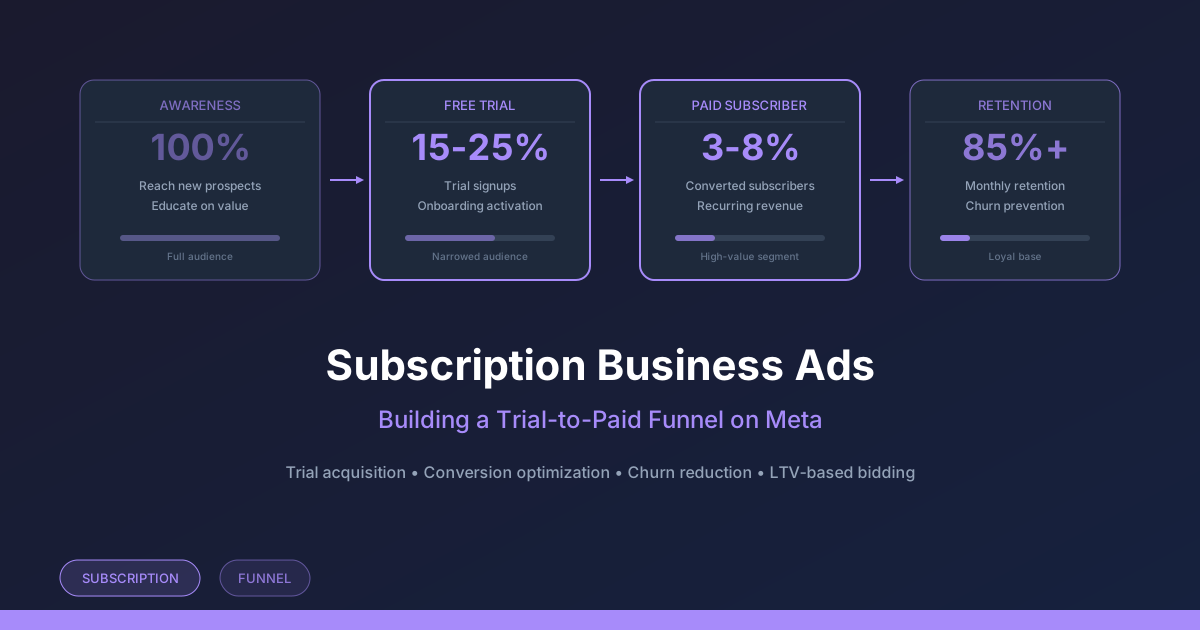
Subscription Business Ads: Building a Trial-to-Paid Funnel on Meta
Map trial, activation, payments and refunds separately, build permission-aware segments and evaluate paid-subscriber acquisition with cohort payback.

Meta Ads for SaaS: Trial and Demo Campaign Planning
Plan separate SaaS trial and demo journeys, reconcile mature paid cohorts, and test targeting and budget changes within contribution and cash limits.
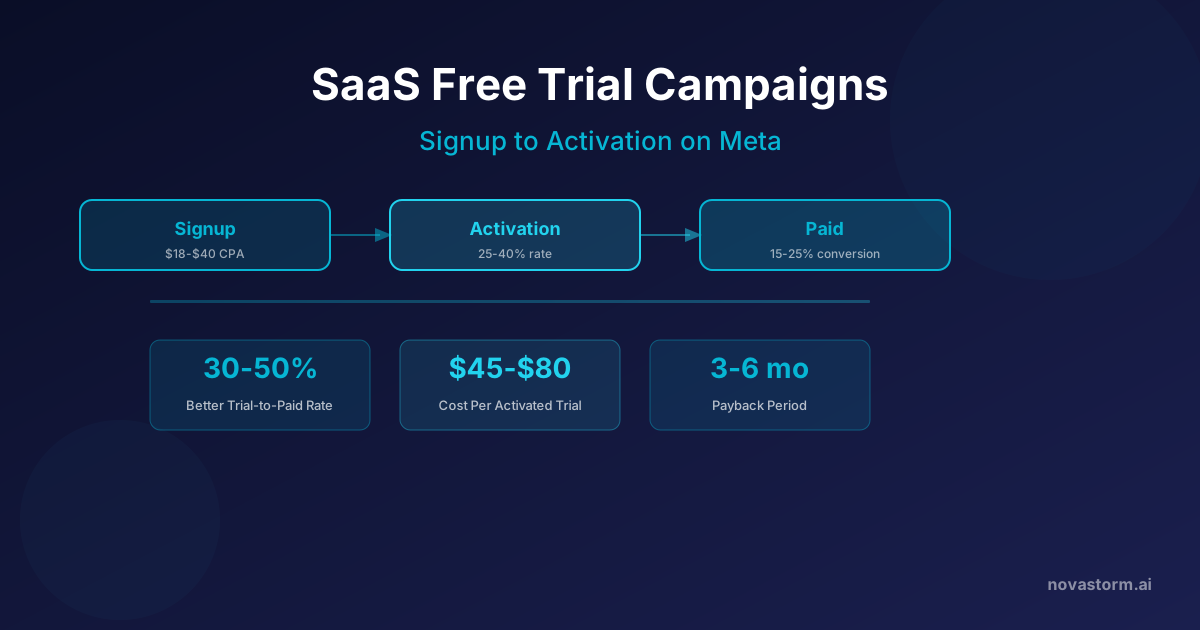
SaaS Free Trial Campaigns on Meta: Signup to Activation
Evaluate SaaS trial ads with verified activation events, retained paid cohorts, complete CAC and contribution-based payback instead of signup benchmarks.

Mobile App Deep Linking From Meta Ads: Setup and Optimization
Configure explicit Universal and Android App Link associations, validate route and authorization states, and separate deferred routing from privacy-aware attribution.