

Meta Ads for SaaS: Trial and Demo Campaign Planning
Plan separate SaaS trial and demo journeys, reconcile mature paid cohorts, and test targeting and budget changes within contribution and cash limits.

A free-trial registration and a demo request are different promises. Choose the journey your buyer can actually complete, then measure retained paid customers and contribution. The examples below are planning assumptions, not SaaS customer results.
Specify two paths through payment
| Stage | Self-service trial | Sales-assisted demo |
|---|---|---|
| Ad promise | Show one real task the trial supports | State what the demo covers and who it suits |
| Entry | Verified account signup and stated trial terms | Accepted request, qualified by an accountable salesperson |
| Value milestone | A meaningful product action, such as completing a first project | An attended demo that establishes requirements and fit |
| Commercial outcome | Settled subscription payment, with refunds recorded | Signed agreement and settled payment; a scheduled call is not revenue |
| Permission and feedback | Separate service messages from optional marketing consent | Record permitted follow-up channel and any opt-out |
Define activation before launch. A login may be too weak; a completed project may fit one product but misrepresent another. Record acquisition date, activation date, paid date, customer ID, net revenue and support cost. Keep trial and demo cohorts separate because their sales delays and service costs differ.
Test an authorized event pipeline separately: a signup should not be mislabeled as Purchase, retrying the same payment should not create another customer, and a refund should reconcile with the revenue ledger. Only send permitted identifiers and truthful event values through a supported, verified integration. Product analytics, CRM routing and Meta conversion feedback are separate implementation steps; a creative tool does not establish that they work.
Activation is an intermediate metric
Hypothetical mature cohorts: each arm has 100 trials, $800 media cost and $200 acquisition-related support cost. Arm A activates 80 users but retains 8 paid customers; arm B activates 30 and retains 12. Full acquisition cost is $1,000 in each arm, so paid-customer CAC is $125 versus $83.33. If contribution within the same declared observation window is $100 per retained customer, contribution after acquisition is $800 − $1,000 = −$200 versus $1,200 − $1,000 = $200. Activation rates alone would rank these arms incorrectly. These small invented cohorts do not prove an audience winner or predict lifetime value.
For a hypothetical webinar costing $5,000 to produce, 500 viewers cost $10 each; 5,000 viewers cost $1 each. If those audiences yield 25 and 100 retained paid customers respectively, production cost per customer is $200 versus $50. Add promotion, sales and support costs before calling either value CAC. Viewer counts cannot establish equal commercial value, and attendee size cannot establish payment conversion.
Stop wasting ad budget
NovaStorm AI cuts Meta Ads CPA by 30% on average. No complex setup required.
Turn targeting and warm-up into hypotheses
- Hypothesis: a narrowly defined lookalike based on permitted retained-customer records may improve paid economics. Compare against another eligible audience under matched offer and creative conditions. A 1% setting is a test choice, not a required starting point or guaranteed advantage.
- Hypothesis: educational content before a trial or demo may help buyers who need context. Compare the entire sequence, including its extra spend and delay, against a direct offer. Some buyers may already be ready to act.
- Hypothesis: more delivery budget can acquire additional profitable customers. Review cohorts old enough for trial expiry, sales lag and refunds; declare the observation window before looking at results. Do not scale merely because recent signup CPA looks cheap.
An illustrative budget gate: with a chosen CAC ceiling of $100 and $600 maximum additional test cash, authorize one bounded test rather than recurring automatic increases. A 20% change may be one hypothesis, but neither that percentage nor a 3–4 day interval guarantees stable performance. Stop further increases if mature paid CAC breaches the ceiling, payment reconciliation fails, or the cash allowance is exhausted; account for delayed reporting and spend before pausing.
Make the creative match the next step
Use real product screens and claims you can substantiate. Trial copy could read, “Create your first project during the trial. See the plan limits before you start.” Demo copy could read, “Book a walkthrough of the approval workflow. Bring your team requirements.” Publish these only if the described terms and capability are accurate. Avoid fabricated dashboards, unnamed customer success statistics and unsupported time-saving promises.
Use the trial-to-activation planning guide to define the first value milestone. NovaStorm can support creative preparation and a campaign draft for review. Activation instrumentation, sales qualification, consent storage and payment feedback require your own verified systems; this guide does not demonstrate a NovaStorm integration for them.
Published by NovaStorm AI. Planning examples are illustrative assumptions, not measured customer results.
Disclaimer: This article was generated with the assistance of AI and reviewed by the NovaStorm AI team. While we strive for accuracy, we recommend verifying specific data points and consulting official sources (linked where available) for critical business decisions.
Ready to automate your Meta Ads?
NovaStorm AI takes full responsibility for your campaigns — from monitoring to optimization.
Start NowMore on SaaS and app growth
Meta Ads for App Install Campaigns: Complete Strategy Guide
Choose an app measurement route, verify install-to-payment and deep links, and evaluate retention and payback before approving acquisition spend.
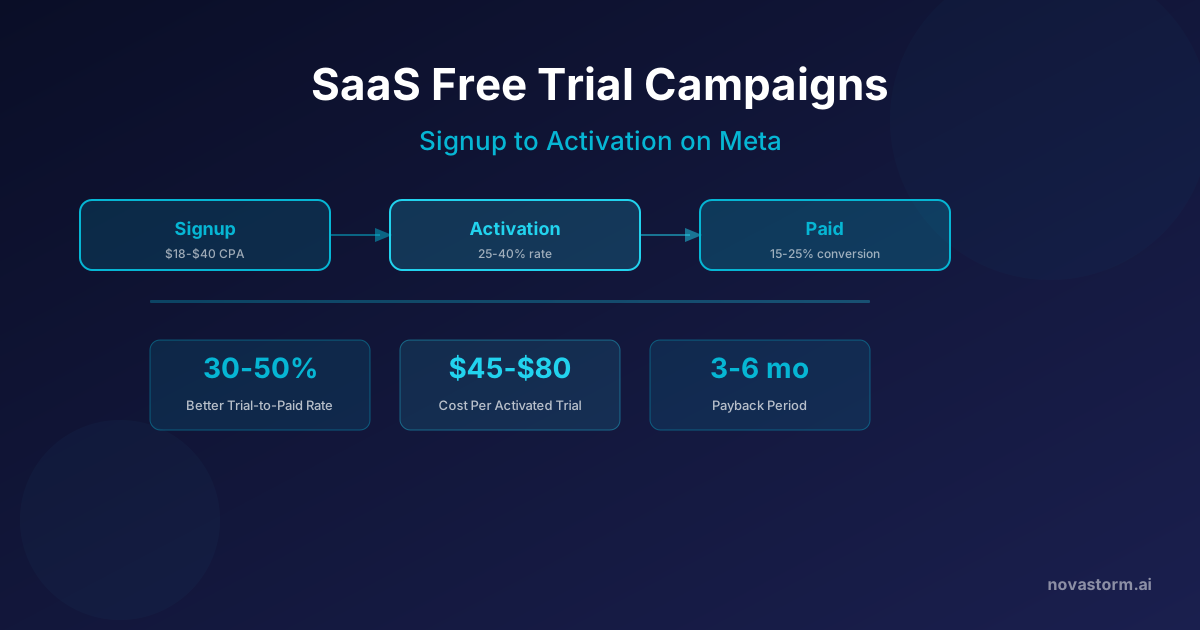
SaaS Free Trial Campaigns on Meta: Signup to Activation
Evaluate SaaS trial ads with verified activation events, retained paid cohorts, complete CAC and contribution-based payback instead of signup benchmarks.
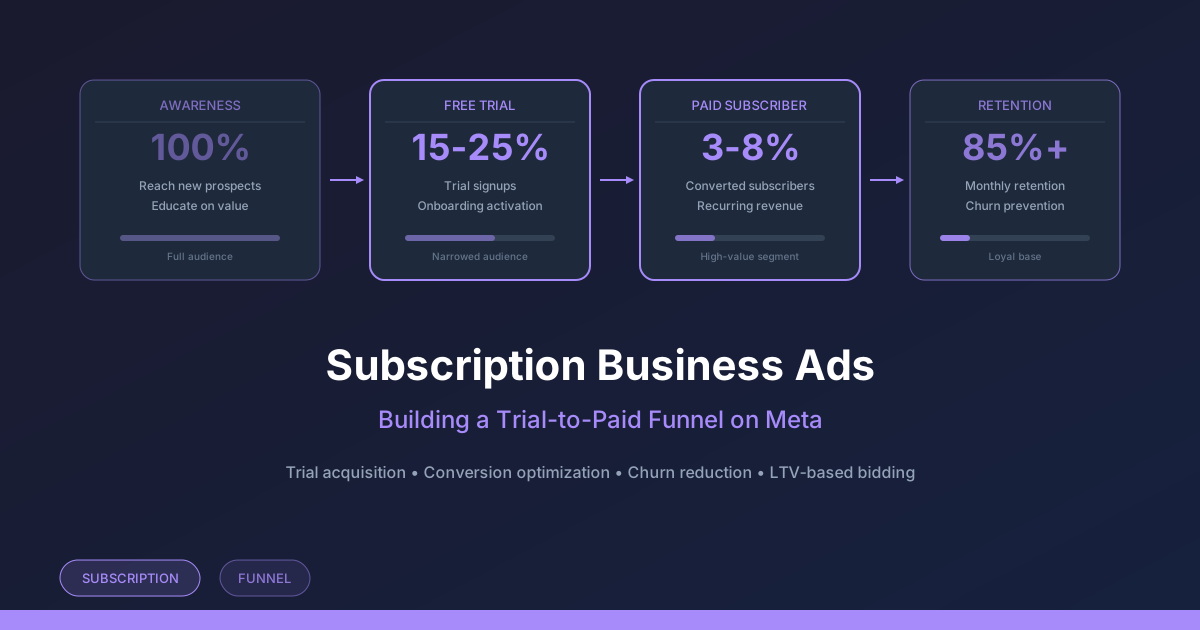
Subscription Business Ads: Building a Trial-to-Paid Funnel on Meta
Map trial, activation, payments and refunds separately, build permission-aware segments and evaluate paid-subscriber acquisition with cohort payback.

Mobile App Deep Linking From Meta Ads: Setup and Optimization
Configure explicit Universal and Android App Link associations, validate route and authorization states, and separate deferred routing from privacy-aware attribution.