

Subscription Business Ads: Building a Trial-to-Paid Funnel on Meta
Map trial, activation, payments and refunds separately, build permission-aware segments and evaluate paid-subscriber acquisition with cohort payback.
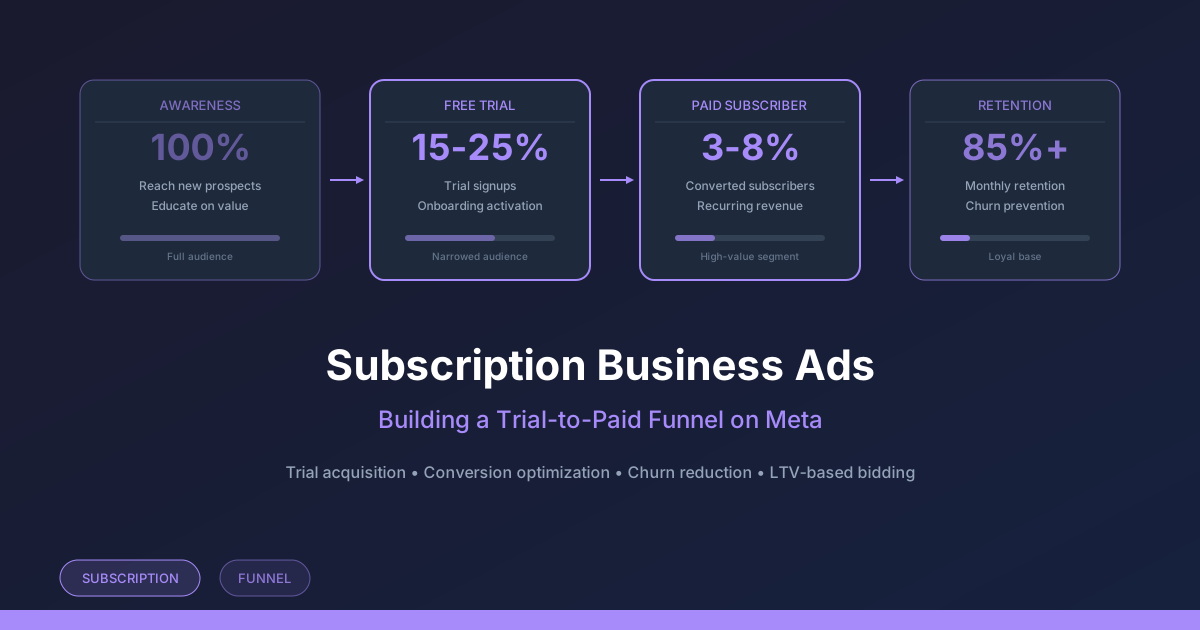
A trial signup, activation and paid subscription are different events. Define each in the business ledger before choosing a supported advertising optimization event. A cheaper trial does not necessarily mean a cheaper retained paying customer.
Separate payments from lifetime forecasts
| Business milestone | Record | Value treatment |
|---|---|---|
| Trial starts | Unique account, start/end dates and permission status | No payment; do not record predicted LTV as a purchase |
| Activation | Declared useful action, such as completing the first real project | Internal milestone or verified supported event; not invented revenue |
| First payment | Settled invoice/order, amount, currency and timestamp | Actual transaction value under the verified payment-event mapping |
| Renewal | New settled invoice with a distinct transaction identity | Actual new payment; do not replay the first invoice |
| Refund/cancellation | Ledger adjustment, refunded amount, access end and status | Reconcile net receipts; use a verified platform adjustment path if supported |
| Predicted LTV | Model version, horizon, costs and uncertainty | Separate forecast field/report, never substitute for a settled payment |
A proposed mapping might use Purchase for a confirmed payment, but the integration owner must verify actual platform semantics, eligibility and deduplication. A forecast may inform a separately designed value model only after validation; this guide does not assert that sending projected lifetime revenue as a Purchase payment is correct.
A filled trial-to-paid model
Synthetic cohort: $1,000 media spend acquires 100 trials; 20 eventually pay, giving $10 per trial and $50 media cost per initial payer. Assume a $50 monthly subscription with $20 variable costs per paid month, leaving $30 contribution. If all 20 pay once, first-month contribution is $600, below the $1,000 spend. If 15 renew, their $450 additional contribution brings the total to $1,050 at month two. These are invented counts and assumptions, not conversion or retention benchmarks.
Payback depends on when invoices settle, refunds, acquisition production costs and future retention. A $100 refund reduces receipts but does not imply all service costs reverse. Compare equal-age cohorts and include trial customers who never pay. Changing the campaign objective requires a new hypothesis about paid outcomes; activation does not guarantee payment.
Stop wasting ad budget
NovaStorm AI cuts Meta Ads CPA by 30% on average. No complex setup required.
Prepare segments without exposing private status
| Segment | Permission/eligibility | Proposed public message | Exit |
|---|---|---|---|
| Inactive eligible trial | Approved contact/audience purpose and current access | "Explore a guided first project." | Activation, payment, expiry or withdrawal |
| Active eligible trial | Current entitlement and permitted use of data | "Review the plan features and pricing." | Payment or withdrawal |
| Trial ending | Verified end date and truthful renewal terms | "Review your plan before your trial ends." | Payment, actual expiry or withdrawal |
| Expired eligible trial | Permitted recontact and valid restart offer | "See current plans and restart options." | Payment, refusal or withdrawal |
| Billing problem | Use an appropriate private service channel | Do not expose personal payment failure in an ad | Resolved billing or end of permission |
Do not imply a person’s private usage or payment status in public copy. Segment source, consent/lawful basis, update cadence and matching must be verified. Paid-user exclusions can lag; inspect actual saved controls and do not promise immediate suppression.
Review mature economics before a growth decision
- Freeze cohort entry, trial length, activation definition and payment/refund rules. Audit duplicate events and account identities.
- Approve affordable spend, total cash-loss cap and payback horizon. Observe through trial completion plus actual billing and refund delay.
- Compare mature paid-customer cost, net contribution and retention at equal ages. Use supported controlled assignment for a causal claim; report sparse outcomes as inconclusive.
- Keep forecast LTV separate and backtest it on later receipts. Revise the model when reality differs rather than relabeling predicted revenue as actual.
NovaStorm can prepare truthful acquisition or trial-message briefs as paused campaign and local ad-set drafts. Billing synchronization, retention automation and LTV-based bidding require separately confirmed integrations and are not assumed here. The LTV and cash guide explains why future contribution is not cash available today.
Published by NovaStorm AI. Planning examples are illustrative assumptions, not measured customer results.
Disclaimer: This article was generated with the assistance of AI and reviewed by the NovaStorm AI team. While we strive for accuracy, we recommend verifying specific data points and consulting official sources (linked where available) for critical business decisions.
Ready to automate your Meta Ads?
NovaStorm AI takes full responsibility for your campaigns — from monitoring to optimization.
Start NowMore on SaaS and app growth
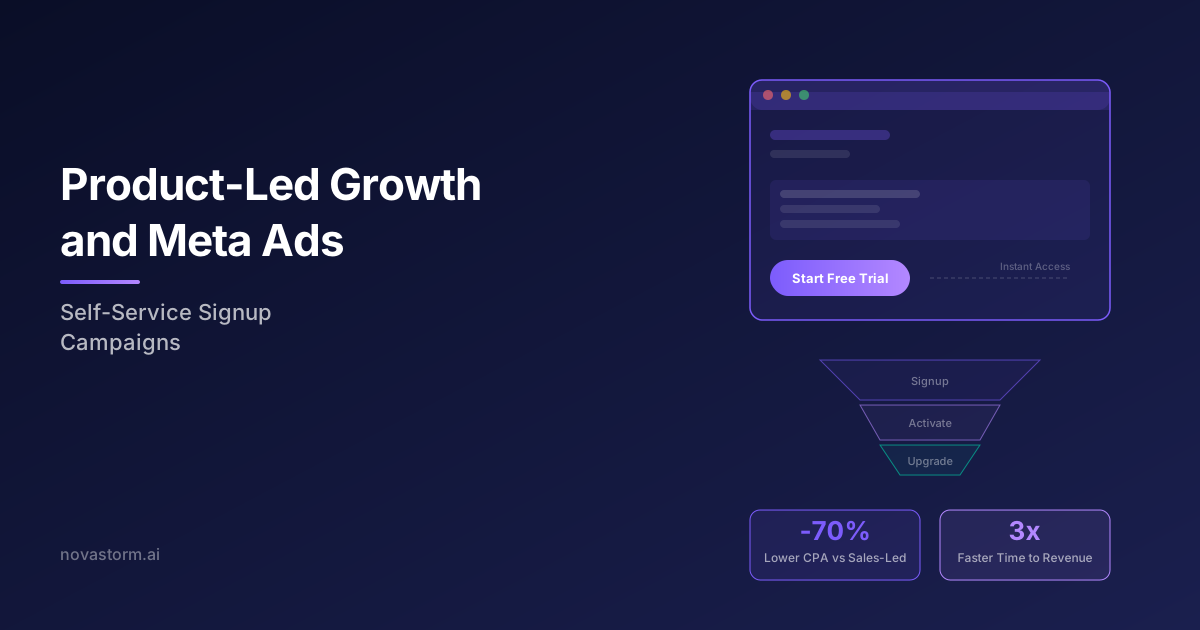
Product-Led Growth and Meta Ads: Self-Service Signup Campaigns
Measure self-service campaigns from signup to useful action, retained use and settled payment. Includes illustrative cohort economics and attribution limits.
Meta Ads for App Install Campaigns: Complete Strategy Guide
Choose an app measurement route, verify install-to-payment and deep links, and evaluate retention and payback before approving acquisition spend.

Meta Ads for SaaS: Trial and Demo Campaign Planning
Plan separate SaaS trial and demo journeys, reconcile mature paid cohorts, and test targeting and budget changes within contribution and cash limits.
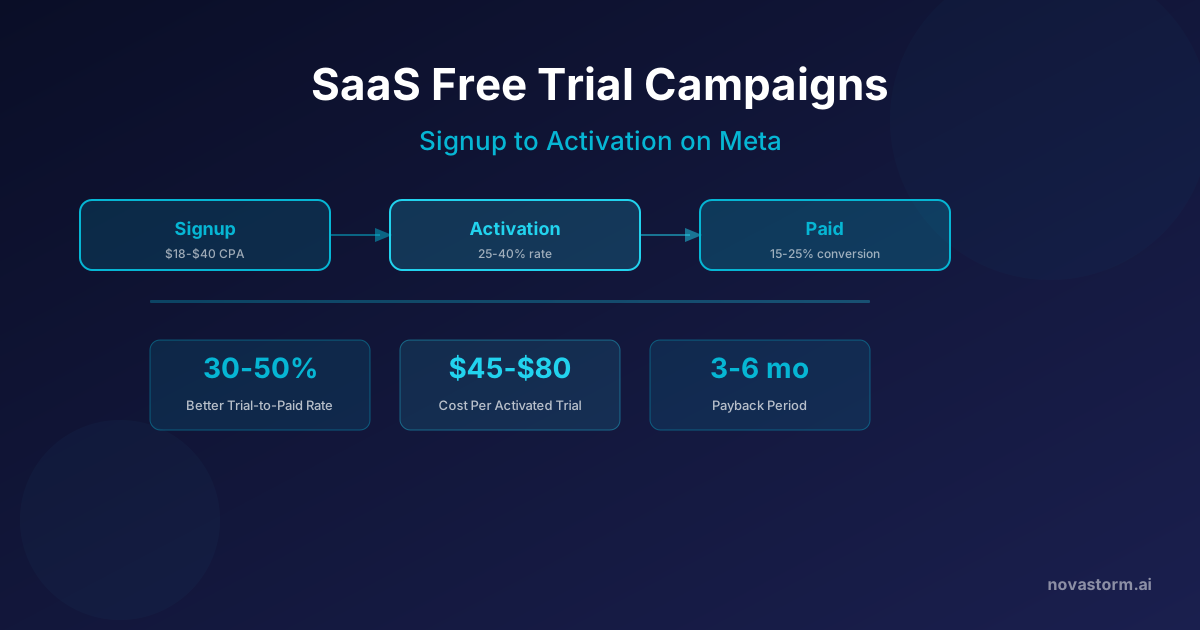
SaaS Free Trial Campaigns on Meta: Signup to Activation
Evaluate SaaS trial ads with verified activation events, retained paid cohorts, complete CAC and contribution-based payback instead of signup benchmarks.