

Market Gap Analysis Through Meta Ad Library Research
Treat missing ad messages as hypotheses, validate willingness to pay and contribution economics, and handle health claims with evidence.
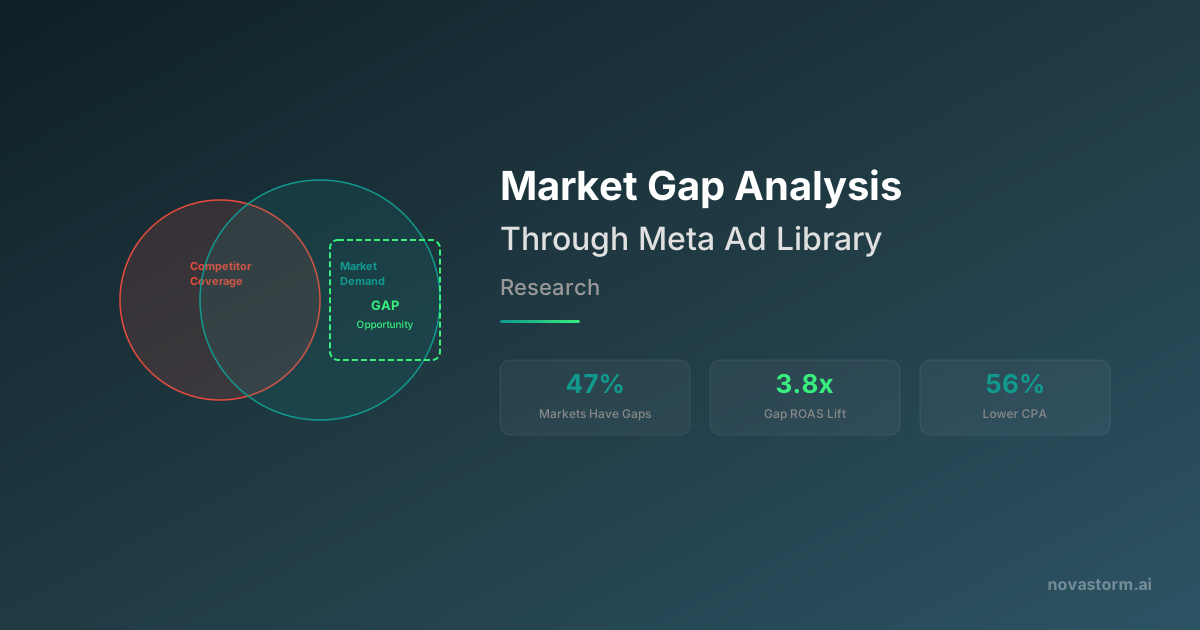
Meta Ad Library research can expose a question worth testing: is a useful message missing from the records we retrieved? That is a coverage hypothesis. It becomes a business opportunity only after you establish customer need, willingness to pay, delivery feasibility and contribution economics.
Define the sample before calling anything a gap
- Choose competitors by product, price and served market; record advertiser identity, country, category and retrieval date.
- Save each accessible record URL and observed copy, format, offer and destination. Distinguish duplicate creative from distinct messages.
- Mark every blank cell not observed in this sample. Keep retrieval failures separate from accessible searches.
- Do not infer weekend schedules, neglected age groups or complete audience targeting from ordinary creative records.
Use the reproducible search log to preserve these limits. An older record or a limited archive can also make a message appear absent. An inaccessible advertiser is not a competitor with zero coverage.
A useful matrix with explicit unknowns
Illustrative matrix for fictional workspace-accessory brands, not retrieved competitor data. Each observation below is assumed solely to demonstrate the worksheet.
| Observed message | Brand A | Brand B | Brand C | Next question |
|---|---|---|---|---|
| Compact desk setup | Assumed observed | Not observed | Assumed observed | Is size a buying criterion? |
| Tool-free assembly | Not observed | Assumed observed | Not observed | Can our product truthfully demonstrate it? |
| Repairable components | Not observed | Not observed | Not observed | Do buyers value repair enough to pay? |
The last row is not proof of an unserved market. The message may be absent because repair matters little, cannot be economically delivered, or appeared outside this sample. Distinguish message coverage from product availability and audience demand.
Validate willingness to pay
- Interview relevant potential buyers about their last purchase, the problem they paid to solve and alternatives considered. Avoid leading questions that merely ask whether repair sounds good.
- Present a truthful, deliverable offer at a stated price with shipping, terms and repair scope. A waitlist measures interest; a paid purchase is a different outcome.
- Compare the new message with your existing truthful message, keeping price and destination consistent. Use a prespecified experiment where feasible.
- Record paid conversion, cancellations, returns and fulfillment costs. Do not report search volume or audience-size estimates as purchases.
Stop wasting ad budget
NovaStorm AI cuts Meta Ads CPA by 30% on average. No complex setup required.
Hypothetical economics: a repairable desk stand sells for $80 net revenue, with $30 product, $8 fulfillment, $3 fees and $9 expected service/returns. Contribution before media is $30. With a chosen $10 retained-contribution target, allowable purchase CPA is $20. An observed future CPA above that threshold would require a revised offer or a deliberate, funded loss decision; market novelty would not fix the arithmetic.
Health-related angles need an evidence gate
A post-injury recovery message is not a harmless generic fitness angle. The FTC health-products guidance requires support for both express and implied health claims; testimonials and search interest do not establish recovery efficacy. Review the full creative impression, scientific support, audience privacy and applicable platform requirements before using such an angle.
If your product cannot substantiate injury-recovery benefits, remove that claim from the brief. A factual feature such as a verified session duration does not authorize implying medical treatment. Do not build audiences from inferred injury status just because the topic has demand.
Write the brief as a falsifiable hypothesis
Illustrative original brief for the fictional stand: “Buyers comparing compact workspace equipment may choose our product more often when we show replaceable parts with their actual prices.” Show only parts that are available and service terms that can be fulfilled. Record the source sample, unresolved questions, control message, outcome, budget cap and decision date.
Use the creative-testing framework to interpret a failed test: the problem, price or offer may be wrong even if the creative is distinctive. No quantified market-gap prevalence or uplift is established here.
Prepare your own NovaStorm campaign draft from that brief and verify the paused state before launch. Library retrieval, market research and gap validation remain separate work; a draft is not an automated competitive audit.
Published by NovaStorm AI. Worked examples and proposed tests are labeled in the article.
Disclaimer: This article was generated with the assistance of AI and reviewed by the NovaStorm AI team. While we strive for accuracy, we recommend verifying specific data points and consulting official sources (linked where available) for critical business decisions.
Ready to automate your Meta Ads?
NovaStorm AI takes full responsibility for your campaigns — from monitoring to optimization.
Start NowMore on Competitive research
First-Mover vs Fast-Follower Strategy in Meta Ads Creative
Compare original and adapted Meta ad concepts with a rights checklist, production budget and bounded test rather than unsupported win-rate claims.

Competitive Intelligence for Meta Ads: Monitoring Rival Campaigns
Archive public rival creatives, distinguish vendor estimates from evidence, and prepare an original campaign hypothesis with a contribution-based decision.
Competitive Benchmarking for Meta Ads: Setting Realistic KPIs
Set comparable Meta Ads KPIs from contribution margin, attribution definitions and transparent targets without inventing competitor performance.
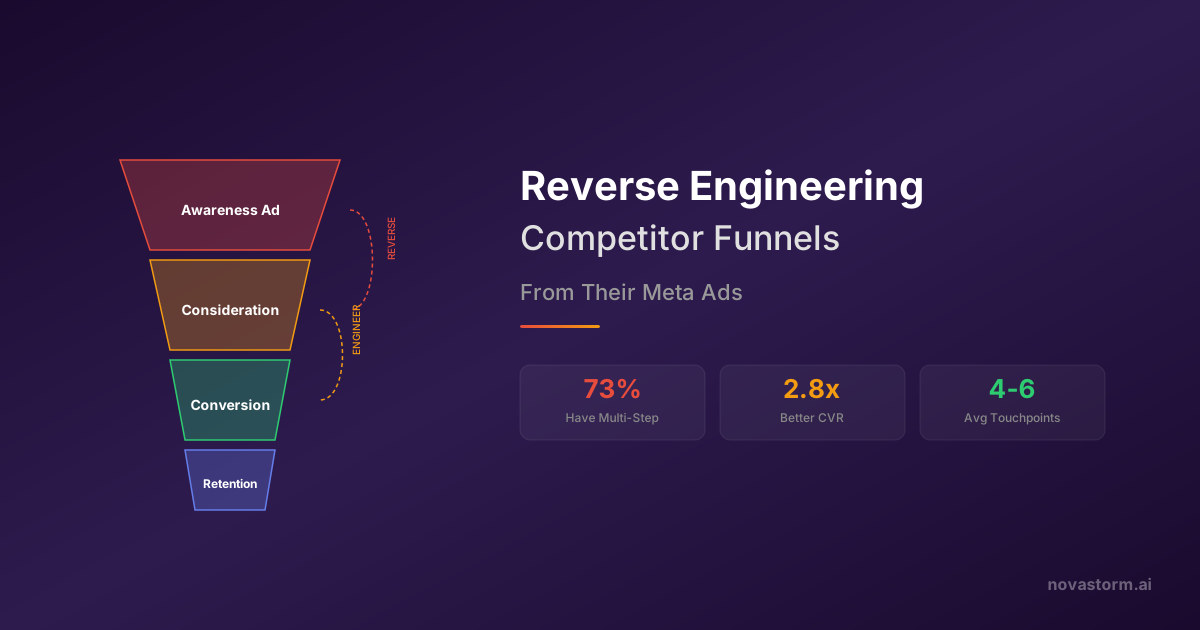
Reverse Engineering Competitor Funnels From Their Meta Ads
Map public competitor pages without inventing ad sequences, targeting or email flows, then test a specific hypothesis in your own funnel.