

Competitive Benchmarking for Meta Ads: Setting Realistic KPIs
Set comparable Meta Ads KPIs from contribution margin, attribution definitions and transparent targets without inventing competitor performance.
A useful Meta Ads KPI starts with your economics and a comparable measurement definition. External benchmarks can provide context, but an industry average cannot tell you your break-even ROAS, your percentile or a competitor’s profit.
Write the comparison contract
| Field | Required definition |
|---|---|
| Business and geography | Product category, price range, currency and served market |
| Period | Exact dates, season and conversion-lag maturity |
| Objective and event | Purchase, qualified lead or other precisely defined outcome |
| Click metric | Link or outbound CTR, rather than an unspecified all-click CTR |
| Revenue | Gross or net; refunds/taxes/shipping treatment; new versus returning customers |
| Attribution | Click/view windows, report source and reporting date |
| Sample and statistic | Advertiser/campaign count, weighting method and mean/median/percentiles |
Reject a comparison that mixes a lead with a paid customer or one reporting window with another. A benchmark provider’s average is a mean only under its documented method; it does not become a median or the 75th percentile. Without a distribution, your percentile is unknown.
Calculate the floor from contribution
Illustrative order economics, not an observed account: net revenue $100; product $40, fulfillment $8, payment fees $3 and expected returns/service $9. Contribution before advertising is $40, or 40% of net revenue. Break-even purchase CPA = $40 and revenue ROAS = $100 ÷ $40 = 2.5, assuming these orders are attributable and the cost basis matches.
To retain $10 contribution per order, allowable CPA becomes $30 and required ROAS becomes $100 ÷ $30 = 3.33. Fixed overhead and cash timing may require a stricter target. At ROAS 1.5, implied CPA is $66.67 and contribution after media is −$26.67 per order under these assumptions.
Use the break-even ROAS calculation with your own cost ledger. Future repeat purchases should enter only through a declared cohort model and sensitivity case, not an optimistic unmeasured lifetime value.
Build three targets without inventing an industry distribution
| Tier | Illustrative target | Basis |
|---|---|---|
| Economic floor | CPA $40 / ROAS 2.5 | Calculated zero contribution after media |
| Operating base | CPA $30 / ROAS 3.33 | Assumed $10 retained contribution |
| Stretch hypothesis | CPA $25 / ROAS 4 | Proposed $15 contribution; feasibility unproven |
Stop wasting ad budget
NovaStorm AI cuts Meta Ads CPA by 30% on average. No complex setup required.
The base and stretch figures are chosen business goals, not market medians or promises. Set a volume requirement alongside them: a strong ratio on a few purchases may not support the business. Compare equal matured periods and describe uncertainty when volumes are small.
Why aggregate ratios need care
Hypothetical two-campaign data: campaign A spends $100 and attributes $400 revenue; B spends $900 and attributes $1,800. The arithmetic mean of their ROAS values is (4 + 2) ÷ 2 = 3. Combined ROAS is $2,200 ÷ $1,000 = 2.2. Use totals for a portfolio ratio and preserve the unit of a published statistic.
No audited industry distribution or advertiser survey is supplied here. Use an external report only if its source and comparison contract are available. Your comparable historical cohorts can supply a documented baseline; they still do not establish competitors’ private outcomes.
What competitor observations add
Public copy, prices and formats can suggest positioning tests. Creative production quality and ad longevity do not disclose cost, margins, spend or ROAS. Keep the competitor evidence log separate from your KPI ledger.
Turn the target into a review decision
- Record actual contribution costs, matured conversions and cash exposure before setting the floor.
- Investigate event quality, offer, destination and audience when the operating target is missed; do not kill a profitable campaign solely for falling below an unrelated average.
- Revisit targets when price, margin, returns or market conditions change; quarterly review is a scheduling choice, not a guaranteed improvement timeline.
Prepare your next campaign draft in NovaStorm with the target, assumptions and review date in your working brief. Review the paused draft before launch. Benchmark collection and profitability calculation belong to your own evidence workflow.
Published by NovaStorm AI. Worked examples and proposed tests are labeled in the article.
Disclaimer: This article was generated with the assistance of AI and reviewed by the NovaStorm AI team. While we strive for accuracy, we recommend verifying specific data points and consulting official sources (linked where available) for critical business decisions.
Ready to automate your Meta Ads?
NovaStorm AI takes full responsibility for your campaigns — from monitoring to optimization.
Start NowMore on Competitive research
Reverse Engineering Competitor Funnels From Their Meta Ads
Map public competitor pages without inventing ad sequences, targeting or email flows, then test a specific hypothesis in your own funnel.
First-Mover vs Fast-Follower Strategy in Meta Ads Creative
Compare original and adapted Meta ad concepts with a rights checklist, production budget and bounded test rather than unsupported win-rate claims.
Meta Ad Library Advanced Search: Finding Competitor Insights
Keep a reproducible Meta Ad Library search log, interpret access failures correctly, and convert verified observations into your own test brief.
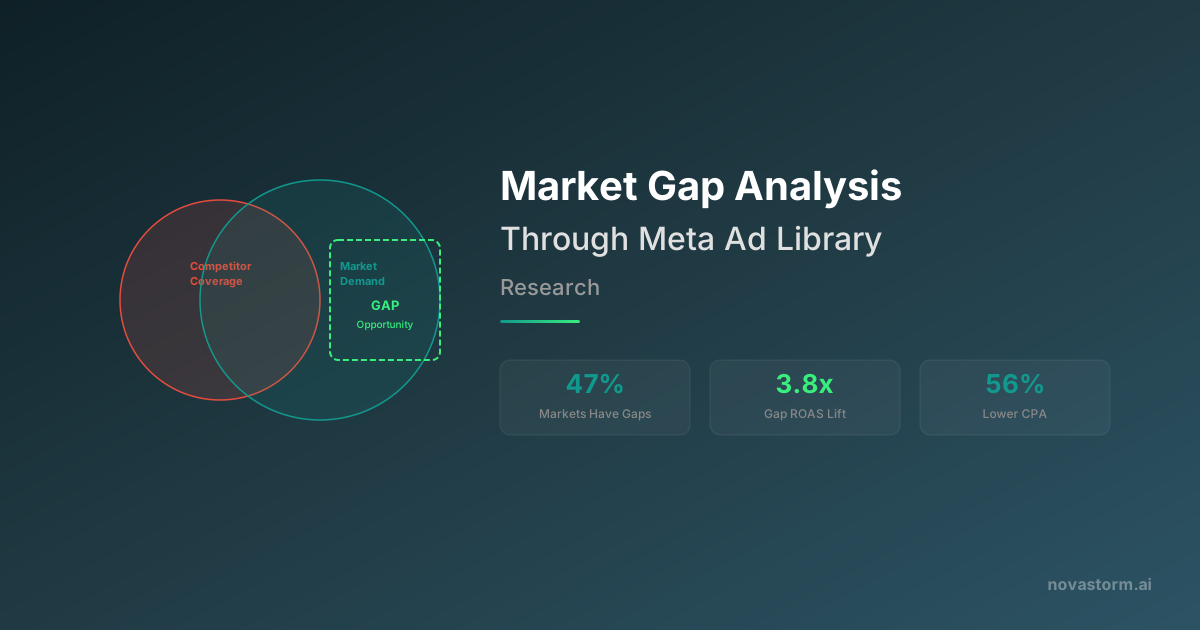
Market Gap Analysis Through Meta Ad Library Research
Treat missing ad messages as hypotheses, validate willingness to pay and contribution economics, and handle health claims with evidence.