

Reverse Engineering Competitor Funnels From Their Meta Ads
Map public competitor pages without inventing ad sequences, targeting or email flows, then test a specific hypothesis in your own funnel.
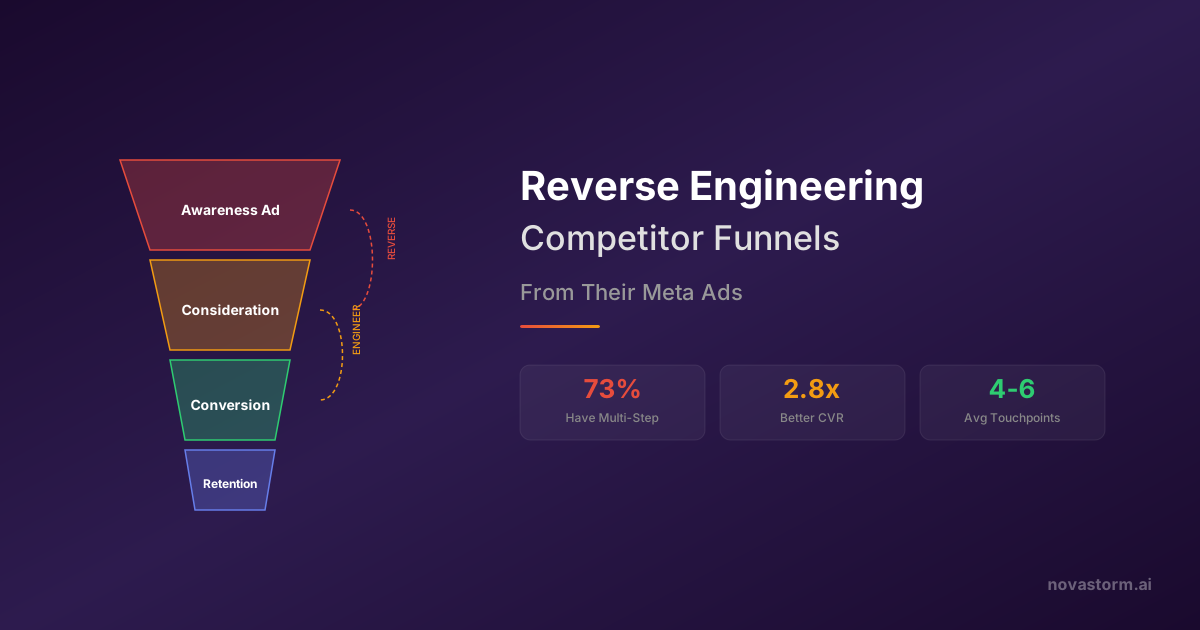
A competitor funnel map is a set of observed pages and proposed connections. Public ads can suggest different messages, but they do not reveal the order in which a person saw ads, audience membership, private emails or conversion results. Use the map to ask better questions about your own customer journey.
Separate evidence from proposed paths
| Evidence | Permissible observation | Still unknown |
|---|---|---|
| Accessible ad record | Advertiser identity, displayed copy, creative, CTA and destination | Audience assignment, order of exposure and profit |
| Public landing page | Visible offer, form and links at retrieval time | Other visitor variants, checkout completion and conversion rate |
| Several similar ads | A visible creative cluster in this sample | An actual retargeting sequence |
| No retention creative retrieved | Retention was not observed in this retrieval | Whether retention exists elsewhere or in another channel |
For each record save date, country, category and source URL. If the library is inaccessible, follow the retrieval log and mark ad evidence as unknown. Neither a Learn More CTA nor a testimonial uniquely identifies a funnel stage.
A public website example, kept separate from Meta evidence
On 2 October 2026, the AdCreative.ai public homepage presented a free-trial CTA linking to app.adcreative.ai and stated a seven-day trial. Those are website observations and vendor terms as displayed, not proof of Meta ad delivery, signup completion or trial-to-paid conversion. A website offer can change; recheck the actual destination and terms.
| Map entry | Source / observation | Status |
|---|---|---|
| Public homepage | www.adcreative.ai; trial CTA and visible product description | Observed website, 2026-10-02 |
| Application destination | app.adcreative.ai link on homepage | Link observed; account journey not completed |
| Meta ad → homepage | No retrieved Meta record connecting these URLs | Unestablished connection |
| Signup → onboarding emails | No permission-based subscription observation recorded | Unknown email trigger/content/timing |
| Retargeting → purchase → retention | No account-level delivery or outcome evidence | Unknown targeting, sequence and results |
Draw solid connections only for observed links. Use dashed connections for hypotheses and label the channel. Do not transform a Google advertising record, public website or vendor story into an observed Meta funnel.
Collect only the journey you can actually inspect
Stop wasting ad budget
NovaStorm AI cuts Meta Ads CPA by 30% on average. No complex setup required.
- Open accessible public destinations; record redirects, viewport, country and visible offer. Save the final URL rather than guessing which variant all customers receive.
- If you voluntarily subscribe under the published terms, log the consent and only emails actually received. No email received within your window means not observed, not no nurture program.
- Do not infer pixel events or audience rules from copy. Validate your own event implementation separately.
- Avoid purchases or paid account creation merely to fill a map. Mark those steps unknown unless separately authorized and completed.
Turn a proposed connection into an own-funnel test
Hypothetical SaaS test, not an AdCreative.ai result: prospects may need a clear task demonstration before being ready for a trial. Compare your current ad-to-signup path with an ad-to-demonstration-to-signup path. Keep truthful product facts, trial terms, audience criteria and downstream qualification consistent.
- Specify the hypothesis, both paths and the exact primary outcome: for example, activated signup within seven days, using your own activation definition.
- Randomize at an appropriate unit with a stable assignment where feasible; avoid comparing unrelated campaign cohorts as a causal test.
- Record allocation, eligible visitors, spend, activated users and variable service costs. Check tracking and consent before launch.
- Choose duration and loss limits from your traffic and risk capacity. An extra page may lower activation despite increasing engagement; include that possibility.
Illustrative arithmetic: assume 2,000 eligible visitors per path, 100 activated users in the current path and 120 in the demonstration path. Rates are 5% and 6%, a difference of 1 percentage point and a descriptive relative increase of 20%. These assumed outcomes are not evidence of improvement; uncertainty, allocation validity and contribution costs would determine a real decision.
Use the map for a concrete decision
Ask which unresolved customer question your own page should answer, rather than which unseen competitor stage you should copy. Use the landing-page workflow to inspect your path. Prepare a paused NovaStorm campaign draft around the selected hypothesis; public competitor collection and experiment measurement remain separate tasks.
Published by NovaStorm AI. Worked examples and proposed tests are labeled in the article.
Disclaimer: This article was generated with the assistance of AI and reviewed by the NovaStorm AI team. While we strive for accuracy, we recommend verifying specific data points and consulting official sources (linked where available) for critical business decisions.
Ready to automate your Meta Ads?
NovaStorm AI takes full responsibility for your campaigns — from monitoring to optimization.
Start NowMore on Competitive research
Meta Ad Library Advanced Search: Finding Competitor Insights
Keep a reproducible Meta Ad Library search log, interpret access failures correctly, and convert verified observations into your own test brief.
Competitive Benchmarking for Meta Ads: Setting Realistic KPIs
Set comparable Meta Ads KPIs from contribution margin, attribution definitions and transparent targets without inventing competitor performance.
Competitor Ad Spy Tools: How to Research Meta Ads Competitors
Compare competitor research tools by verifiable fields, keep a dated evidence log, and turn creative inspiration into an honest campaign hypothesis.
First-Mover vs Fast-Follower Strategy in Meta Ads Creative
Compare original and adapted Meta ad concepts with a rights checklist, production budget and bounded test rather than unsupported win-rate claims.