

First-Mover vs Fast-Follower Strategy in Meta Ads Creative
Compare original and adapted Meta ad concepts with a rights checklist, production budget and bounded test rather than unsupported win-rate claims.
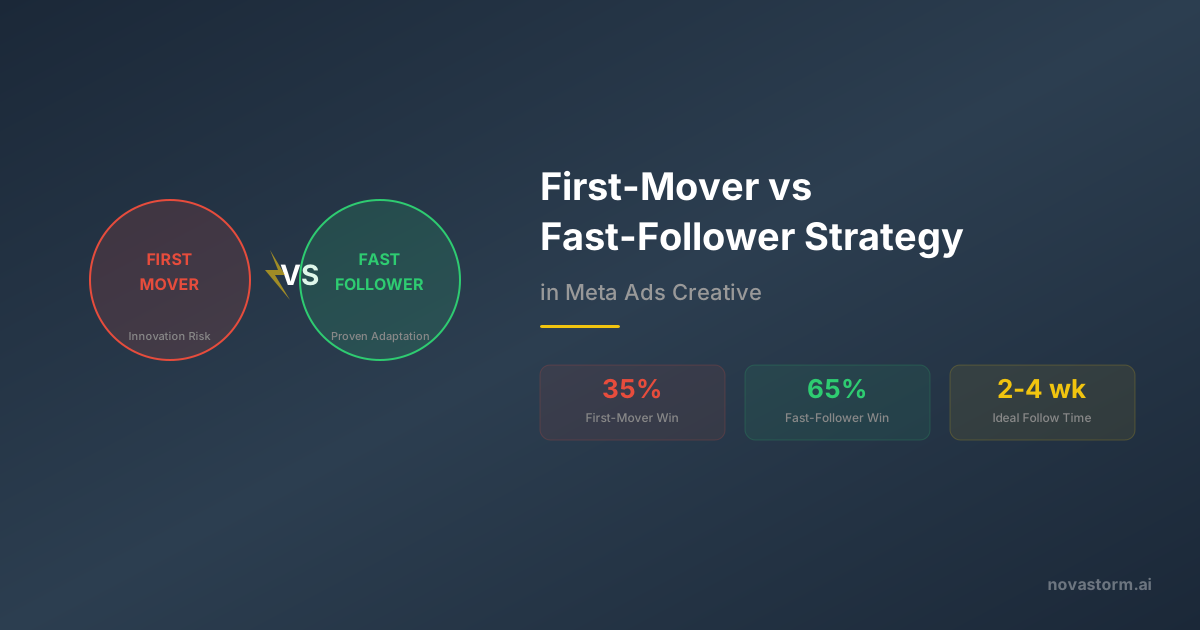
Choose whether to develop a new creative idea or adapt an observed pattern by comparing production cost, rights, test capacity and your product’s facts. A competitor’s visible ad is inspiration, not access to their testing data. Neither novelty nor imitation guarantees better delivery or conversion.
Two approaches, one evidence standard
| Approach | Potential benefit to test | Cost or uncertainty |
|---|---|---|
| Original concept | A distinctive demonstration or message suited to your product | More production work; audience response unknown |
| Adapted pattern | A familiar storytelling structure made with your own assets | Similar execution can become generic; source performance unknown |
A long-running ad does not establish a winning concept. Describe the source’s observed format, not a private win rate. Do not assume Meta rewards novelty with preferential distribution or that an emerging format has an inevitable expiration date.
Adapt the idea, create your own expression
The U.S. Copyright Office overview distinguishes ideas from protected original expression. A broad demonstration structure is different from copying another advertiser’s footage, copy, music or distinctive artwork. Check rights for every asset, talent appearance, testimonial and soundtrack you plan to use; permission for an organic post may not cover paid advertising.
Illustrative fictional kitchen-tool brief: an observed problem–demonstration–result structure suggests showing how our own tool fits a small drawer. Film our product in our setting, write original copy and state only verified dimensions. Do not borrow a competitor’s customer quote or imply their result is ours.
Price production before allocating media
Hypothetical $5,000 total creative-test envelope: allocate $4,000 to adapting existing owned assets and $1,000 to one original experiment. This 80/20 split is a portfolio hypothesis, not an established optimum. Include production inside each allocation rather than adding it later.
| Allocation | Production assumption | Media ceiling | Total |
|---|---|---|---|
| Adapted concepts | 4 × $250 = $1,000 | $3,000 | $4,000 |
| Original experiment | $600 | $400 | $1,000 |
| Whole envelope | $1,600 | $3,400 | $5,000 |
Stop wasting ad budget
NovaStorm AI cuts Meta Ads CPA by 30% on average. No complex setup required.
If editing and rights increase the original concept’s production cost to $900, its remaining media capacity becomes $100. Reduce scope or revise the allocation before launch. A small media ceiling may be too weak to answer the question; a cheap adaptation can also fail.
One consistent example schedule
- Week 1: record accessible examples and choose a customer question; source collection does not establish global first-mover status.
- Week 2: approve original script, rights and production budget.
- Week 3: produce both variants, validate the destination and outcome tracking.
- Week 4: review a paused draft and launch only after the checks pass.
- Following weeks: complete the prespecified measurement window; delay if production or data quality requires it.
This four-week production schedule is an illustrative operating plan, not a claim that adaptation must happen in two to four weeks or launch in four to six weeks. Customer timing, asset approvals and your ability to measure determine the actual dates.
Set a limit before looking at results
Hypothesis: the original drawer demonstration will create more qualified purchases per dollar of total production and media cost than the adapted structure. Keep the offer, destination and measurement definition consistent. Use an appropriate randomized comparison where feasible; label nonrandomized observations accordingly.
- Agree the primary outcome, minimum meaningful difference and sample plan before launch.
- Cap each experiment at its authorized envelope. Stop for broken tracking, misleading claims or rights issues; avoid declaring a winner from one early purchase.
- Include production costs in the decision. Report purchase contribution and uncertainty, not only engagement.
- If evidence is inconclusive, retain that finding and decide whether further sampling is affordable.
Use the creative-testing framework to document the comparison. NovaStorm can support preparation of the campaign draft; review its paused state and your brief before publishing. Competitor alerts, trend detection and outcome measurement require separate tools and evidence.
Published by NovaStorm AI. Worked examples and proposed tests are labeled in the article.
Disclaimer: This article was generated with the assistance of AI and reviewed by the NovaStorm AI team. While we strive for accuracy, we recommend verifying specific data points and consulting official sources (linked where available) for critical business decisions.
Ready to automate your Meta Ads?
NovaStorm AI takes full responsibility for your campaigns — from monitoring to optimization.
Start NowMore on Competitive research
Competitive Benchmarking for Meta Ads: Setting Realistic KPIs
Set comparable Meta Ads KPIs from contribution margin, attribution definitions and transparent targets without inventing competitor performance.
Market Gap Analysis Through Meta Ad Library Research
Treat missing ad messages as hypotheses, validate willingness to pay and contribution economics, and handle health claims with evidence.
Reverse Engineering Competitor Funnels From Their Meta Ads
Map public competitor pages without inventing ad sequences, targeting or email flows, then test a specific hypothesis in your own funnel.

Competitive Intelligence for Meta Ads: Monitoring Rival Campaigns
Archive public rival creatives, distinguish vendor estimates from evidence, and prepare an original campaign hypothesis with a contribution-based decision.