

Influencer Content Licensing for Meta Ads: Legal and Creative Guide
License creator ads with explicit paid-use, edit and third-party rights, then track each live ad against approval and expiration records.
A paid creator ad requires permission covering paid use, the actual edits, identity, territories and term. Paying for production or receiving a Partnership Ads permission is not, by itself, a complete rights clearance. Keep a license ledger that maps every derivative creative to every live ad.
Distinguish production, ownership and usage
Determine ownership from the applicable law and contract rather than assuming the creator always owns every commissioned asset. In the US, Copyright Office Circular 30 explains employee and qualifying commissioned work-made-for-hire conditions. Obtain the actual license or assignment and confirm the signer can grant the needed rights.
| Illustrative permission scope | Permitted only when expressly agreed | Not implied |
|---|---|---|
| Organic only | Specified unpaid brand/creator posting | Boosting, paid ads and new edits |
| Paid use of final asset | Named paid channels, territories and exact term | Raw-footage edits or creator-handle advertising |
| Editing license | Defined crops, captions, hooks and approved variants | Changing meaning or extending third-party licenses |
| Creator-identity permission | Approved paid use of name, likeness and handle | All future posts or unlimited new ads |
| Assignment/buyout | Rights actually transferred under the contract | Ownership of separately licensed music or participant rights |
Boosting an organic post is paid promotion and needs appropriate paid-use permission. Negotiate fees for the actual rights and deliverables; no universal percentage premium is established here. Hypothetical contract math: USD 800 production plus USD 400 paid-use licensing totals USD 1,200; the 50% premium is an invented negotiation example, not a market rate.
Clear the rights inside the video
- List music composition and recording rights separately. The Copyright Office distinguishes these works. A creator’s permission or an organic-platform music selection does not prove the brand has commercial ad rights for that track.
- Check featured participants, minors’ guardian permissions where applicable, locations, artwork, stock assets and visible brand material. Record geographic scope, duration and editing restrictions for each.
- Review every testimonial claim against the creator’s actual experience and substantiation for the implied product result. Editing should not manufacture an endorsement the creator did not give.
- Determine disclosure for the audience and market. FTC guidance considers the overall impression and clarity of material connections; a platform tool is not automatically sufficient or always insufficient. Preview the actual disclosure in the exported placement and seek the appropriate market review.
A license ledger with a pause deadline
Stop wasting ad budget
NovaStorm AI cuts Meta Ads CPA by 30% on average. No complex setup required.
The following entries are entirely fictional training records, not real creator contracts, account identifiers or cleared ads. Use the fields to build your own rights-controlled register.
| Ledger field | Fictional record | Operational meaning |
|---|---|---|
| Asset and version | TRAIN-ASSET-A/v2 | Connect approved edits to their original source |
| License | TRAIN-LICENSE-01; Meta paid placements; US only | No other territory/channel inferred |
| Term | 2026-10-05 00:00 to 2026-11-04 00:00 UTC; end excluded | Use one exact clock across review and media |
| Approval/third-party rights | Exercise assumes v2 approved and owned original music | Real signed approvals are required before use |
| Ad references | TRAIN-AD-A and TRAIN-AD-B | Exercise labels, not Meta IDs; real ledger stores actual IDs |
| Owner and planned pause | Media owner; 2026-11-03 23:00 UTC | Illustrative one-hour operational buffer, not a legal rule |
| Confirmation | Log actual pause time and effective delivery status | Do not mark completed from a calendar reminder alone |
On expiration or an applicable termination, pause all mapped live ads and derivative versions, remove uses no longer authorized and confirm effective delivery has stopped. Check scheduled drafts and reposts before renewal. Preserve only records and archives permitted by the agreement and policy; a paused ad does not automatically erase a public post.
Manage Partnership Ads access separately
Record whether the technical permission covers one asset or broader account access. Before starting, agree which party can revoke permission and how each running ad will be stopped. Test the actual platform controls for the permission type; do not assume disabling a code, deleting or archiving a post automatically stops every active derivative ad. Use the media owner’s explicit pause-and-confirm process when access changes, and reconcile contractual termination separately.
If permission is withdrawn or a right is disputed, suspend the affected use, identify every ad from the ledger and resolve rights before resuming. Never treat an unexpired contract as proof a revoked technical permission remains usable, or technical access as proof a contract is valid.
Prepare only approved assets and claim/disclosure notes for a NovaStorm campaign draft, then review before publication. Keep contracts, rights evidence and expiration control in the actual external register; draft preparation does not grant a license. See creator-identity advertising for separating identity permission from asset use.
Published by NovaStorm AI. Worked examples and test fixtures in this article are illustrative, not observed customer results.
Disclaimer: This article was generated with the assistance of AI and reviewed by the NovaStorm AI team. While we strive for accuracy, we recommend verifying specific data points and consulting official sources (linked where available) for critical business decisions.
Ready to automate your Meta Ads?
NovaStorm AI takes full responsibility for your campaigns — from monitoring to optimization.
Start NowMore on Creative production and UGC
Case Study Ads on Meta: Turning Customer Success Into Creatives
Build case study ads from verifiable claims, permissions and transparent comparisons, then test the story using mature paid outcomes.
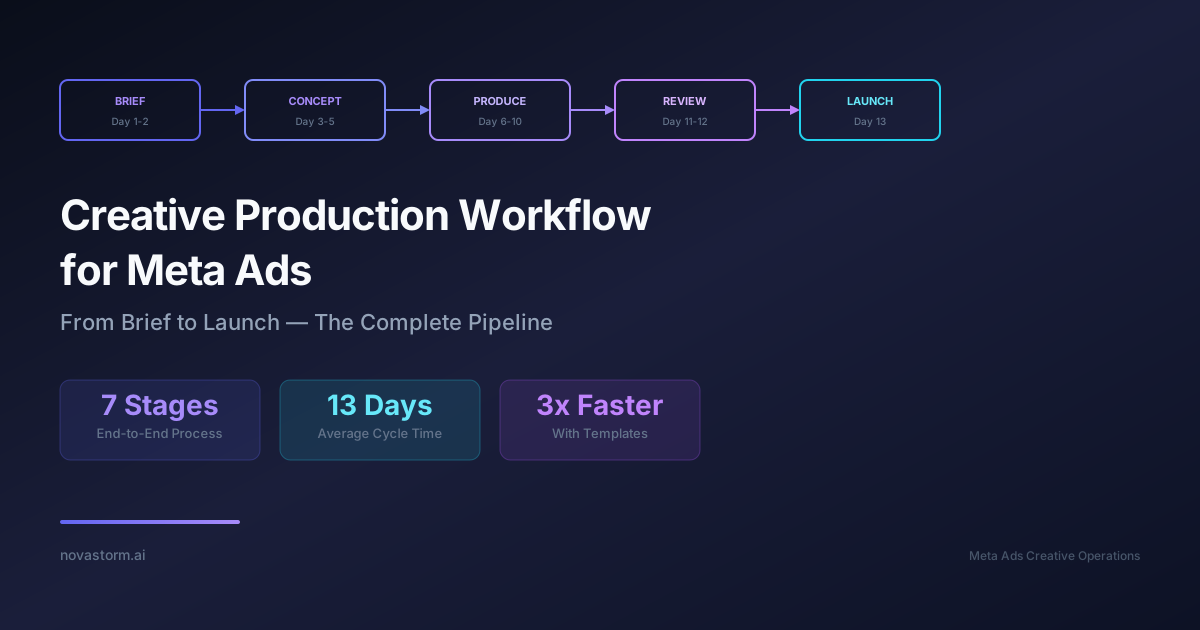
Creative Production Workflow for Meta Ads: From Brief to Launch
Organize a creative project with a filled brief, evidence and rights checks, a coherent schedule and mandatory launch acceptance gates.
Webinar Replays as Meta Ads: Evergreen Lead Generation
Create a truthful self-contained webinar ad clip, retain source dates and rights, and evaluate mature qualified demand with full funnel costs.
Canva for Meta Ads: Designing Professional Ads Without a Designer
Build a Canva ad from an original notebook layout, verify content rights and export options, and inspect both mobile adaptations before approval.