

B2B Retargeting Strategies on Meta Ads
Build B2B retargeting from verified events, honest sequencing limits and a mature form-starter test with contribution-based budget decisions.
B2B retargeting should answer an unresolved purchase question for an eligible audience. It is not automatically more incremental than prospecting: people who return may already intend to buy. Start with a permitted behavior signal and a bounded experiment, then evaluate mature sales outcomes.
Define an audience that can actually be built
For a form-abandonment hypothesis, instrument form start and accepted submission in the website workflow, with the applicable consent controls. Test both records and verify the saved audience rule available in the account. A page view is not a form start, and a click is not a completed submission.
| Proposed segment | Rule concept | Important limitation |
|---|---|---|
| Form starters | Eligible form-start event, excluding accepted submissions | Requires tested event and available audience controls |
| Product-page visitors | Relevant URL/event and chosen window | Visit does not establish company fit |
| Existing prospects | Permitted contact list, excluding relevant closed/suppressed records | CRM status and removal timing can lag |
Use Meta’s Custom Audience SDK schema as an implementation reference, then inspect actual account eligibility and saved settings. A conceptual segment name does not guarantee delivery or a stable match rate.
Keep sequences and identities honest
- A campaign impression does not ordinarily provide a named-contact audience that guarantees the next ad exposure. Separate ad sets and exclusions do not ensure a person sees messages in order.
- Use available interaction/event audiences to propose message stages, and make each creative understandable on its own.
- UTM parameters describe tagged click visits; they do not record every ad impression or identify all cross-device behavior.
- An eligible first-party contact list can be independently prepared for another platform under its rules. A Meta audience membership list is not an export of identified people to Google Ads.
- Cross-device matching is incomplete and permission-dependent. Keep unknown identities and missing sources visible.
- Inspect frequency controls for the actual campaign/objective. Where a cap is unavailable, monitor average frequency and delivery; that average is not a maximum per person.
A mature form-starter experiment
Stop wasting ad budget
NovaStorm AI cuts Meta Ads CPA by 30% on average. No complex setup required.
Hypothetical test: consenting eligible form starters are assigned to an offer-clarification reminder or a holdout, with ordinary sales handling unchanged. Evaluate accepted SQLs and retained paid contracts after a declared 60-day sales window and refund maturity. Prespecify allocation, meaningful improvement, treatment delivery checks and a $1,000 media ceiling; do not stop early for attractive form counts.
| Teaching outcome | Reminder arm | Holdout arm |
|---|---|---|
| Eligible people assigned | 500 | 500 |
| Media / additional production and labor | $1,000 / $200 | $0 / $0 incremental |
| Accepted SQLs | 20 | 16 |
| Retained paid contracts | 4 | 3 |
| Contribution before incremental acquisition | $2,000 per contract | $2,000 per contract |
The observed difference in this synthetic worksheet is one retained contract, worth $2,000 contribution, against $1,200 incremental execution cost: $800 net. With only seven paid contracts across arms, uncertainty could easily change the decision. These assumed counts do not establish a reliable lift or benchmark; a real analysis must account for randomization, contamination and outcome lag.
Give the review a period and a human decision
Proposed manual review card: “Form-starter test, September 1–30 exposure; final sales review November 30. Owner: demand-generation lead. Check: assigned groups, saved exclusions, mature SQL and retained contracts. Action: continue only if the approved contribution and loss criteria are supported.” This is an example review workflow, not a NovaStorm alert interface.
Prepare the clarification message and Meta campaign draft in NovaStorm. Review saved audience, budget and destination fields before publication; the owner approves any subsequent budget decision using the separate sales ledger.
Published by NovaStorm AI. Worked examples and proposed tests are labeled in the article.
Disclaimer: This article was generated with the assistance of AI and reviewed by the NovaStorm AI team. While we strive for accuracy, we recommend verifying specific data points and consulting official sources (linked where available) for critical business decisions.
Ready to automate your Meta Ads?
NovaStorm AI takes full responsibility for your campaigns — from monitoring to optimization.
Start NowMore on Custom audiences and retargeting
Video Viewer Audiences: Building Warm Pools for Retargeting
Compare video warming with direct acquisition using unique retained customers, full funnel costs and explicit audience definitions.
App Retargeting on Meta: Re-Engaging Dormant Users
Define exact dormancy windows, verify available audience and frequency controls, and measure mature incremental reactivation against a no-ad comparison.
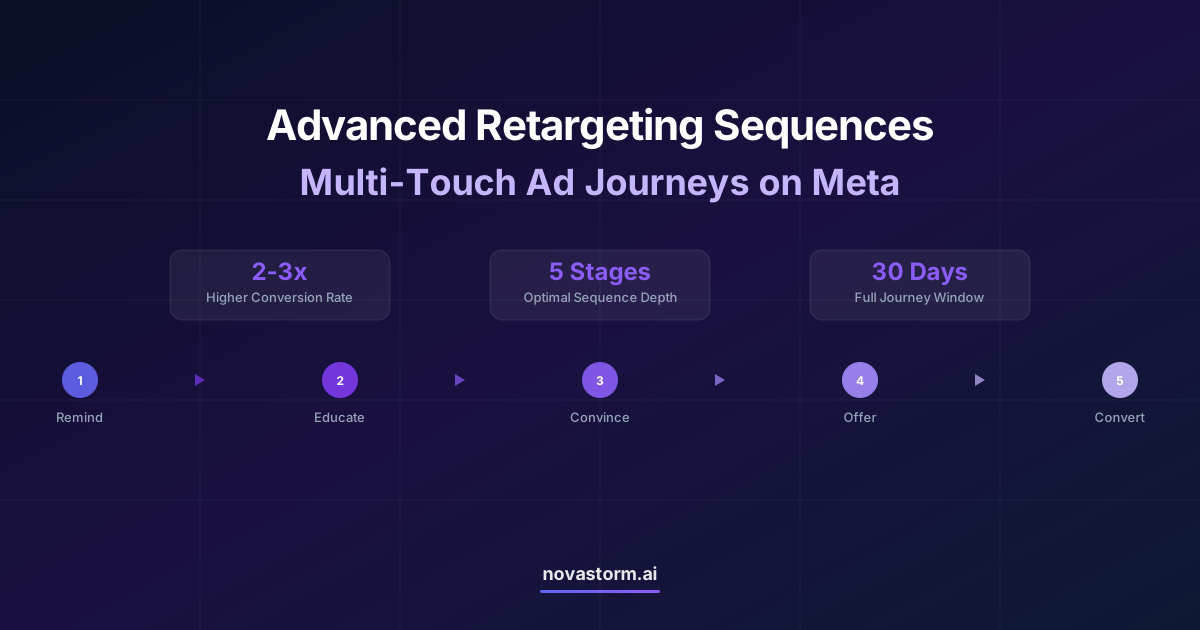
Advanced Retargeting Sequences on Meta: Multi-Touch Ad Journeys
Design recency-based retargeting without assuming prior impressions, validate events and exclusions, and compare an assigned control honestly.

Dynamic Retargeting for Non-E-commerce Businesses on Meta
Map non-commerce offers safely, verify catalog eligibility and event semantics, and measure qualified clients without inventing value optimization.