

Video Viewer Audiences: Building Warm Pools for Retargeting
Compare video warming with direct acquisition using unique retained customers, full funnel costs and explicit audience definitions.
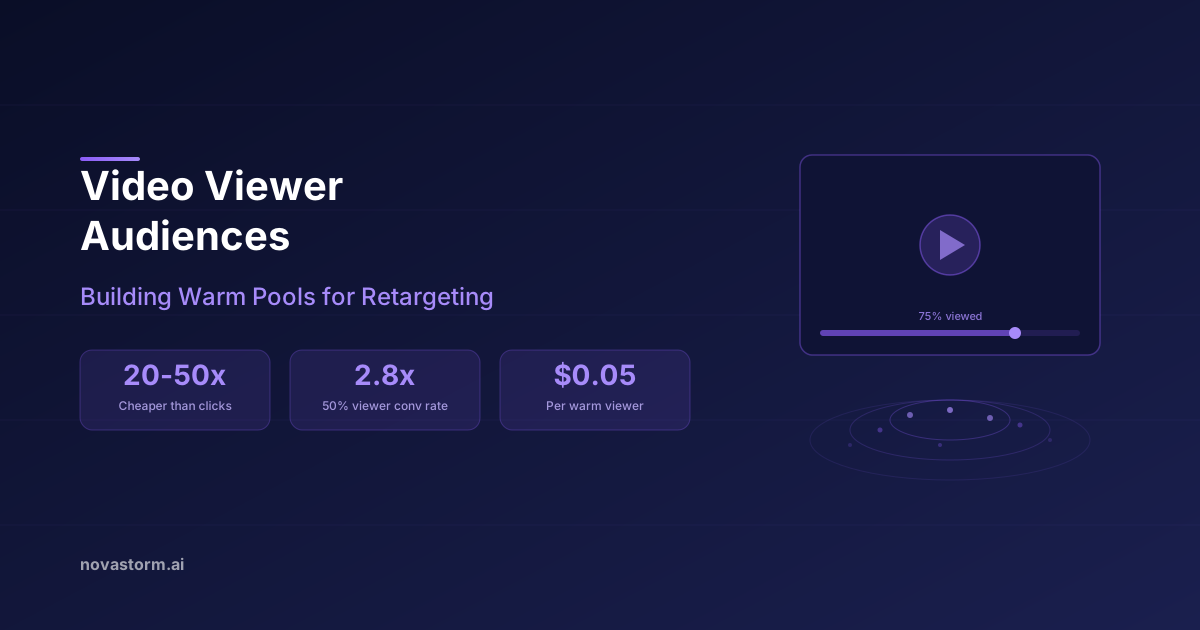
Video retargeting is worth funding when the complete journey earns more retained customer contribution than a simpler direct campaign. Cheap plays alone cannot answer that question. Define the video cohort, keep repeated plays separate from unique eligible people, and compare the costs of every stage before expanding the funnel.
Define the denominator before pricing the audience
| Metric | Denominator | Interpretation |
|---|---|---|
| Cost per recorded play | Plays at one defined threshold | Repeat plays can count more than once |
| Cost per unique threshold viewer | Unique viewers under a supported reporting definition | Not necessarily eligible audience members |
| Cost per retargetable member | Eligible matched unique people, if actually available | An approximate audience range is not an exact count |
| Full acquisition cost | Unique retained new paying customers across the journey | Deduplicate across stages and remove refunds |
Record selected video IDs, runtime, accepted audience threshold, window, data source and report timestamp. The Meta CustomAudience SDK exposes video subtype, approximate count bounds and delivery status; it does not turn view totals into an exact reachable pool. Check the actual audience creation options and saved campaign controls. If only a range or unavailable count is returned, report it that way and leave exact member cost undefined.
Watch depth measures exposure, not qualification
Hypothetical runtimes: 75% of a 20-second clip equals 15 seconds, while 75% of a two-minute demo equals 90 seconds. Neither is a completed 100% view or a qualified lead. A short playback may contain the entire offer; a deep viewer may be researching, entertained or already a customer. Treat “deeper exposure may help this offer” as a hypothesis and verify qualified leads or retained payments downstream.
Illustrative arithmetic, not a market benchmark: $500 at $0.01–$0.05 per recorded play buys 50,000–10,000 plays respectively. Even 50,000 plays do not prove 50,000 unique people. If a separate verified unique-viewer report hypothetically returned 8,000 people, cost per unique viewer would be $500 / 8,000 = $0.0625; eligible audience size could still differ. Never combine a playback price with a promise of unique pool size.
A two-route brief tests whether warming is necessary
| Route | Completed hypothetical creative plan | What stays aligned |
|---|---|---|
| Direct | A 20-second desk-organizer demonstration and checkout offer | Same product, region, price, stock and business outcome |
| Video then retargeting | A 40-second organizing tutorial followed by the same checkout offer | Same commercial offer; all warming and production costs included |
Stop wasting ad budget
NovaStorm AI cuts Meta Ads CPA by 30% on average. No complex setup required.
Hypothetical hypothesis: a tutorial helps customers understand whether the organizer fits their desk, enough to cover its extra cost. Use accurate measured dimensions and show the actual product. Proposed follow-up copy: “Check the organizer dimensions and see what fits before you order.” Do not fabricate urgency or customer testimony. Verify supported source exclusions; sequence instructions do not guarantee each individual sees the tutorial before the offer.
Approve one total allowance per route and a common follow-up period before testing. Use eligible randomized assignment where available; if delivery groups overlap or differ materially, call the comparison descriptive. Include direct purchases after the tutorial as well as retargeted purchases, but count a customer once. Document organic purchases, unresolved attribution and refunds. A holdout with a planned sample and uncertainty is needed to claim incremental impact, rather than comparing warm buyers with cold prospects.
Calculate the whole journey
Illustrative assumptions, not observed results: the warming route spends $200 on video distribution, $300 on retargeting and $100 on production, and gets 15 unique retained new customers. Full acquisition cost = $600 / 15 = $40. A direct route spends $500 on media and $100 on production and gets 18, for $600 / 18 = $33.33. If each retained customer contributes $35 before acquisition cost, warming contribution after acquisition is 15 × $35 − $600 = −$75; direct is 18 × $35 − $600 = $30. The hypothetical cheaper-view route therefore loses on this business outcome.
- Choose reporting age from actual purchase and refund delay; do not compare a one-day warm cohort with a month-old direct cohort.
- Review at the approved total allowance or date, and stop sooner for invalid permissions, broken targeting or an unsafe offer. Pending outcomes justify recording uncertainty, not automatic extra spend.
- If the direct route is sufficient, skip the extra warming stage. If both fail, investigate offer, fit, checkout or measurement rather than purchasing more views.
Prepare and review the campaign
Use the two-route brief to prepare a NovaStorm campaign draft and inspect its saved objective, audience, budget and creative before publication. Keep a separate defined-metric worksheet with media, production, unique retained payments and reporting age; do not assume automatic blended-funnel reporting. If the remaining question is watch-depth selection, use engagement audience logic to check unions, overlap and runtime first.
Published by NovaStorm AI. Worked examples and proposed tests are labeled in the article.
Disclaimer: This article was generated with the assistance of AI and reviewed by the NovaStorm AI team. While we strive for accuracy, we recommend verifying specific data points and consulting official sources (linked where available) for critical business decisions.
Ready to automate your Meta Ads?
NovaStorm AI takes full responsibility for your campaigns — from monitoring to optimization.
Start NowMore on Custom audiences and retargeting
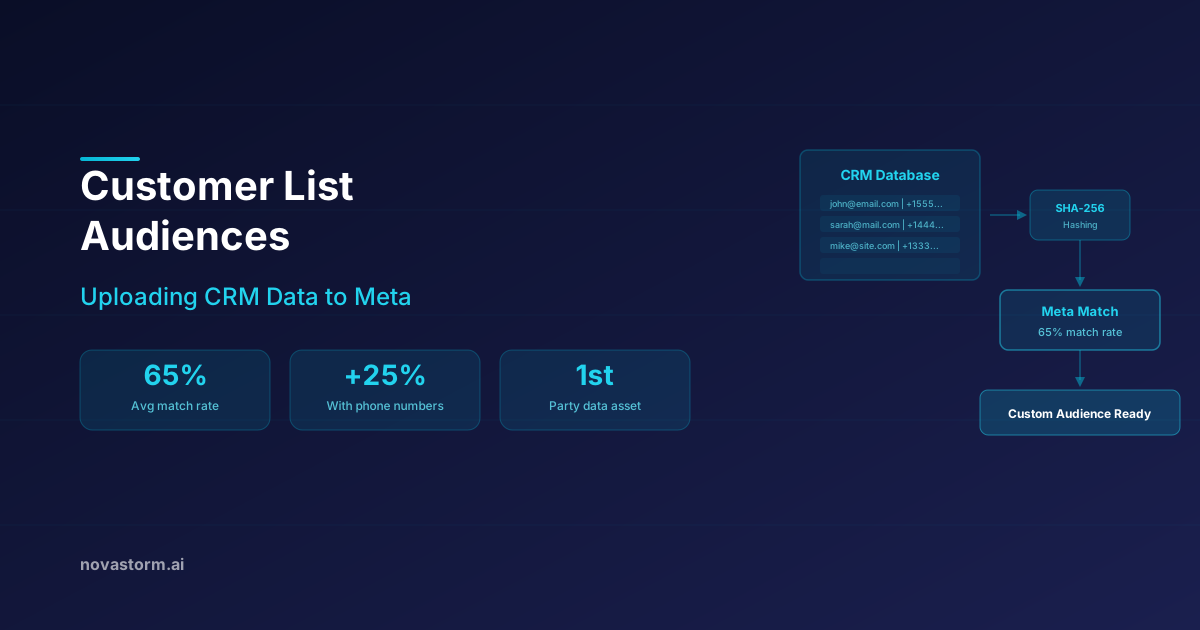
Customer List Audiences: Uploading CRM Data to Meta
Learn how to upload CRM customer lists to Meta Ads for targeting and lookalike creation. Covers formatting, match rates, hashing, and segmentation strategies.
B2B Retargeting Strategies on Meta Ads
Build B2B retargeting from verified events, honest sequencing limits and a mature form-starter test with contribution-based budget decisions.
Engagement Custom Audiences: Retargeting Social Interactions
Build engagement custom audiences on Meta Ads to retarget people who interacted with your content. Covers page, post, video, lead form, and shopping sources.
App Retargeting on Meta: Re-Engaging Dormant Users
Define exact dormancy windows, verify available audience and frequency controls, and measure mature incremental reactivation against a no-ad comparison.