

App Retargeting on Meta: Re-Engaging Dormant Users
Define exact dormancy windows, verify available audience and frequency controls, and measure mature incremental reactivation against a no-ad comparison.
App retargeting asks whether advertising adds valuable returns among eligible dormant users. Existing-user revenue and cheaper attributed actions do not automatically establish an incremental advantage over acquisition. Define inactivity and return depth from real app events, then compare with a valid no-ad control when feasible.
Exact inactivity intervals
Illustrative cohort rule: evaluate at a fixed timestamp T, with age = floor((T − last meaningful activity timestamp)/24 hours). Include only consent-eligible known users with reliable activity history. Let A(d) mean users with at least one qualifying activity strictly after T − d days and no later than T.
| Segment | Exact age rule | Equivalent activity-set logic |
|---|---|---|
| Recently lapsed | 7 ≤ age ≤ 14 | A(15) minus A(7) |
| Medium dormant | 15 ≤ age ≤ 30 | A(31) minus A(15) |
| Long dormant | 31 ≤ age ≤ 90 | A(91) minus A(31) |
| Very old dormant | age ≥ 91 | Known eligible population minus A(91), with reliable history |
Boundary example: last activity exactly seven days ago is outside A(7) and inside A(15), so it belongs in the first segment. Users with missing history are unknown, not automatically dormant. This is analytical set logic: confirm whether the platform’s actual retention/window controls implement those same boundaries before mapping it to audience settings.
Verify permitted audience and frequency controls
- Record app/event source, eligibility, available inclusion windows, exclusions and actual refresh delay. Exclude recent meaningful activity and refresh when users return.
- Distinguish audience suggestions from hard exclusions and verify match/expansion limits. A schema field does not establish account-specific precision.
- Inspect the chosen objective and buying configuration for an accepted frequency-control setting. Meta’s ad-set schema contains frequency_control_specs, but this does not promise a 2–3/week cap for every app-event configuration. If unavailable, monitor delivered frequency and use an operational budget/creative review rather than invent a cap.
- Keep app state and personal data out of generic public ad copy. A progress reminder must reflect permitted actual state or be phrased as a general suggestion; do not fabricate friend activity or urgency.
A no-ad comparison with mature two-session return
Illustrative design: randomly assign 2,000 eligible dormant users to an advertising strategy and 2,000 to a no-paid-retargeting holdout. Keep ordinary product access and other communications comparable and document contamination. Count reactivation only when two distinct meaningful sessions occur on separate visits within 14 days of assignment; wait for every assigned member to complete that window.
Stop wasting ad budget
NovaStorm AI cuts Meta Ads CPA by 30% on average. No complex setup required.
| Synthetic mature cohort | Advertising | No-ad holdout |
|---|---|---|
| Assigned users | 2,000 | 2,000 |
| Two-session reactivations | 200 | 150 |
| Reactivation rate | 10% | 7.5% |
| Assumed media spend | $600 | $0 |
| Attributed cost per advertised reactivation | $600/200 = $3 | Not applicable |
| Estimated additional reactivations at equal group size | 200 − 150 = 50 | Baseline comparator |
| Cost per estimated additional reactivation | $600/50 = $12 | Not applicable |
The difference is 2.5 percentage points. An approximate unpooled 95% rate-difference interval is about +0.75 to +4.25 percentage points under the assumed independent design. It remains a hypothetical dataset. Matching only users who already returned, or comparing their LTV with a different acquired cohort, would not estimate the assigned strategy’s effect.
Use a contribution limit instead of a fraction of CPI
Assume incremental retained contribution over the chosen period is $18 per additional two-session reactivation after variable costs and refunds. Fifty additional reactivations imply $900 contribution, leaving $300 after $600 media. The point-estimate break-even cost per additional reactivation is $18, not 40% of an unrelated cost per install. Apply uncertainty and full production/support costs before committing spend.
Revenue ROAS also needs careful scope. A hypothetical spend split of 70% at revenue ROAS 1.4 and 30% at 4.5 gives 0.7 × 1.4 + 0.3 × 4.5 = 2.33 blended revenue ROAS. This accounting calculation does not establish causality or an optimal split, and it is not profit.
Prepare a truthful return message
Hypothesis: an accurate new-feature demonstration gives eligible users a reason to revisit. Confirm actual feature availability and the destination route before preparing campaign drafts in NovaStorm. App event audiences, personal state, automated bids and holdout measurement remain separate capabilities that must be implemented and verified.
Sources: Meta ad-set SDK schema; Meta targeting schema. The interval logic and comparison above are explicit teaching designs.
Published by NovaStorm AI. Worked examples and proposed tests are labeled in the article.
Disclaimer: This article was generated with the assistance of AI and reviewed by the NovaStorm AI team. While we strive for accuracy, we recommend verifying specific data points and consulting official sources (linked where available) for critical business decisions.
Ready to automate your Meta Ads?
NovaStorm AI takes full responsibility for your campaigns — from monitoring to optimization.
Start NowMore on Custom audiences and retargeting
B2B Retargeting Strategies on Meta Ads
Build B2B retargeting from verified events, honest sequencing limits and a mature form-starter test with contribution-based budget decisions.
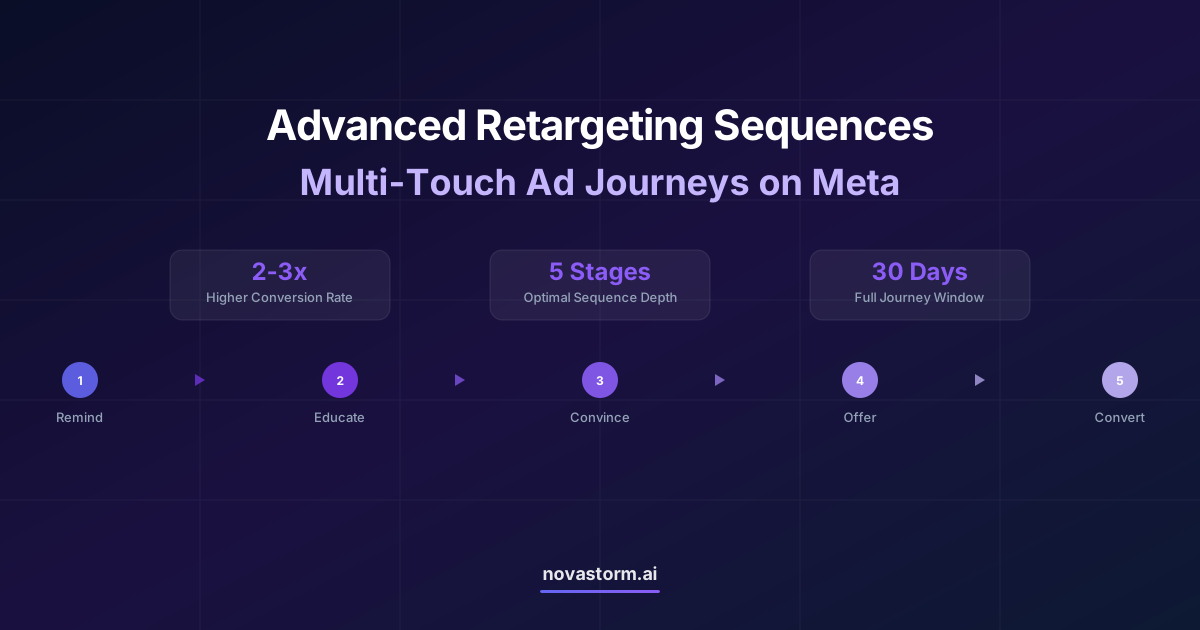
Advanced Retargeting Sequences on Meta: Multi-Touch Ad Journeys
Design recency-based retargeting without assuming prior impressions, validate events and exclusions, and compare an assigned control honestly.
Video Viewer Audiences: Building Warm Pools for Retargeting
Compare video warming with direct acquisition using unique retained customers, full funnel costs and explicit audience definitions.

Sequential Retargeting on Meta Ads: Storytelling Across Touchpoints
Create five independent story chapters, verify supported audience transitions, and test the narrative without assuming order or personal exposure data.