

Advanced Retargeting Sequences on Meta: Multi-Touch Ad Journeys
Design recency-based retargeting without assuming prior impressions, validate events and exclusions, and compare an assigned control honestly.
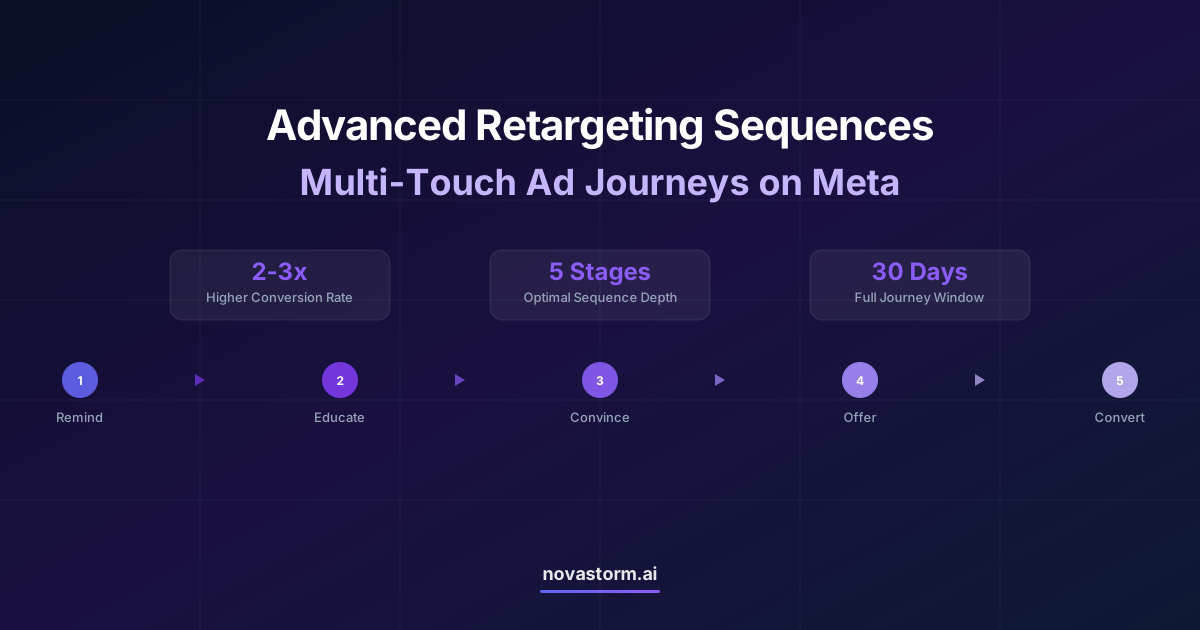
A retargeting plan can vary the message by recency or verified behavior. It does not automatically orchestrate a personal sequence of ad impressions. Someone in an older visitor window may never have seen your earlier creative; every message therefore needs to make sense independently.
Visitor age is not exposure history
Illustrative recency design, not a delivered campaign: define V3 as visitors in the last 3 days and V7 as visitors in the last 7 days, measured from the same event and rolling clock. V7 excluding V3 describes a proposed older visitor group. It does not prove that its members completed a first advertising stage. A new qualifying visit can move a person back into the recent group.
| Illustrative visitor window | Message hypothesis | What is not established |
|---|---|---|
| Last 3 days | Reminder and clear offer | Prior impression |
| Older than 3 through 7 days | Product demonstration | Reminder viewed |
| Older than 7 through 14 days | Answer a common objection | Demonstration viewed |
| Older than 14 through 21 days | Verified service/return terms | Earlier message understood |
| Older than 21 through 30 days | Alternative useful content or end this test | A personal final touch |
These windows are test choices. The CustomAudience SDK includes retention/rule and exclusion-related fields, but that schema does not establish every rule or expansion control in your account. Save the accepted inclusion/exclusion settings and check actual eligibility. Exclude confirmed purchasers from acquisition when supported and appropriate; retention has a separate purpose.
Define behavior before creating audiences
| Proposed signal | Required collection check | Limit |
|---|---|---|
| 15 or 60 seconds of engagement | Custom instrumentation with consent, foreground/active-time definition and one threshold event | Not an automatic website timer event |
| Repeat session | Stable permitted identity and explicit session boundary | Reloads or duplicate events are not additional sessions |
| Form started | First real field interaction;no sensitive contents sent | A view or attempted submission is not a qualified lead |
| Purchase | Confirmed unique paid order with consistent value/currency | A cart addition is not a purchase |
Test hidden tabs, reloads, consent denial and navigation before using an engagement threshold. A timer measures your defined site behavior, not whether an advertisement was watched. Keep personal or sensitive form contents out of advertising payloads.
Check frequency instead of promising universal caps
Stop wasting ad budget
NovaStorm AI cuts Meta Ads CPA by 30% on average. No complex setup required.
The ad-set SDK contains frequency_control_specs. Availability and allowed combinations require an accepted account configuration. Compare impressions/reach over equal windows, pool size and matured outcomes; a high average frequency plus weaker CTR is a diagnostic signal, not proof of fatigue or a specific cost penalty.
Evaluate assignment, not only completers
Hypothetical experiment: assign eligible visitors to the proposed recency-message plan or a consistent-message control before the plan runs. Keep eligibility, offer and measurement consistent. Compare all assigned participants where outcomes are observable, including those who receive no later ad. Comparing only people who complete every stage introduces self-selection.
Illustrative assumed counts: 1,000 assigned per group, 60 purchases in the plan and 50 in control. Rates are 6% and 5%; the descriptive difference is 1 percentage point. With $300 extra media, the point estimate of 10 extra purchases implies $30 per extra purchase, but uncertainty may include no lift. These numbers are not a measured outcome or proof to scale.
A click/view attribution window controls credit eligibility; it is not a complete assisted-touch history or causal experiment. Use the incrementality workflow and report allocation, uncertainty, cash cap and contribution.
Prepare a bounded draft
Build the smallest message set your audience and budget can support. Record each creative, supported audience rule, purchaser exclusion, pooled cash allowance and review date. Prepare NovaStorm campaign drafts and verify paused status before launch; sequence execution and exposure measurement require separate verified mechanisms.
Published by NovaStorm AI. Worked examples and proposed tests are labeled in the article.
Disclaimer: This article was generated with the assistance of AI and reviewed by the NovaStorm AI team. While we strive for accuracy, we recommend verifying specific data points and consulting official sources (linked where available) for critical business decisions.
Ready to automate your Meta Ads?
NovaStorm AI takes full responsibility for your campaigns — from monitoring to optimization.
Start NowMore on Custom audiences and retargeting
App Retargeting on Meta: Re-Engaging Dormant Users
Define exact dormancy windows, verify available audience and frequency controls, and measure mature incremental reactivation against a no-ad comparison.

Sequential Retargeting on Meta Ads: Storytelling Across Touchpoints
Create five independent story chapters, verify supported audience transitions, and test the narrative without assuming order or personal exposure data.
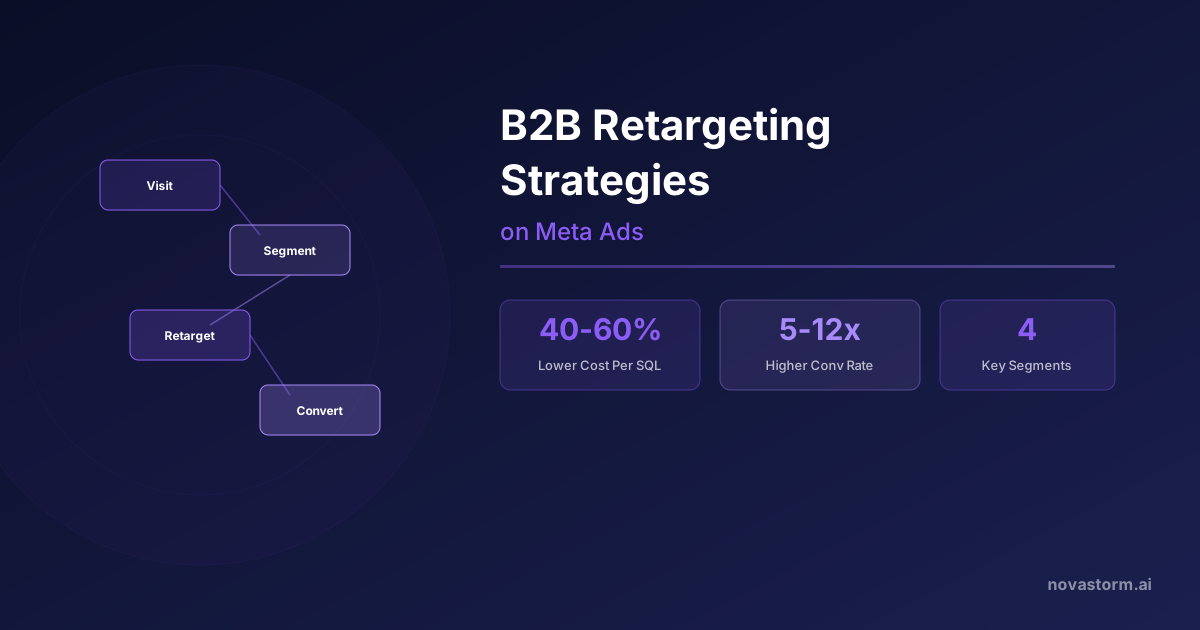
B2B Retargeting Strategies on Meta Ads
Build B2B retargeting from verified events, honest sequencing limits and a mature form-starter test with contribution-based budget decisions.

Dynamic Retargeting for Non-E-commerce Businesses on Meta
Map non-commerce offers safely, verify catalog eligibility and event semantics, and measure qualified clients without inventing value optimization.