

Automated Creative Testing Frameworks for Meta Ads at Scale
Design a Meta creative testing pipeline with sample planning, mature conversions, reviewed scaling decisions and explicit cost limits.
A creative pipeline should produce decisions you can defend: what changed, who was assigned to each version, how much was spent and when conversions matured. Automation can reduce repetitive preparation while carrying a bad decision rule across many ads. Start with an approved experiment and a review queue.
Separate discovery from a causal comparison
Several ads competing inside campaign budget optimization can receive unequal, adaptive delivery. Their raw CPA differences mix creative, exposure and selected audiences. Use that delivery as discovery evidence, not an independent randomized test. For a causal comparison, use an eligible experiment with documented assignment, concurrent conditions and a predeclared primary metric.
Calculate a sample rather than using an impression threshold
Illustrative planning assumptions: independent assigned visitors, purchase probability 2.0% versus a minimum detectable 2.4%, two-sided 5% significance and 80% power. The normal two-proportion approximation gives about 21,109 visitors per arm: n = [1.96√(2p̄(1−p̄)) + 0.8416√(p0(1−p0)+p1(1−p1))]²/(p1−p0)², where p̄ = 0.022. This is a planning approximation, not proof of a detected effect.
At an assumed $1 per eligible visitor, media alone would be about $42,218 for both arms. A $1,000 budget cannot fund this design. Reduce the number of hypotheses, accept that only larger differences can be detected, or run a bounded exploratory pilot with an inconclusive outcome permitted. Impressions are not unique assigned visitors; repeated exposure, clustering, exclusion and noncompliance require a different sample model.
The original research on Facebook incrementality experiment design discusses power and sample requirements. It does not validate a universal 1,000-impression rule or today’s account eligibility. See the significance guide for test interpretation.
A filled pipeline and decision register
Hypothetical brief: test whether a concrete setup demonstration improves retained purchases compared with a generic product visual. The offer, audience, destination and measurement stay constant. Proposed rules below are choices for this plan, not proven Meta benchmarks.
Stop wasting ad budget
NovaStorm AI cuts Meta Ads CPA by 30% on average. No complex setup required.
| Stage | Completed entry | Gate |
|---|---|---|
| Prepare | Concept DEMO-01; one changed visual; rights and price checked by creative owner | Save approved asset and unchanged baseline |
| Allocate | Two concurrent arms; sample and authorized cost signed before start | If funded sample is impossible, label exploratory |
| Observe | Purchase observation window chosen as seven days; returns assessed separately | No winner declaration from incomplete cohorts |
| Review | Fixed final analysis; primary retained-purchase metric; guardrail contribution | Do not repeat unadjusted significance tests daily |
| Graduate | Decision owner approves one bounded deployment, with rollback baseline saved | Re-check mature costs after the deployment |
| Retire | Broken destination, wrong price or exhausted authorization | Pause for operational failure without calling it evidence of creative fatigue |
Bound false decisions and budget changes
Testing many variants creates multiple opportunities for false positives. Choose one primary comparison here. If the plan expands, predeclare multiplicity adjustment or a suitable sequential method. Keep an exploration variant out of the confirmed-winner count. A high win rate can reflect strong briefs, easy comparison thresholds or analysis bias; it is not automatically a flaw.
Hypothetical pilot: A spends $500 for 20 mature retained purchases, CPA $25; B spends $500 for 25, CPA $20. At $30 contribution per purchase their media-only contributions are $100 and $250. This pilot falls far short of the planned sample and should be logged as exploratory, not a statistically confirmed winner. Production, review and tool costs also affect whether the pipeline pays back.
Use preparation automation with human approval
Prepare the reviewed concept and campaign structure in NovaStorm as a draft, compare the saved content and status with the test register, and approve publication separately. The campaign defaults to Paused; unpublished ad sets remain local drafts. Review delivery and mature conversions in available reporting tools, then authorize any scaling change. No automatic graduation or statistical testing capability is assumed.
- Track concepts proposed, eligible tests completed, confirmed wins, inconclusive tests, review errors and cost per completed decision.
- Measure staff time including rejected drafts and corrections. Separate saved preparation time from performance gains.
- Retain the assignment definition, raw export dates, conversion window and approver with each decision; do not promise monthly payback before measuring all costs.
Published by NovaStorm AI. Worked examples and proposed tests are labeled in the article.
Disclaimer: This article was generated with the assistance of AI and reviewed by the NovaStorm AI team. While we strive for accuracy, we recommend verifying specific data points and consulting official sources (linked where available) for critical business decisions.
Ready to automate your Meta Ads?
NovaStorm AI takes full responsibility for your campaigns — from monitoring to optimization.
Start NowMore on Creative and audience testing
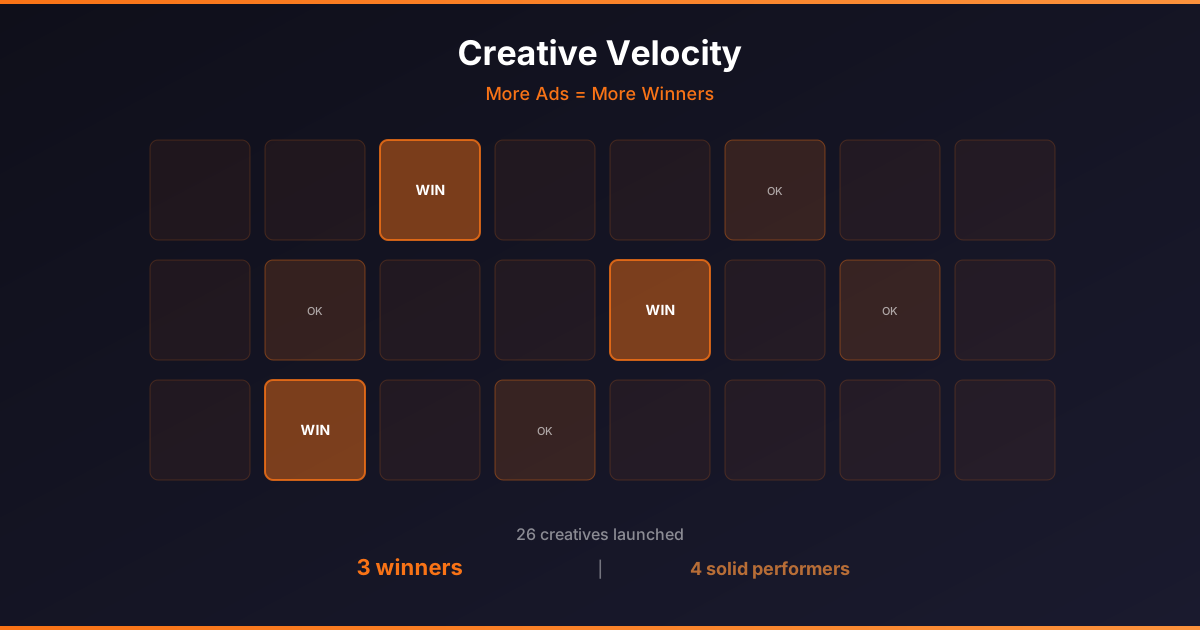
Creative Velocity for Meta Ads: Plan Production and Affordable Tests
Build a creative production journal and choose a testing batch that fits your budget, mature outcomes and review capacity.
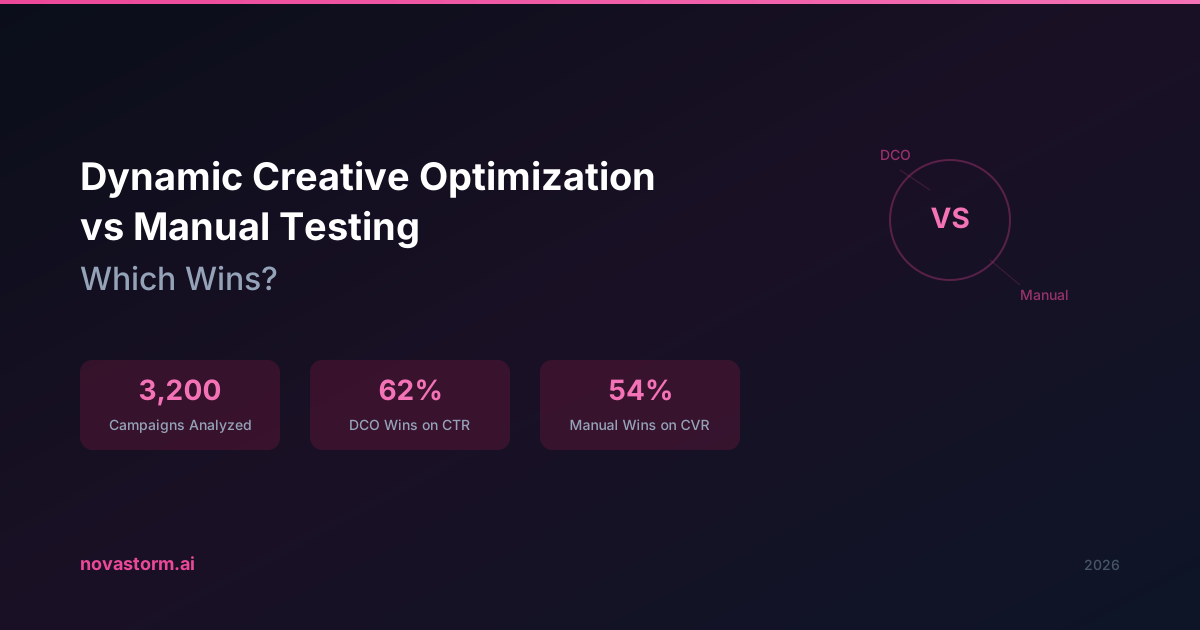
Dynamic Creative Optimization vs Manual Testing: Which Wins
Choose dynamic creative for exploration and controlled testing for causal conclusions, with correct combination counts and reviewed variants.
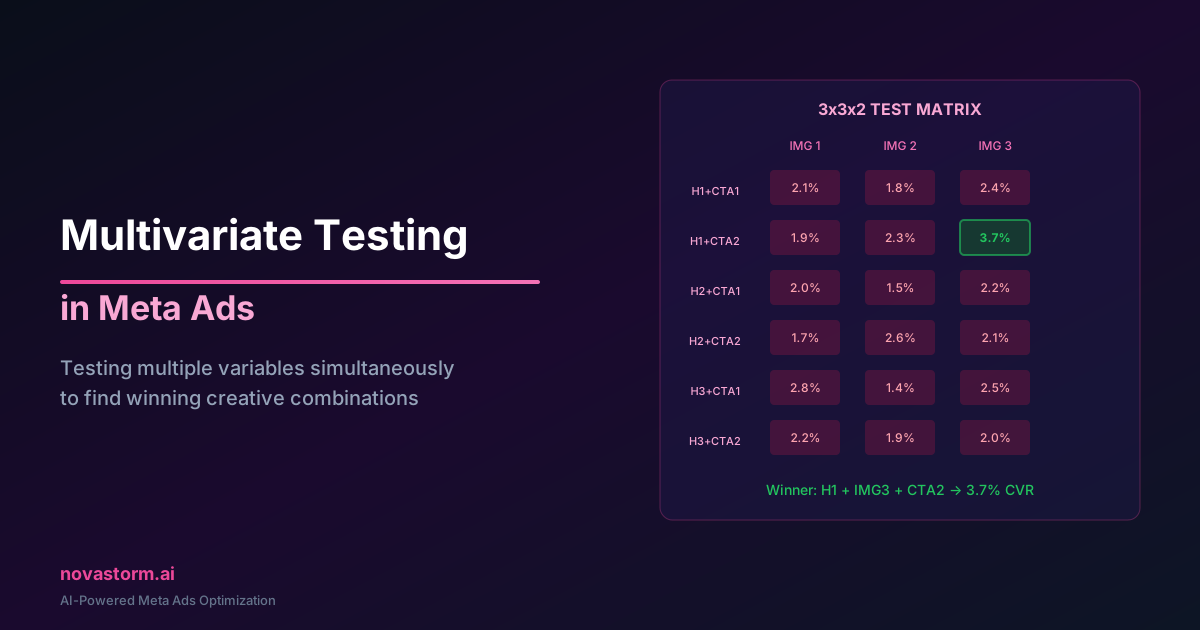
Multivariate Testing in Meta Ads: Testing Multiple Variables
Build an 18-cell creative matrix, distinguish adaptive delivery from random assignment, and plan interactions, uncertainty and an affordable comparison.
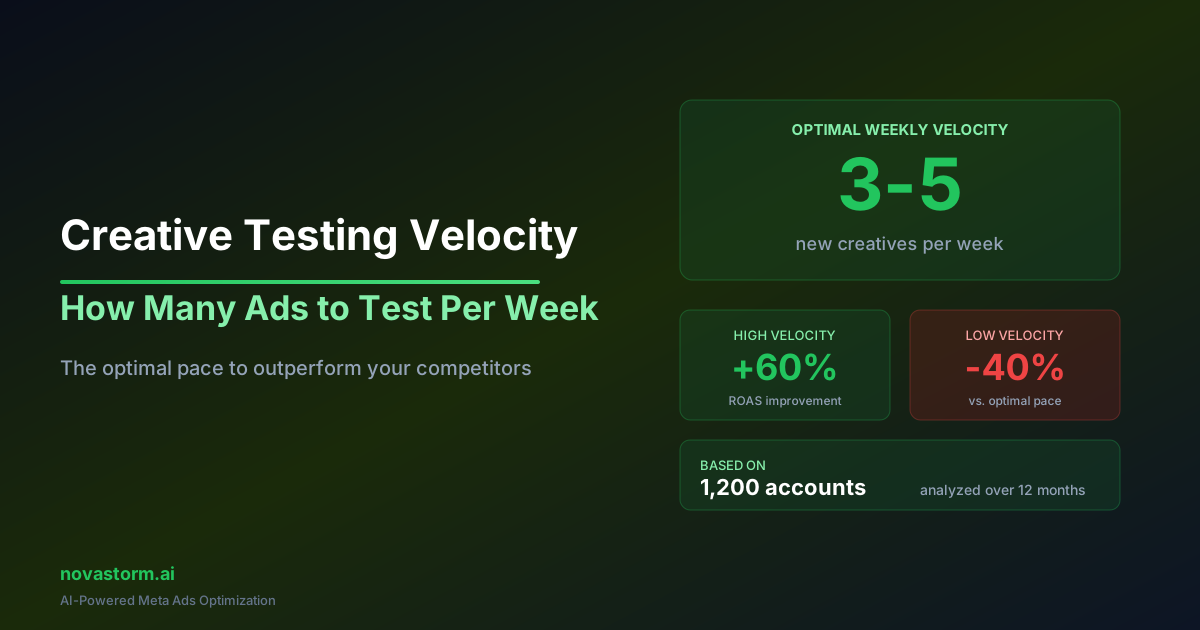
Creative Testing Velocity: How Many Ads to Test Per Week
Choose creative production pace from team hours, media budget and mature evidence; keep asset counts separate from experimental conclusions.