

Multivariate Testing in Meta Ads: Testing Multiple Variables
Build an 18-cell creative matrix, distinguish adaptive delivery from random assignment, and plan interactions, uncertainty and an affordable comparison.
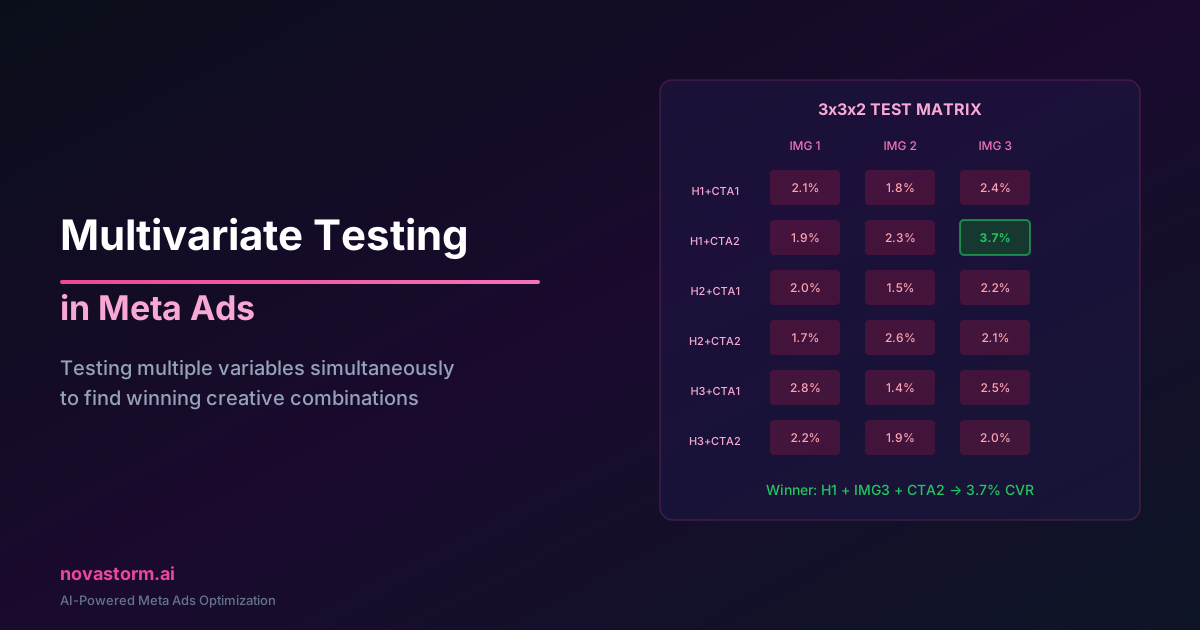
A full factorial creative test asks whether elements work differently in combination. Listing ads in one ad set does not randomly distribute equal independent exposure or control spend for each combination. Separate creative production, adaptive discovery, and a designed experiment.
Keep the 3 × 3 × 2 matrix
| Factor | Three or two proposed levels | Record |
|---|---|---|
| Headline | Problem, benefit, product explanation | H1, H2, H3 |
| Image | Product, contextual use, authorized creator demonstration | I1, I2, I3 |
| CTA | Two actual accepted options matching the destination | C1, C2 |
Combine every H with every I and C: 3 × 3 × 2 = 18 cells, labeled H1-I1-C1 through H3-I3-C2. The labels describe the design, not observed performance. CTA availability depends on configuration; Meta’s creative SDK schema includes call-to-action types, but a schema enum is not a guarantee that a particular button appears in your account. Do not presume a “See Results” button exists.
Assignment comes before analysis
- Define the eligible independent unit and all 18 treatments before launch. A valid mechanism must randomly assign eligible units to cells, retain assignment across repeat visits and prevent cross-treatment contamination.
- Use equal assignment probabilities of 1/18 only if the approved design requires balanced cells. Monitor assigned counts against that plan, not merely Meta impression totals.
- Hold offer, destination and follow-up constant. Record treatment, exposure, assigned ID and mature binary outcome; reconcile missing joins.
- If the available platform setup cannot implement that design, treat delivered combinations as exploratory associations. Reduce to a supported controlled comparison; do not rename ordinary ad delivery a factorial experiment.
Model main effects and interactions
For independent binary outcomes, a proposed analysis is a binomial logistic model: logit(P(purchase)) = intercept + H + I + C + H:I + H:C + I:C, with a three-way term only if it is specified and estimable. Define reference levels, contrasts, and analysis population in advance. Report estimated probability contrasts and intervals, not only coefficient rankings. NIST explains the full-factorial structure; the binary-outcome model and power calculation need an analyst to match them to your actual assignment design.
Illustrative four-cell slice with 1,000 independent visitors per cell: H1-I1 has 30 purchases, H2-I1 40, H1-I2 40, and H2-I2 30. The H2-minus-H1 difference changes from +1 percentage point to −1 percentage point. The difference of differences is −2 percentage points. Its approximate unpooled 95% interval is about −4.28 to +0.28 percentage points. Crossing lines suggest a pattern to examine; this noisy slice does not establish an interaction.
Stop wasting ad budget
NovaStorm AI cuts Meta Ads CPA by 30% on average. No complex setup required.
Define the primary interaction contrasts and a multiple-comparison method before reading the results. An omnibus model test and adjusted follow-up intervals serve different purposes. Report uncertainty and validate any selected combination on fresh data; searching 18 noisy cells increases selection risk.
Derive the cost instead of promising 25 purchases are enough
Illustrative inputs: baseline 2%, alternative 2.4%, two-sided α = 0.05, power 80%, equal independent groups. A single two-cell comparison needs roughly 21,200 visitors per cell using a rounded normal approximation. At assumed $0.80 per visitor, filling 18 cells to that count costs 18 × 21,200 × $0.80 = $305,280. Baseline expected purchases per cell are 424; assumed baseline CPA is $0.80 / 0.02 = $40.
That is a scale illustration for one unadjusted pairwise effect, not a powered 18-cell interaction design. Interaction effects, multiplicity, clusters, missing outcomes and unequal allocation can require a different sample. At $800/day the illustrated media alone would take about 382 days, before maturation; reduce the design if budget and stability cannot support it. Use the sample-size planning method for the chosen contrast.
Keep conclusions local
A creator demonstration winning in one eligible cohort does not show that UGC always wins. Record the observed context, rights, delivery conditions and interval. In NovaStorm, prepare selected creative messages as campaign drafts for review; full factorial assignment and analysis are not established product capabilities.
Published by NovaStorm AI. Worked examples and proposed tests are labeled in the article.
Disclaimer: This article was generated with the assistance of AI and reviewed by the NovaStorm AI team. While we strive for accuracy, we recommend verifying specific data points and consulting official sources (linked where available) for critical business decisions.
Ready to automate your Meta Ads?
NovaStorm AI takes full responsibility for your campaigns — from monitoring to optimization.
Start NowMore on Creative and audience testing
Dynamic Creative Optimization vs Manual Testing: Which Wins
Choose dynamic creative for exploration and controlled testing for causal conclusions, with correct combination counts and reviewed variants.
Statistical Significance in Ad Testing: When Results Are Real
Calculate independent binary-test samples, distinguish significance from contribution, and decide whether budget and outcome delays support a test.
Automated Creative Testing Frameworks for Meta Ads at Scale
Design a Meta creative testing pipeline with sample planning, mature conversions, reviewed scaling decisions and explicit cost limits.
Creative Testing Velocity: How Many Ads to Test Per Week
Choose creative production pace from team hours, media budget and mature evidence; keep asset counts separate from experimental conclusions.