

When to Increase Meta Ads Budget: Signals That Say Scale Now
Check four scaling gates, stress-test contribution, and approve a capped increase with capacity, cash timing and mature stop conditions.
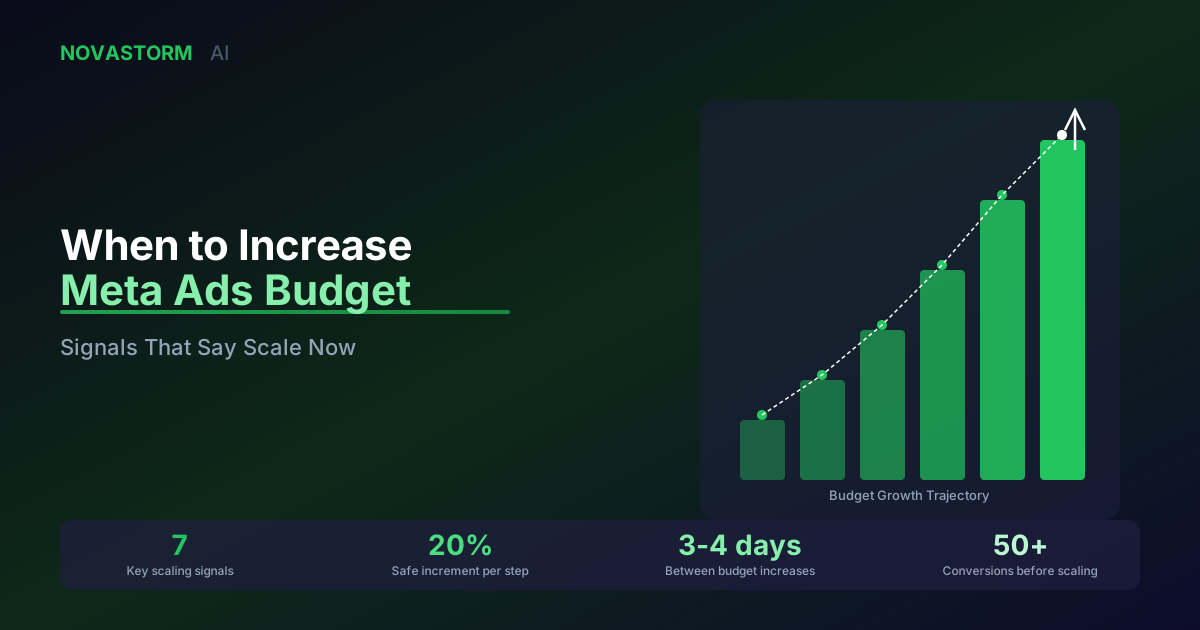
The readiness question is: what evidence and operating capacity must exist before committing more cash? This checklist precedes the budget-increase example; it does not repeat a universal scaling rule.
Four gates before the increase
| Gate | Evidence to inspect | Reason to wait |
|---|---|---|
| Economics | Paid orders, variable costs, refunds and allowable CPA | Revenue looks good but contribution is unknown |
| Measurement | Unique outcomes, mature delay window and consistent attribution | Duplicates or missing orders explain the apparent gain |
| Capacity | Inventory, delivery and lead-response capacity | More orders would worsen costs or service |
| Cash | Affordable spending allowance and payment timing | Expected contribution cannot cover near-term outflows |
A fictional shop check
Suppose 28 mature paid orders cost $700 in ads. CPA is $25, each order contributes $40 before advertising and the chosen ceiling is $30. Contribution after ads is 28 × $40 − $700 = $420 before fixed costs. That supports considering a capped increase; it does not guarantee the next orders cost $25.
If fulfillment can handle only ten additional orders this week, the plan must respect that capacity. If payout timing delays cash receipts, the spending allowance must also reflect the cash gap. A profitable report does not create available cash automatically.
Check quality as well as quantity
- For a service, follow raw leads through qualification and closed-client contribution.
- For a shop, examine refunds, new-customer mix and order-level costs.
- Separate temporary discounts or promotional demand from an ongoing baseline.
- Reconcile actual spend and paid outcomes over equivalent mature windows.
- Mark small-sample results as uncertain instead of asserting stability from one good day.
Write the decision before editing
Record the new allowance, review date, conversion-delay allowance and stop condition. Technical defects and spending caps can require immediate intervention. Business performance should be assessed against the agreed mature evidence window. Choose the scaling route through the vertical versus horizontal decision guide.
Stop wasting ad budget
NovaStorm AI cuts Meta Ads CPA by 30% on average. No complex setup required.
Sensitivity of the $420 contribution
Further illustrative costs: if unexpected return losses reduce per-order contribution by $8, the 28-order pre-media contribution becomes 28×$32=$896 and post-media contribution $196. Allocating $200 fixed costs to that period leaves −$4. At an extra $15 loss per order, contribution becomes 28×$25−$700=$0 before overhead. Do not count the same return provision twice.
A filled increase plan with a capacity ceiling
| Decision field | Illustrative plan |
|---|---|
| Original mature cohort | 28 orders;$700 media;CPA $25;contribution $40/order |
| Next cohort / measurement | 2026-10-05 to 2026-10-11;assumed 7-day conversion delay;UTC |
| Capacity ceiling | At most 10 additional orders;reduce delivery if capacity is filled |
| Extra media allowance | $250 modeled from 10×$25;not a prediction of actual CPA |
| Total next-week ceiling | Existing authorized $700 plus extra $250=$950 |
| Payment timing | Assume receipts unavailable until 2026-10-19;reserve cash before launch |
| Mature review | 2026-10-19;reconcile orders and return reserve |
| Stop / hold | Immediate tracking/destination defect or cash cap;hold further increases if mature CPA>$30 |
An ad-spend cap cannot guarantee at most ten purchases. Monitor orders and capacity directly and stop accepting or promoting an unavailable offer. The modeled ten-order increase yields 10×$40−$250=$150 contribution before overhead; if it produces only six orders, CPA is $41.67 and contribution −$10. Review the mature cohort rather than promising the baseline CPA will persist.
Check saved settings with the budget owner
Proposed NovaStorm preparation checklist: record the authorized old and new budget, currency, budgeting level, dates and cumulative allowance; read back the saved draft and confirm PAUSED before any launch decision. Record the approver and review date in your own change log. The extra $250 is an envelope, not necessarily a supported field in every interface.
Synthetic analytics rows and saved draft settings establish no commercial readiness. Require actual matured paid outcomes, contribution, capacity and cash for all four gates. Platform learning status describes delivery behavior; it does not replace those gates.
Published by NovaStorm AI. Worked examples and proposed tests are labeled in the article.
Disclaimer: This article was generated with the assistance of AI and reviewed by the NovaStorm AI team. While we strive for accuracy, we recommend verifying specific data points and consulting official sources (linked where available) for critical business decisions.
Ready to automate your Meta Ads?
NovaStorm AI takes full responsibility for your campaigns — from monitoring to optimization.
Start NowMore on Scaling and bidding

New Meta Ad Account: Readiness and Bounded Scaling
Launch a new Meta account with verified payment and event readiness, then authorize spending from mature marginal economics and an affordable cash limit.
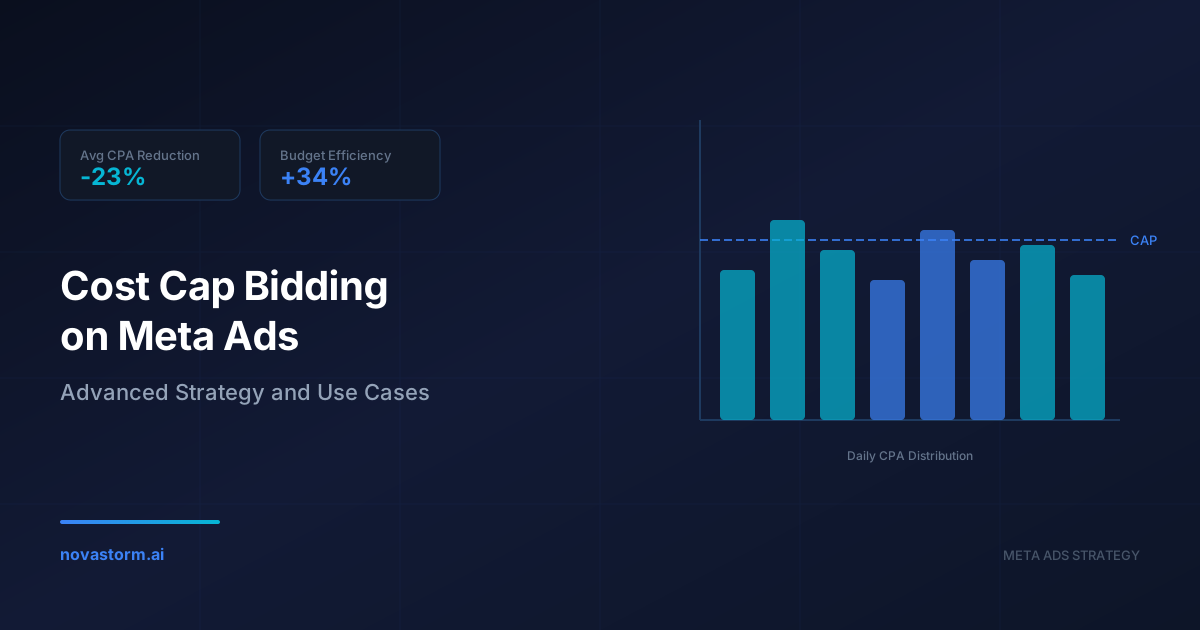
Cost Cap Bidding on Meta Ads: Advanced Strategy and Use Cases
Evaluate cost cap against mature outcomes and contribution, diagnose underspend, and approve changes with an explicit financial limit.
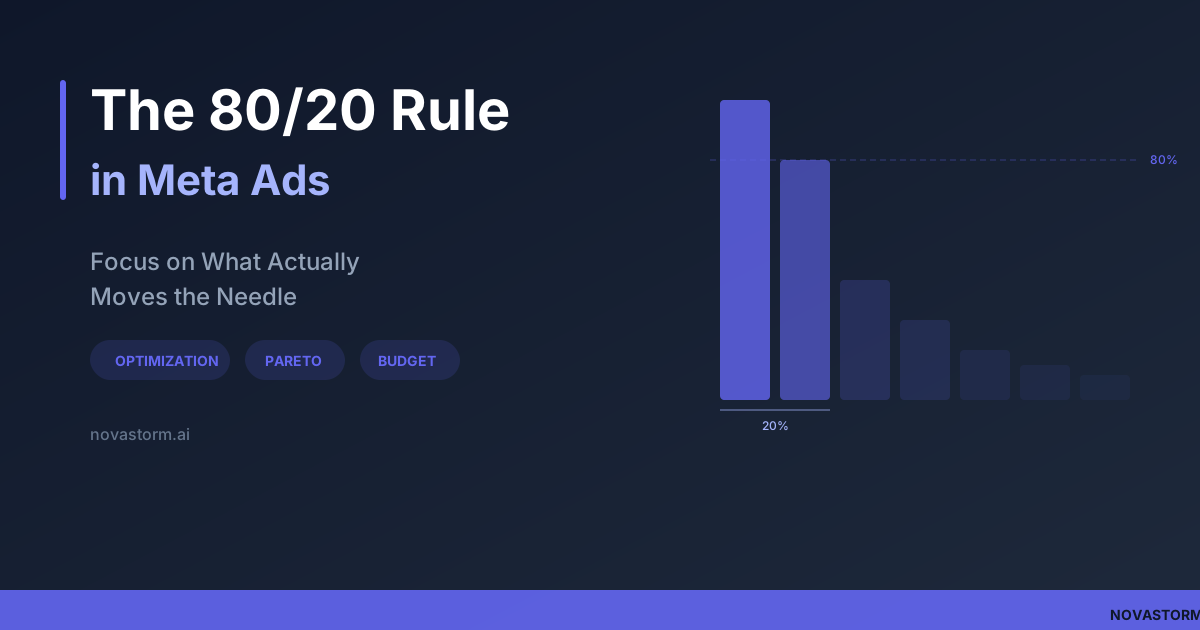
The 80/20 Idea in Meta Ads: Measure Concentration and Set Priorities
Use the 80/20 idea as a concentration hypothesis, rank mature contribution and work effort, and apply cash-risk limits without automatic CPA-multiple pauses.
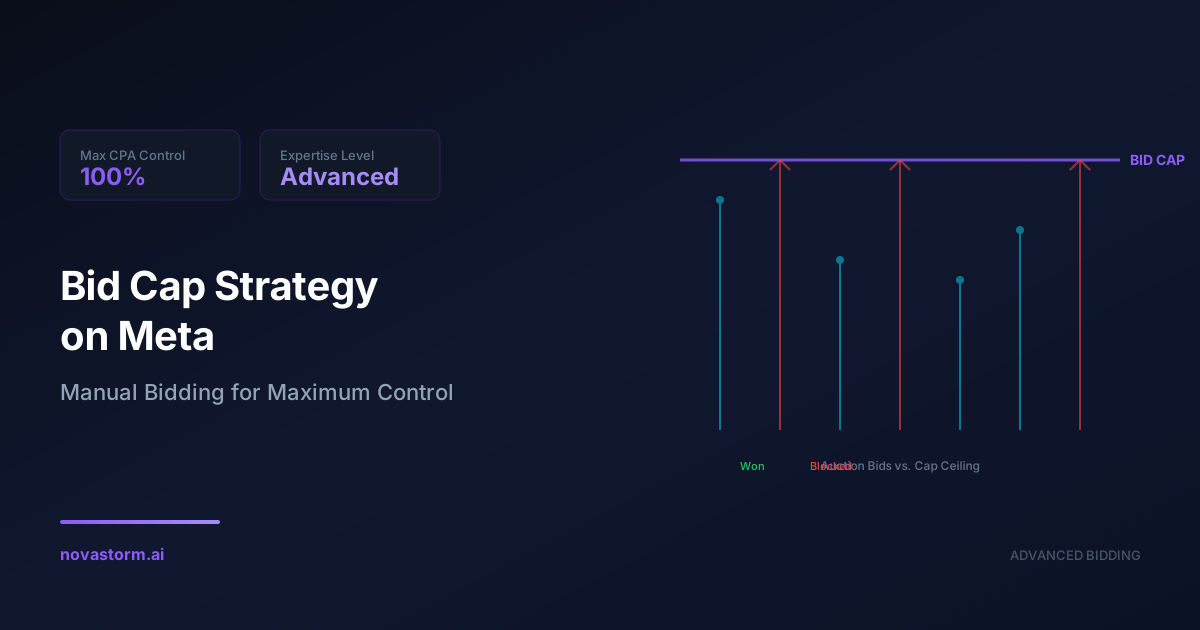
Bid Cap Strategy on Meta: Manual Bidding for Maximum Control
Use bid cap with correct units, a defensible comparison and a separate financial stop; avoid confusing auction bids with customer acquisition cost.