

Bid Cap Strategy on Meta: Manual Bidding for Maximum Control
Use bid cap with correct units, a defensible comparison and a separate financial stop; avoid confusing auction bids with customer acquisition cost.
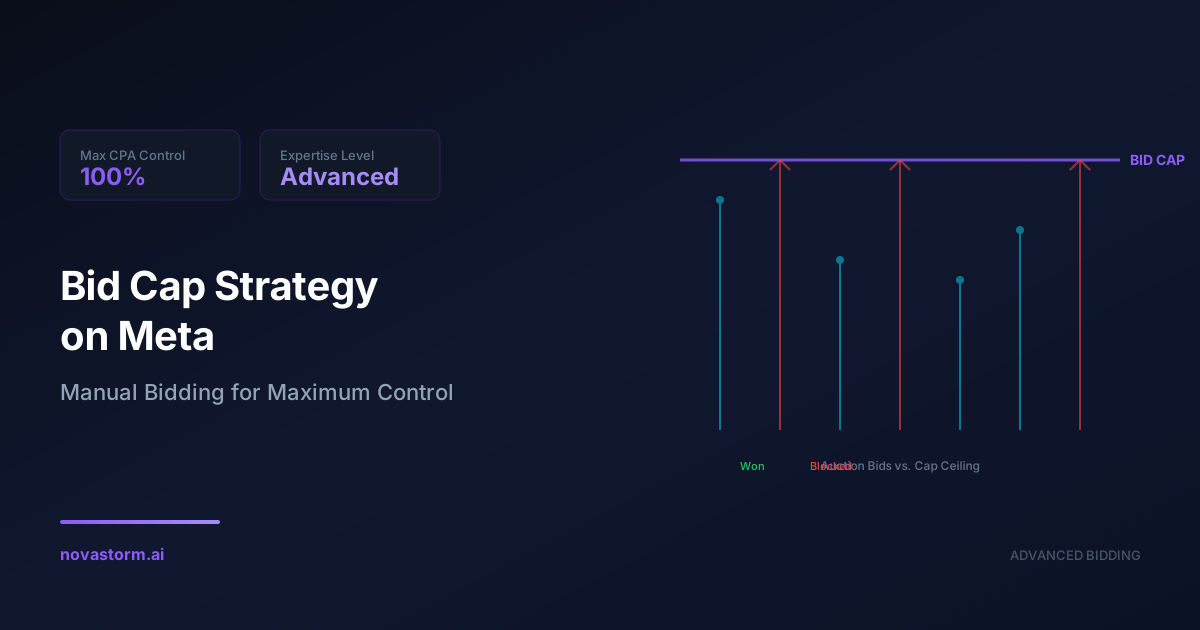
Bid cap constrains the bid entered into the auction. It does not cap the total cost of acquiring an actual customer. An ad can spend on impressions or clicks that never convert, so realized CPA can exceed the bid amount or be undefined when no purchases occur.
Keep the unit of every calculation visible
The ad set SDK includes LOWEST_COST_WITH_BID_CAP and bid-related fields. Verify the available setup, currency units and current field documentation before entering a value. A median historical CPA is a descriptive metric, not a direct conversion into a valid bid setting.
Hypothetical economic calculation: maximum affordable purchase CPA is USD 40 and click-to-purchase conversion is assumed to be 5%. USD 40 per purchase × 0.05 purchases per click = USD 2 per click. This is an affordable CPC equivalent under the assumption; it is not a Meta bid-cap formula. At 2% conversion, the equivalent is USD 0.80 per click. A conversion-probability estimate and an auction bid are not interchangeable units.
A bid ladder is a test design, not three competing duplicates
Suppose a verified account setup uses an initial bid amount B. Candidate amounts 0.8B, B and 1.2B form a hypothetical ladder. These percentages are chosen experimental contrasts, not platform recommendations. Launching identical overlapping ad sets simultaneously does not guarantee random assignment or a clean comparison.
- Define the hypothesis: a particular bid amount improves completed contribution at an acceptable delivery level.
- If an available experiment supports disjoint randomized assignment, record its assignment method, population and equal comparison conditions. Otherwise label sequential observations as potentially confounded by time and auction changes.
- Keep offer, optimized result, creative and comparison currency consistent. Choose sample and maturity requirements from the outcome, not from a fixed five-day rule.
- Set a spend ceiling and maximum tolerable loss before delivery. Preserve baseline and obtain approval for one changed amount.
- Compare spend, completed purchases and contribution for the full assigned population. Report limited delivery rather than interpreting a low-spend cell as a guaranteed bargain.
Stop wasting ad budget
NovaStorm AI cuts Meta Ads CPA by 30% on average. No complex setup required.
Calculate the financial stop separately
Hypothetical example: USD 200 media spend yields four completed purchases. CPA is USD 50. With assumed contribution of USD 35 per purchase and USD 20 creative cost, net contribution is 4 × USD 35 − USD 200 − USD 20 = −USD 80. The bid limit may have been respected while this campaign lost money. A pilot loss allowance of USD 80 would call for a pause and reconciliation at this point; it is a chosen governance limit, not a Meta requirement.
| Delivery symptom | First checks | Permitted next step |
|---|---|---|
| Zero spend | Status, review, schedule, billing and valid bid configuration | Correct the verified cause; do not assume the bid is always too low |
| Partial spend | Audience availability, creative and delivery diagnostics | Review one proposed bid change against economics |
| Full spend, poor contribution | Mature sales, costs, refunds and quality | Pause or revise the offer before increasing exposure |
| Changing daily results | Small counts and delayed conversions | Wait for planned reconciliation unless loss limit is reached |
Neither horizontal duplication nor a fixed 15% daily budget increase is a proven universal advantage. Additional segments can overlap, fragment signals and create more operational work. Treat any proposed scaling pattern as a hypothesis and evaluate its incremental economics.
Use the signal to request a decision
Prepare the delivery snapshot, proposed bid amount and financial stop in the NovaStorm campaign brief, then ask the responsible reviewer to approve the change. The paused draft workflow supports preparation; it does not demonstrate implemented alerts, an automatic bid ladder or guaranteed CPA enforcement. Use the cost cap comparison when choosing between an average cost goal and a bid constraint.
Published by NovaStorm AI. Worked examples and test fixtures in this article are illustrative, not observed customer results.
Disclaimer: This article was generated with the assistance of AI and reviewed by the NovaStorm AI team. While we strive for accuracy, we recommend verifying specific data points and consulting official sources (linked where available) for critical business decisions.
Ready to automate your Meta Ads?
NovaStorm AI takes full responsibility for your campaigns — from monitoring to optimization.
Start NowMore on Scaling and bidding
Cost Cap Bidding on Meta Ads: Advanced Strategy and Use Cases
Evaluate cost cap against mature outcomes and contribution, diagnose underspend, and approve changes with an explicit financial limit.
Minimum ROAS Bidding on Meta Ads: Value-Based Optimization
Evaluate minimum ROAS using truthful purchase values, returns, contribution and controlled comparisons rather than revenue-only profit claims.
When to Increase Meta Ads Budget: Signals That Say Scale Now
Check four scaling gates, stress-test contribution, and approve a capped increase with capacity, cash timing and mature stop conditions.

New Meta Ad Account: Readiness and Bounded Scaling
Launch a new Meta account with verified payment and event readiness, then authorize spending from mature marginal economics and an affordable cash limit.