

The 80/20 Idea in Meta Ads: Measure Concentration and Set Priorities
Use the 80/20 idea as a concentration hypothesis, rank mature contribution and work effort, and apply cash-risk limits without automatic CPA-multiple pauses.
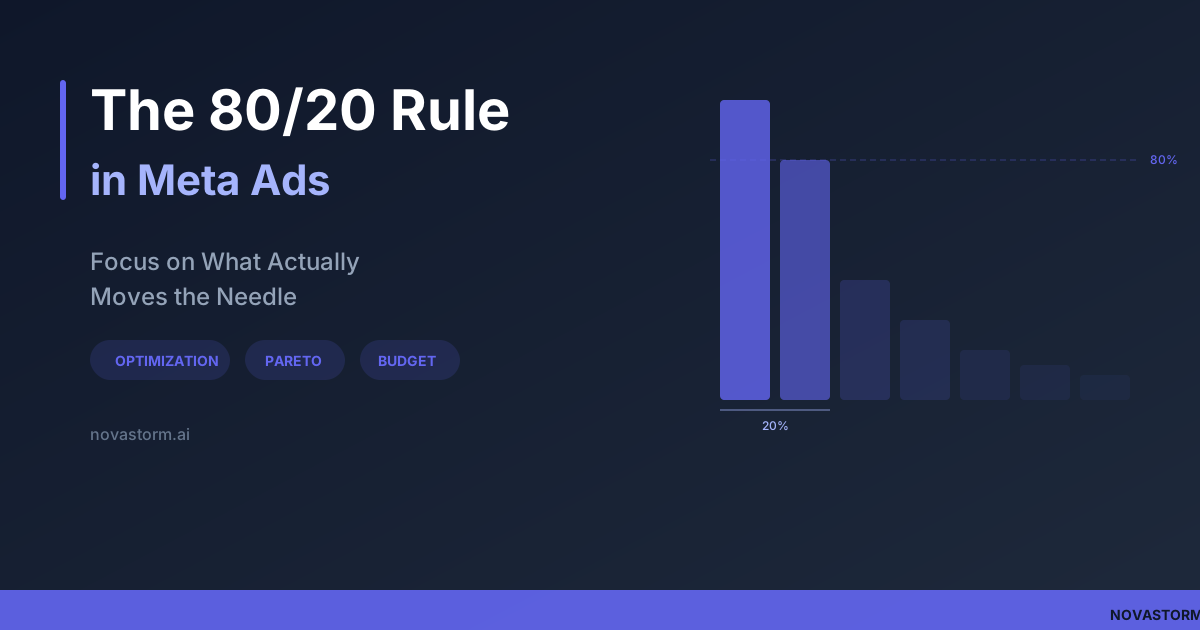
The 80/20 idea is a prioritization hypothesis: a minority of items may account for a large share of results or work. Measure the actual concentration in your account. It is not a universal law of Meta delivery, and low delivery does not prove a creative is weak.
Rank a mature export with clear denominators
- Choose the review scope, currency, attribution rule, conversion/refund cutoff and contribution definition. Reconcile unique paid outcomes rather than summing duplicate platform events.
- Keep spend, retained orders and contribution before media for each item. Rank contribution after media separately from purchase count and revenue ROAS.
- Mark limited-delivery items as insufficiently tested. Do not give a reliable-performance rank to a nearly unexposed variant.
- Separate products or markets with materially different cost definitions. If the export is partial, label that coverage before calculating shares.
Illustrative export, not customer data: assume $45 contribution before media per retained order and the same mature review scope for five creatives. Costs outside that definition are excluded here.
| Teaching creative | Media spend | Retained orders | Contribution after media | Decision status |
|---|---|---|---|---|
| A | $400 | 15 | 15 × $45 − $400 = $275 | Positive mature contribution |
| B | $300 | 10 | 10 × $45 − $300 = $150 | Positive mature contribution |
| C | $200 | 6 | 6 × $45 − $200 = $70 | Positive mature contribution |
| D | $100 | 2 | 2 × $45 − $100 = −$10 | Review economics and uncertainty |
| E | $20 | 0 | 0 × $45 − $20 = −$20 | Limited delivery; no strong efficacy conclusion |
The positive-contribution pool is $275 + $150 + $70 = $495. A is one of five creatives, or 20% by count, and accounts for $275 / $495 ≈ 55.6% of positive contribution, not 80%. The net total including D and E is $465; do not silently swap that denominator into the concentration statistic. This worked example shows how to test the 80/20 claim rather than assume it.
CPA multiples do not replace profit and maturity
Hypothetical counterexample: a $30 target CPA and $150 spend equal five target CPAs. If ten mature retained orders each contribute $40 before media, contribution after media is 10 × $40 − $150 = $250. Automatically pausing because spend reached five target CPAs would ignore the positive economics.
With the same $150 spend but only two mature retained orders, the calculation is $80 − $150 = −$70. A chosen $80 total-loss allowance leaves $10 of loss capacity, not an instruction to keep spending. The owner may stop because the next spend lacks a reasonable commercial case. If results are pending, report that uncertainty; do not count possible purchases as cash or wait beyond the agreed allowance merely to obtain more data.
Use the pause decision tree to separate a known broken path, immature conversions and an economically weak mature cohort. Declare actual spend checks and stop ownership; an operator’s loss allowance is not a Meta requirement.
Stop wasting ad budget
NovaStorm AI cuts Meta Ads CPA by 30% on average. No complex setup required.
Prioritize work with expected value and time cost
Keep a work log that separates a measured defect from an optimization hypothesis. Estimate effort in your own team, record confidence and review whether the action actually improved the declared outcome. There are no assumed successive CPA improvements of 40%, 15% and 2%.
| Priority candidate | Evidence and effort to record | Acceptance or evaluation |
|---|---|---|
| Repair duplicate orders in reporting | Reproduced identity issue; engineer/reviewer time | One logical order reconciles once under the tested path |
| Repair a mobile checkout failure | Reproduction steps; actual fix and QA effort | Valid order reaches payment/confirmation on affected device |
| Review creative A’s next spending increase | Mature positive contribution but unknown marginal response; analysis effort | Separate approved increment within a cash allowance |
| Explore limited-delivery creative E | Small exposure; cost of a fair comparison | Treat as a hypothesis, not an established loser |
| Simplify repetitive report formatting | Time log and error frequency | Retain correct scope and units while reducing measured manual work |
Hypothetical time-planning example: a two-hour investigation and a 30-minute formatting task cannot be ranked by duration alone. A reproducible payment failure may warrant the longer work. Estimate the affected business exposure, confidence and actual repair criterion before assigning priority; do not invent sales recovered by the repair.
Avoid fragmentation when reallocating attention
A leading item does not automatically need a new dedicated ad set. Creating groups for every audience/placement winner changes delivery and splits evidence. First record what operational question requires separation. Keep the existing structure where it serves the objective, and evaluate any spend increase with the marginal-return worksheet rather than extending average performance indefinitely.
Review priorities in NovaStorm
Bring the reconciled export, maturity labels and work-priority log into your NovaStorm review. Confirm the actual available reporting fields against the source. Prepare an approved creative proposal as paused campaign and local ad-set drafts, and keep any spending change with the responsible user’s decision. This workflow does not claim automatic loss-limit enforcement, budget reallocation or performance gains from the 80/20 rule.
Published by NovaStorm AI. Planning examples are illustrative assumptions, not measured customer results.
Disclaimer: This article was generated with the assistance of AI and reviewed by the NovaStorm AI team. While we strive for accuracy, we recommend verifying specific data points and consulting official sources (linked where available) for critical business decisions.
Ready to automate your Meta Ads?
NovaStorm AI takes full responsibility for your campaigns — from monitoring to optimization.
Start NowMore on Scaling and bidding
Dayparting in Meta Ads: Does Time-of-Day Targeting Still Work
Verify schedule availability and time-zone behavior, align ads with real contact handling, and test mature outcomes within a spending allowance.

New Meta Ad Account: Readiness and Bounded Scaling
Launch a new Meta account with verified payment and event readiness, then authorize spending from mature marginal economics and an affordable cash limit.
Scaling Meta Ads Without Killing Performance: The Step-by-Step Guide
Review a bounded Meta budget increase with actual spending, refunds, delayed orders, marginal cost and user-approved campaign fields.
When to Increase Meta Ads Budget: Signals That Say Scale Now
Check four scaling gates, stress-test contribution, and approve a capped increase with capacity, cash timing and mature stop conditions.