

Q1 Meta Ads Planning: Setting Up the Year for Success
Master Q1 Meta Ads planning with proven frameworks for budget allocation, audience strategy, and campaign structure that set the foundation for year-long success.
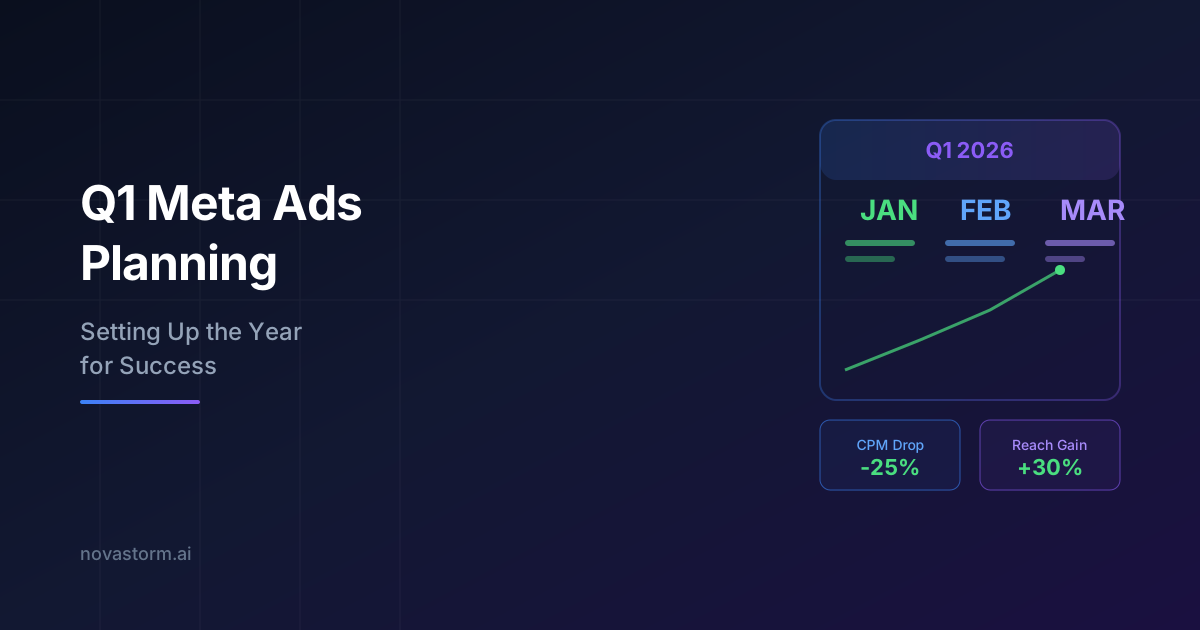
Q1 planning should allocate a finite budget to business outcomes, tests and a reserve. January is not automatically a cheaper auction or a better time to acquire customers. Use your own market, product availability and mature contribution data to decide what the quarter can afford.
A filled quarterly brief
Hypothetical brief for Q1 2027, prepared in October 2026 for a fictional annual-plan service. Owner: marketing lead; approver: finance owner. Objective: acquire customers whose collected contribution covers media and production costs. Geography: one authorized market; currency: USD. Offer: annual subscription with clearly disclosed upfront charge. This is a completed teaching brief, not a real company plan or forecast.
| Budget bucket | Share | USD from 12,000 ceiling | Boundary |
|---|---|---|---|
| Core acquisition | 40% | 4,800 | Existing approved offer; mature contribution check |
| Retargeting | 25% | 3,000 | Eligible recent interest with permission |
| Retention | 15% | 1,800 | Relevant current customers, not all historical buyers |
| Experiments | 10% | 1,200 | Separate test identities and preselected loss limit |
| Unreleased reserve | 10% | 1,200 | Requires explicit new approval |
| Total | 100% | 12,000 | No double-counting tests inside core budget |
These are chosen allocations, not recommended universal percentages. USD 10,800 is initially allocated and USD 1,200 remains unreleased. If a test later moves into core acquisition, transfer its allocation explicitly rather than keeping it in both rows. Forecast cash collection separately from reported conversion value.
Gate the transition from test to growth
Hypothetical mature test: media USD 400, production USD 80, 20 accepted customers and USD 30 contribution per customer after variable costs and refunds. Contribution is 20 × 30 = USD 600; net result is 600 − 400 − 80 = USD 120. Media-only cost per acquired customer is 400 / 20 = USD 20; including production, acquisition cost is (400 + 80) / 20 = USD 24. The positive contribution is the relevant economic check.
Chosen pilot rule: maximum affordable loss USD 100, no extension while unresolved returns could reverse the result, and only USD 200 additional exposure allowed after owner approval. These limits are assumptions selected for this fictional business. A positive result does not establish a causal effect or guarantee the next USD 200 remains profitable. A pending cohort cannot be compared directly with the mature test.
Stop wasting ad budget
NovaStorm AI cuts Meta Ads CPA by 30% on average. No complex setup required.
Check seasonality and audience freshness
| Question | Evidence to collect | Decision boundary |
|---|---|---|
| Are January auction costs lower here? | Comparable country, objective, placements, offer and mature outcome periods | No universal CPM, CPA or reach improvement is assumed |
| Is a January visitor still interested in March? | Offer expiry, recent behavior, permission and suppression rules | Expire or refresh the segment when its intent no longer fits |
| Does high frequency indicate fatigue? | Comparable exposure window, response trend and contribution | Eight impressions is not a universal stop rule |
| Can the planned targeting signal be used? | Current account control, accepted configuration and effective settings | Schema fields alone do not prove current UI eligibility |
The Meta SDK targeting schema includes interest, life-event and keyword-related fields, but their presence is not evidence that every account can target people currently searching for a solution. This brief therefore makes no search-history targeting assumption. Use permitted first-party intent where justified and verify actual configuration; do not infer private needs or permission from a label.
A phased calendar with gates
| Period | Deliverable | Gate before advancing |
|---|---|---|
| January, weeks 1–2 | Reconcile prior-year outcomes, offer terms, event and payment definitions | Accepted test result and version-bound approval |
| January, weeks 3–4 | Prepare and approve limited acquisition drafts | Currency, destination and affordable exposure confirmed |
| February, weeks 5–8 | Run bounded creative or audience hypotheses | Mature contribution, refund treatment and remaining budget reconciled |
| March, weeks 9–13 | Review qualified evidence and prepare Q2 brief | No automatic scale-up from early CTR or nominal ROAS |
Retain available attribution settings explicitly rather than assuming any sales-cycle duration can become a Meta attribution window. Reconcile accepted business results with event reporting; a tracking fix can change reporting without creating additional sales.
NovaStorm’s natural role is preparing campaign drafts from the approved quarterly offer and creative brief. An operator and finance owner approve exposure before launch; this plan does not promise automatic product monitoring or budget transfers. Use the quarterly review worksheet to record which hypotheses deserve another allocation.
Published by NovaStorm AI. Worked examples and test fixtures in this article are illustrative, not observed customer results.
Disclaimer: This article was generated with the assistance of AI and reviewed by the NovaStorm AI team. While we strive for accuracy, we recommend verifying specific data points and consulting official sources (linked where available) for critical business decisions.
Ready to automate your Meta Ads?
NovaStorm AI takes full responsibility for your campaigns — from monitoring to optimization.
Start NowMore on Seasonal and launch campaigns
Easter and Spring Campaign Strategies for Meta Ads
Coordinate Easter and seasonal Meta campaigns using market-specific calendars, transparent budget envelopes and mature product contribution.
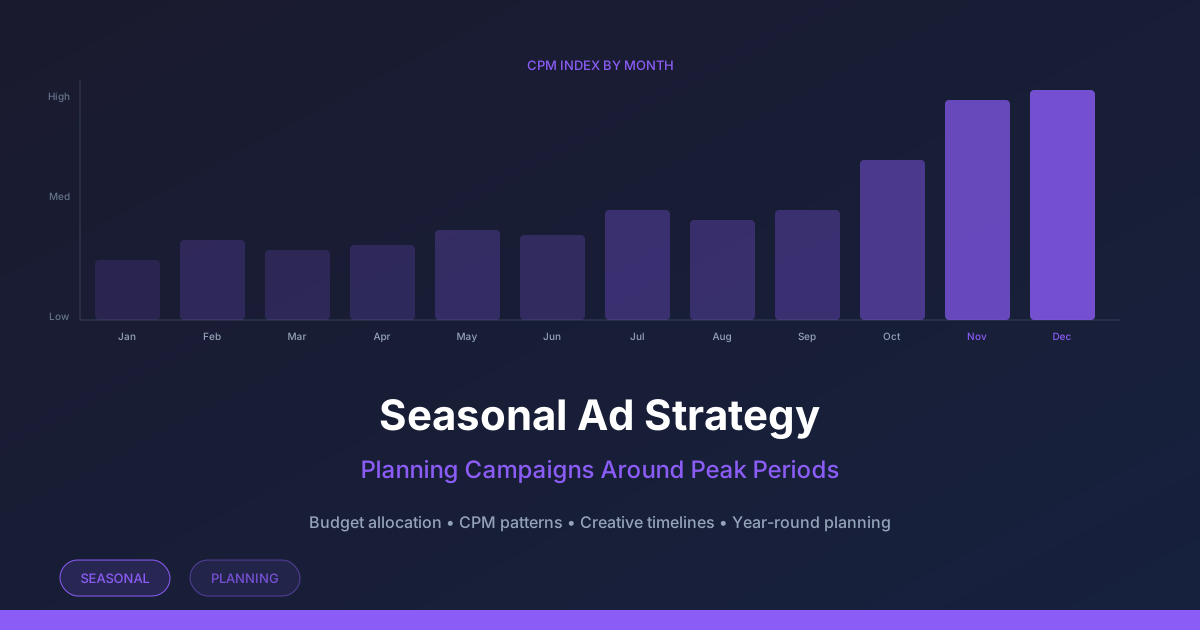
Seasonal Ad Strategy: Planning Campaigns Around Peak Periods
Build a local seasonal campaign calendar from inventory, contribution, cash and delivery deadlines, then approve a bounded creative brief.

Mother's Day and Father's Day Ads on Meta: Gift Campaign Guide
Plan parent-holiday gift ads with local dates, personalization cutoffs, permitted family footage and a reconciled approved budget.
New Year Resolution Ads on Meta: January Campaign Playbook
Plan January Meta ads around truthful product actions, transparent trials and mature contribution rather than assumed resolution behavior.