

Product-Led Growth and Meta Ads: Self-Service Signup Campaigns
Measure self-service campaigns from signup to useful action, retained use and settled payment. Includes illustrative cohort economics and attribution limits.
A self-service signup is a step toward value, not a paid customer. Design the ad around a real task the product can perform, then measure registration, a useful action, retention and payment as different outcomes. A lower signup CPA does not prove a cheaper customer than a sales-assisted funnel.
Define the useful action and its evidence
Hypothetical product: a scheduling tool. Registration creates an account; activation means a user creates an available booking slot and a real invitee successfully books it. Demo-data bookings are not real invitee actions. A return visit alone is not evidence of scheduling value. Validate whether this action predicts retained use and contribution within a declared cohort; correlation does not establish that forcing it improves revenue.
| Stage | Hypothetical definition | Common alternative explanation for drop-off |
|---|---|---|
| Signup | Unique eligible account created | Identity/login failure or duplicated accounts |
| Activation | First real booking succeeds | Timezone, permissions, availability or invitation failure |
| Retention | Another qualifying booking in days 15–30 | Low task frequency, seasonality or missing event |
| Paid | First settled subscription invoice by day 30 | Pricing, procurement, unsupported payment or value mismatch |
| Contribution | Paid revenue minus refunds and variable service costs over 90 days | Compute and support costs differ between cohorts |
Do not infer inaccurate ad promises from low activation alone. Test the actual flow across supported devices, email/SSO, timezone and account permissions, then ask appropriately sampled users where the task stopped. Keep necessary notices and setup; fewer than three fields or a value moment in 60 seconds is not a universal standard.
Continue the 50 versus 120 activation example
All numbers below are hypothetical equally aged acquisition cohorts, not a SaaS benchmark or a NovaStorm result. Media is assumed USD 3,000 per cohort; signup, activation and payment use unique people, while retained activation has its own days 15–30 window.
| Hypothetical cohort | A | B |
|---|---|---|
| Signups / signup CPA | 1,000 / USD 3 | 300 / USD 10 |
| Activations | 1,000 × 5% = 50 | 300 × 40% = 120 |
| Retained activated users | 20 of 50 = 40% | 90 of 120 = 75% |
| Paid customers by day 30 | 10 | 30 |
| Media cost per paid customer | USD 300 | USD 100 |
| 90-day contribution before acquisition | USD 80 per paid customer | USD 80 per paid customer |
| 90-day total contribution minus media | 10 × 80 − 3,000 = −USD 2,200 | 30 × 80 − 3,000 = −USD 600 |
B activates and monetizes better under these assumptions, but neither pays back within 90 days. Add creative production, onboarding/support and sales-assisted labor if incremental to the acquisition path. Compare sales-led and self-service paths with the same retained paid-customer scope and period; a demo lead’s CPA and a signup CPA have different denominators. Do not annualize young cohorts as proven lifetime value.
Stop wasting ad budget
NovaStorm AI cuts Meta Ads CPA by 30% on average. No complex setup required.
Show a verifiable workflow, with accurate boundaries
Hypothetical storyboard: show a real user creating a booking slot, sending the link and completing a booking; hide real personal data and label sample records. Copy can say “Create a booking link for your available times” only if that flow is available on the advertised plan. State trial duration, limits and billing conditions accurately. A storyboard is not a recorded product demo; capture the actual supported version and compare each frame against the approved offer.
Keep setup that helps users finish the task. Test whether a preloaded example clarifies the workflow without making users mistake demo records for actual bookings. If comparing a shortened flow, record completion, errors, retained tasks and paid outcomes with a fixed sample and delay, not just signup speed. No screen-recording CTR multiplier is assumed.
Attribution is partial, even with identifiers
An ad click identifier is not a permanent person ID. It may be lost through consent choice, storage restrictions, redirects, devices or later untagged visits. Google’s User-ID guidance requires a consistently assigned business identifier and appropriate handling, rather than treating one URL parameter as cross-device identity. This describes GA4, not Meta identity matching.
Where lawful, store a first-party acquisition record with source, timestamp, identifier scope and consent; keep unknown source as unknown. Use internal account IDs for product events and settled invoices, with deduplication and deletion/retention rules. Do not send impermissible personal data or detailed usage to ad platforms merely because the product collected it. Platform-attributed outcomes and all-source internal cohorts answer different questions; publish their coverage and join limits.
Use the trial-to-activation workflow to prepare the offer and measurement handoff. In NovaStorm, prepare the approved product creative, accurate destination and campaign draft. Signup instrumentation, usage-based personalization, cohort billing joins and cross-device attribution require independently verified systems; draft preparation alone does not implement them.
Published by NovaStorm AI. Worked examples and test fixtures in this article are illustrative, not observed customer results.
Disclaimer: This article was generated with the assistance of AI and reviewed by the NovaStorm AI team. While we strive for accuracy, we recommend verifying specific data points and consulting official sources (linked where available) for critical business decisions.
Ready to automate your Meta Ads?
NovaStorm AI takes full responsibility for your campaigns — from monitoring to optimization.
Start NowMore on SaaS and app growth
Referral Incentive Ads on Meta: Give $20 Get $20 Campaign Strategy
Design a two-sided referral offer with server-authoritative links, refund reversals, contact permissions and full reward costs before advertising it.
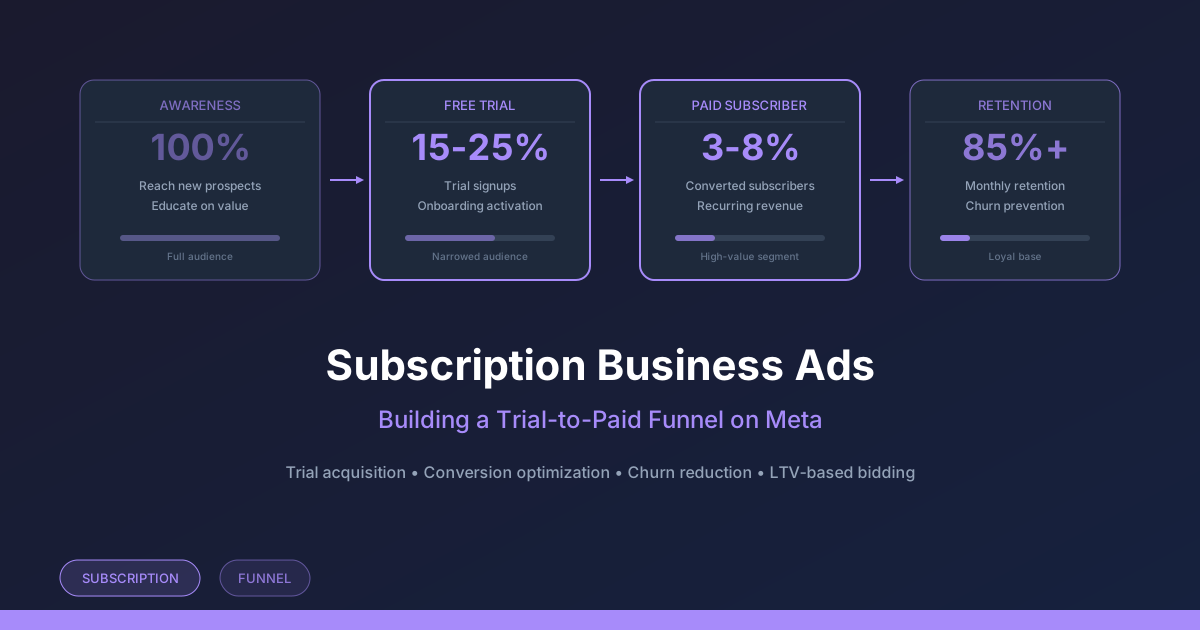
Subscription Business Ads: Building a Trial-to-Paid Funnel on Meta
Map trial, activation, payments and refunds separately, build permission-aware segments and evaluate paid-subscriber acquisition with cohort payback.

Cloud Service Advertising on Meta: AWS and Azure Alternative Marketing
Advertise a cloud alternative with reproducible workload comparisons, migration costs and mature paid-adoption economics.
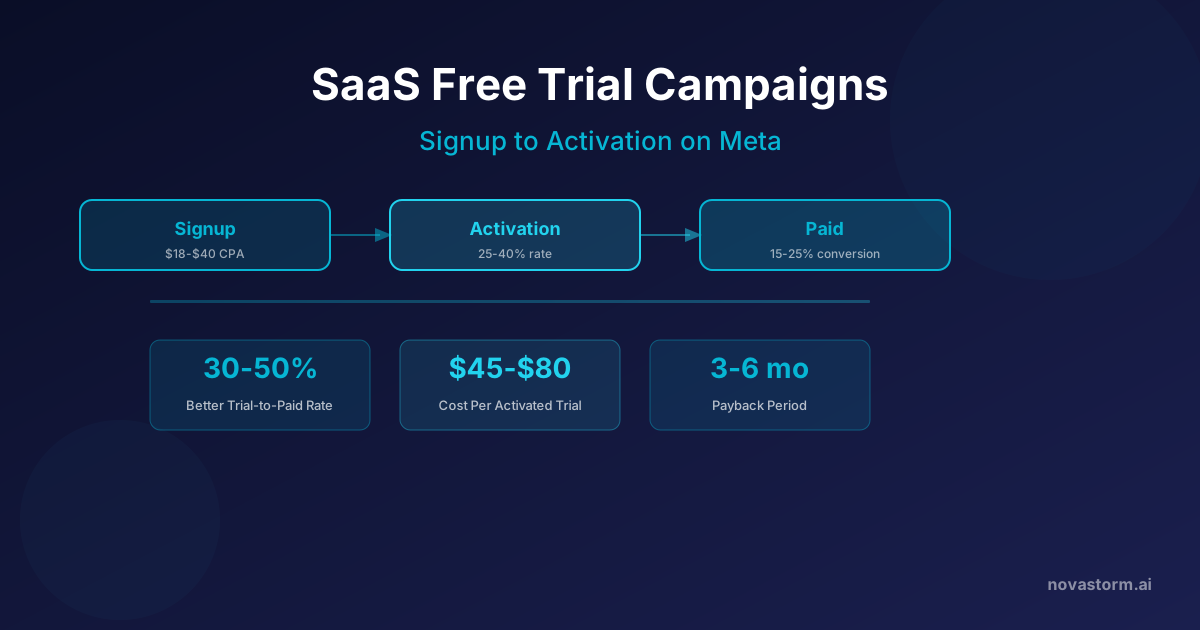
SaaS Free Trial Campaigns on Meta: Signup to Activation
Evaluate SaaS trial ads with verified activation events, retained paid cohorts, complete CAC and contribution-based payback instead of signup benchmarks.