

Referral Incentive Ads on Meta: Give $20 Get $20 Campaign Strategy
Design a two-sided referral offer with server-authoritative links, refund reversals, contact permissions and full reward costs before advertising it.
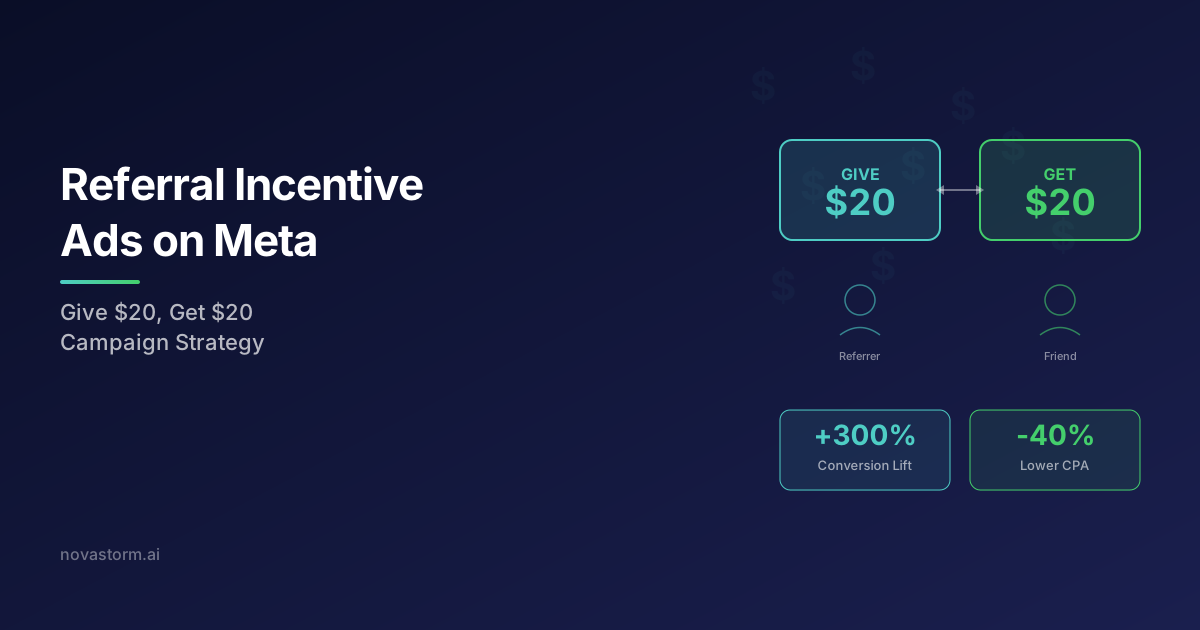
“Give USD 20, get USD 20” is an offer with two reward obligations. Write the qualification rules, server ledger and cost model before buying referral ads. Encoding a customer ID in a URL is neither authentication nor tamper protection.
Specify the offer before advertising it
Hypothetical commercial terms: a new eligible customer receives USD 20 off one qualifying order; the referring customer earns USD 20 store credit only after that order survives the published return qualification period. The real program must specify market, minimum order, eligible products, new-customer definition, stacking, qualification, return handling and any credit restrictions before launch. Equal face values are a chosen design, not a requirement or proof of effectiveness.
Illustrative ad copy for that design: “Give a new customer USD 20 off an eligible order. Get USD 20 store credit after their qualifying purchase clears the return period. Eligibility and terms apply.” A share message should say “I may earn store credit if you make a qualifying purchase.” FTC guidance explains the relevance of incentivized recommendations. Do not add invented “15,000 customers” social proof or a false deadline.
Use an opaque server-authoritative referral token
Proposed architecture, not a deployed implementation: the authenticated referrer requests a link from the server. Generate a cryptographically random opaque token, map its hash to the referrer and program version on the server, and place only the opaque token in the URL. The token never authorizes account access or supplies the reward amount. Changing it must not reveal or select an arbitrary customer ID. OWASP token guidance describes meaningless random identifiers and server-side state for sessions; the same design principles are useful here, although a referral link is not a login session.
- Resolve the token against server state and eligibility; reject unknown, expired or revoked program tokens without exposing customer information. Determine attribution using the program’s declared first/last referral rule.
- Verify payment and order facts from trusted server records, not a browser Purchase callback or URL amount. Check the referred account is new and differs from the referrer.
- In one durable transaction, lock the qualifying order/referral, check the uniqueness constraint for program + referred customer + qualifying order, and append the two pending reward ledger entries once. Retries must return the existing result.
- After the actual return qualification period and any review, move pending rewards to earned once. A refund or chargeback before qualification cancels them; later refunds create idempotent reversal entries according to disclosed terms. Do not erase the original ledger.
- If credit has already been spent, apply a documented adjustment/recovery policy after review rather than secretly charging a card. Reconcile the merchant discount, referring credit and order refund separately.
A changed token may resolve to another genuine referral link because referral links are shareable. Enforce the declared attribution rule and bind the qualifying referral to the order on the server; no token design alone proves a friend relationship. A signed payload is another option only with server-verified signature, version and expiry and no exposed personal data. Base64 alone is not a signature.
| Unexecuted acceptance test | Required ledger outcome |
|---|---|
| Duplicate payment notification | One friend discount and one referrer reward pair, not another issuance |
| Same customer referring themselves | No earned pair; documented rejection |
| Two emails with suspected same payer | Review based on legitimate signals; emails alone do not prove distinct customers |
| Refund before qualification | Pending pair canceled once |
| Refund after earning; event retried | One reversal pair; prior entries preserved |
| Two referrers claiming one qualifying order | One credited referral under written attribution rule |
Shared addresses or IPs can be legitimate households and are not automatic proof of fraud. Use proportionate risk checks, rate limits and review with a dispute route; do not collect full payment-card data for this program. The table is a QA specification, not evidence that NovaStorm has a reward engine.
Stop wasting ad budget
NovaStorm AI cuts Meta Ads CPA by 30% on average. No complex setup required.
Reconcile rewards, CPA and the funnel
| Hypothetical cost per qualifying new buyer | Full reward realization | Illustrative expected redemption |
|---|---|---|
| Media | USD 15 | USD 15 |
| Friend discount | USD 20 | USD 20 |
| Referrer credit cost | USD 20 | 50% × USD 20 = USD 10 |
| Administration/fraud handling | USD 5 | USD 5 |
| Total program cost | USD 60 | USD 50 |
| Contribution before these costs | USD 50 | USD 50 |
| Contribution after these costs | −USD 10 | USD 0 |
Expected redemption is an assumption to validate, not permission to ignore outstanding credit. Estimate the incremental economic cost of store credit using actual redemption, displacement and fulfillment; conservatively reserving face value avoids presenting future liability as profit. With two immediate cash rewards of USD 20, reward cost alone is USD 40, so an all-in USD 15–30 CPA would be inconsistent unless the metric or subsidy were explicitly different.
Hypothetical funnel instead of an unsupported chart: 100 referrers generate links; 200 distinct eligible friends visit; 20 qualify, giving 20/200 = 10% friend conversion. That assumed 10% sits between 8% and 12%, but none is a benchmark. If all 20 incur the full USD 60 program cost, cost is USD 1,200. A 10% relative improvement at each of five valid conditional stages mathematically gives 1.1⁵ ≈ 1.6105, but assumes rates remain feasible and costs/mix do not change; it is not an observed lift.
Contact rights and market-specific credits
Let customers share a link themselves instead of uploading friends’ address books. European Commission marketing guidance requires a lawful basis and appropriate permissions for received contact data and compliance with electronic-marketing rules. Customer participation does not automatically authorize marketing to their friend or a Meta audience upload.
US Regulation E gift-card rules distinguish covered gift cards from certain loyalty/promotional products and impose different conditions and disclosures. A store credit may have a different classification by market; do not set a universal 30-day expiry. Obtain the applicable classification, expiration, refund and tax terms before advertising them.
Use the unique-generation measurement guide to separate tagged buyers from causal growth. Prepare the offer, exclusions, claims, disclosure and destination in a reviewed NovaStorm campaign brief. Reward issuance, refunds, referral attribution and antifraud belong to the verified external backend, not an assumed NovaStorm integration.
Published by NovaStorm AI. Worked examples and test fixtures in this article are illustrative, not observed customer results.
Disclaimer: This article was generated with the assistance of AI and reviewed by the NovaStorm AI team. While we strive for accuracy, we recommend verifying specific data points and consulting official sources (linked where available) for critical business decisions.
Ready to automate your Meta Ads?
NovaStorm AI takes full responsibility for your campaigns — from monitoring to optimization.
Start NowMore on SaaS and app growth
Viral Loop Campaigns on Meta: Designing Ads That Get Shared
Define referral generations, deduplicate new customers and include incentive cost. Evaluate useful sharing without confusing organic impressions with sales.
Product-Led Growth and Meta Ads: Self-Service Signup Campaigns
Measure self-service campaigns from signup to useful action, retained use and settled payment. Includes illustrative cohort economics and attribution limits.
Advantage+ App Campaigns on Meta: Automated App Install Strategy
Evaluate Advantage+ app campaigns with SDK and ATT readiness checks, meaningful creative questions and mature-cohort unit economics.
Fintech App Advertising on Meta: Banking and Payment Campaigns
Plan fintech app ads with country-specific promotion approval, minimal event data and fraud-adjusted customer economics.