

Emotional Branding in Meta Ads: Creating Ads People Remember
Create an emotional Meta ad story, review cultural meaning and branding, and compare it with a factual creative using mature business outcomes.
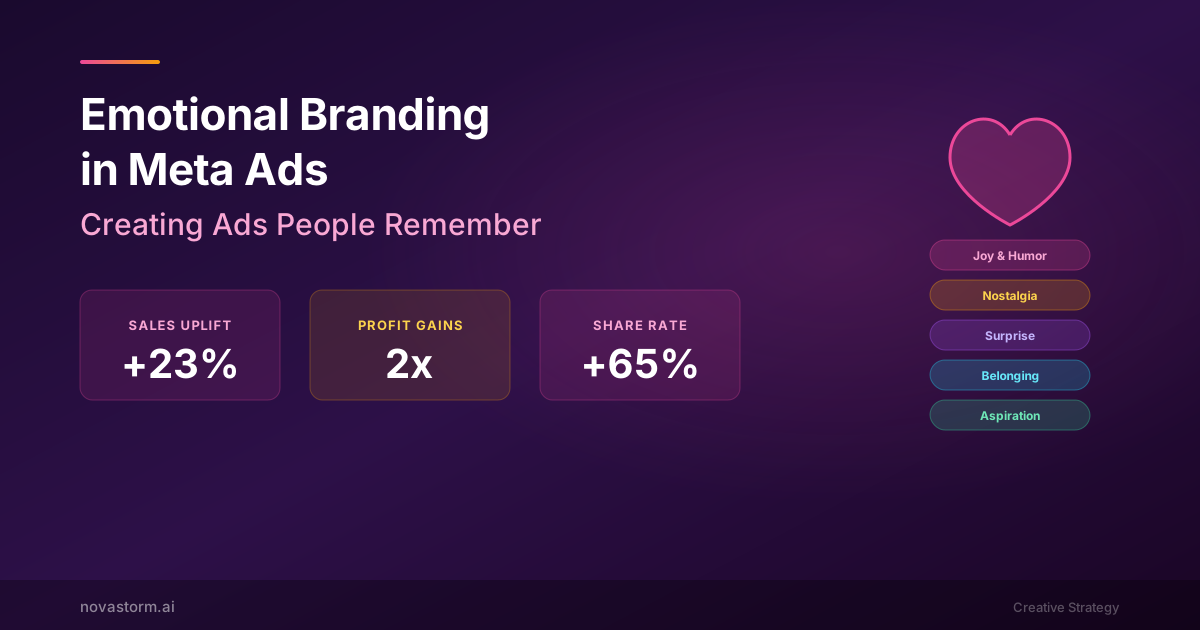
An emotional story needs a useful product truth, recognizable branding and a measurable business objective. This guide gives you a complete fictional tension-to-resolution script and a protocol for comparing it with a factual product demonstration. Whether the story improves sales is a hypothesis, not a property of the format.
What the research supports
Nielsen’s January 2016 article describes 100 ads across 25 fast-moving consumer goods brands and reports a 23% sales lift for above-average neuroscience-based copy-test scores. That is a historical study of a composite test score, not a measured advantage for every emotional Meta ad. The public summary does not provide enough detail to reproduce a causal Meta experiment or a forecast for your business.
IPA’s Feelings sell report page points to Virgin Media and McDonald’s UK effectiveness cases. These are selected campaign examples, not a random assignment of emotional and rational ads in your account. Use them as creative research rather than a promised profit multiplier. The Ehrenberg-Bass Institute’s distinctive-asset guidance focuses on the measured link between elements and a brand. A feeling shared by competitors is not automatically a distinctive brand asset.
A complete fictional story: a desk organizer
Illustrative creative concept, not a customer case: Northline is a fictional organizer brand. Assume the pictured organizer really has separate compartments and the shown mug fits; verify these product facts before using the script. Intended emotion: relief when a small daily frustration is resolved. Avoid implying that buying it treats anxiety or changes a person’s worth.
| Beat | Visual and exact copy | Brand and claim check |
|---|---|---|
| Tension | A person reaches for a notebook, nudging loose pens. Overlay: “A crowded desk. A small daily interruption.” | Northline name and teal corner marker appear in the opening; staged scene, not testimonial. |
| Resolution | They place pens and the notebook into visible compartments. Overlay: “Give the things you use a place.” | Show the actual product; do not fake capacity, speed or a before-and-after room transformation. |
| Payoff | The person returns to their work. Overlay: “Make room for your next idea.” End card: “Northline. See the organizer.” | Same marker, product and name; link to the exact organizer page. No invented productivity uplift. |
The factual comparison uses the same product, offer, CTA and branding: “Separate compartments for pens and notebooks. See the organizer’s dimensions before you choose.” Its visual is a direct compartment demonstration. This tests two creative packages; it cannot isolate emotion from storytelling, pacing and framing.
Adapt the story and review cultural meaning
Stop wasting ad budget
NovaStorm AI cuts Meta Ads CPA by 30% on average. No complex setup required.
- Prepare a vertical Stories/Reels version and a Feed crop. Preview each selected placement with interface overlays; do not rely on universal attention windows or safe-area coordinates.
- Keep the opening brand cue and product demonstration visible in each crop. Caption the action and check the story without sound; music is an optional layer, not a quantified share of emotional impact.
- Ask a local reviewer whether the scenario, humor, gesture, setting and translation make sense. Ask “What happens in this story?” before naming the intended emotion to avoid prompting.
- Check whether the reviewer identifies Northline or another brand. A teal corner alone is a proposed asset until recognition is measured.
- Record market, language, script version, reviewer role and approved crop. Reject stereotypes, unlicensed music and unverifiable product statements.
Compare mature sales, then diagnose attention
Pre-register story versus factual demo, the same eligible market, offer, landing page, schedule and attribution setting. Use an eligible randomized A/B setup if available; two ordinary ad sets do not guarantee random exposure. Pick a primary outcome such as net contribution per assigned person, accounting for spend and refunds. Set the minimum worthwhile difference, required sample, budget ceiling and order-maturity window before launch.
Illustrative accounting only: suppose each arm spends USD 600 and, after the same refund window, has 20 and 22 paid retained orders. At assumed USD 40 contribution per retained order, contribution after media is 20 × 40 − 600 = USD 200 versus 22 × 40 − 600 = USD 280. The USD 80 descriptive gap is not proof of an emotional mechanism or a statistically reliable sales gain; uncertainty and assignment quality still matter.
Saves, shares and watch time can explain attention patterns but do not establish emotion, memory or profitable demand. If memory matters, separately ask an unprompted brand-recall question with identical timing and sampling in each arm; report respondent counts, refusals and competitor confusion. Retain the factual version when the business evidence is inconclusive rather than promoting a save-rate winner.
Turn the approved story into a draft
Bring the product facts, script, local-review notes and approved Feed/Stories/Reels assets into a NovaStorm campaign-preparation brief. Keep the campaign as a draft for human review, then verify placement previews and launch settings in Meta. This workflow does not claim NovaStorm measures emotion, randomizes a lift test or approves rights.
Published by NovaStorm AI. Worked examples and test fixtures in this article are illustrative, not observed customer results.
Disclaimer: This article was generated with the assistance of AI and reviewed by the NovaStorm AI team. While we strive for accuracy, we recommend verifying specific data points and consulting official sources (linked where available) for critical business decisions.
Ready to automate your Meta Ads?
NovaStorm AI takes full responsibility for your campaigns — from monitoring to optimization.
Start NowMore on Visual creative and design
Product Reviews as Ad Creative: Mining Your Reviews for Meta Ads
Turn permissioned product reviews into truthful ad creative with a source record, editing example and independent measurement protocol.
Brand Consistency Across Meta Ad Campaigns: Style Guide Enforcement
Build a versioned Meta ad style library, use ten approval checks, preview mobile typography and govern controlled creative exceptions.
Meme Marketing in Meta Ads: When Humor Drives Performance
Prepare an original licensed humor concept, check comprehension and product truth, and run a capped mature-purchase test with a negative-response plan.
Product Photography vs Lifestyle Imagery in Meta Ads
Plan matched clean and contextual product photos with truthful scale, rights, production costs and a mature-order comparison.