

Brand Consistency Across Meta Ad Campaigns: Style Guide Enforcement
Build a versioned Meta ad style library, use ten approval checks, preview mobile typography and govern controlled creative exceptions.
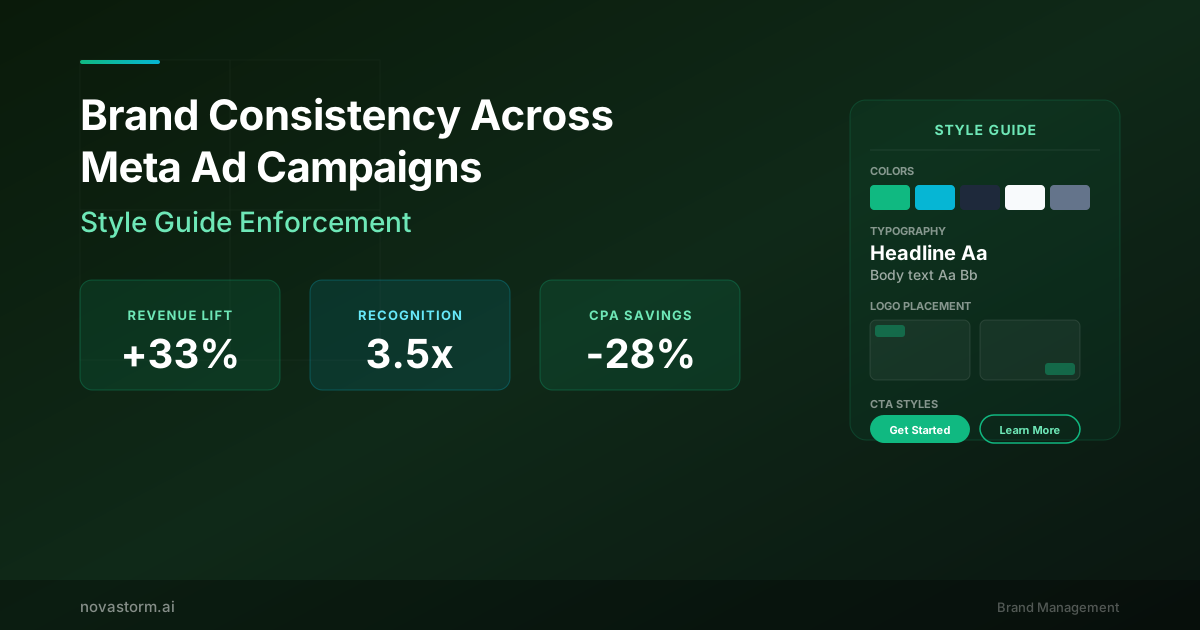
A practical style guide tells a creator what to use, who approves a deviation and how to retire an old asset. The fictional library and ten checks below turn brand consistency into a repeatable review process across Meta placements without assuming that consistent styling guarantees recognition or lower acquisition costs.
Evidence and its limits
Marq’s State of brand consistency landing page describes a Lucidpress survey of more than 400 organizations. A vendor survey of reported experience is not a randomized revenue experiment or a forecast for Meta campaigns. Use your own approval-error and recognition measures before assigning a financial return to a style guide. Ehrenberg-Bass distinctive-asset measurement evaluates whether elements link to the intended brand; consistent use and actual consumer recognition are separate questions.
An illustrative asset library with accountable owners
Fictional Northline library, version 1.0; these are proposed production rules, not a real company’s assets or platform requirements. Store an immutable approved file and its version, market, rights expiry and owner. The roles below are responsibilities to assign in your team, not named employees.
| Asset | Illustrative specification | Owner and lifecycle |
|---|---|---|
| Palette | Dark ink #102A43; light background #F4F8FA; accent teal #00A6A6. Ink on light for body text; teal is an accent, not automatically a readable text pair. | Design lead; palette v1.0 approved, later changes require review. |
| Typeface and crop | Licensed font package; headline and body hierarchy tested at actual display size. Separate vertical and Feed templates. | Design lead; template v1.0; archived exports cannot be launch candidates. |
| Voice | Clear and calm. Use “See the organizer’s dimensions”; reject “Triple your productivity” without supporting evidence. | Copy lead; phrase library v1.0, product owner verifies every factual benefit. |
| Offer | Product SKU, current price, currency, stock and destination-page version tied to each creative. | Merchandising owner; reapprove after price or availability changes. |
| Final export | NL_ORGANIZER_EN_FEED_v1.0_APPROVED; record exact source, reviewer and date. | Campaign owner checks final file against the approved source before launch. |
Ten pre-flight checks for every ad
- Identity: the visible brand name, logo file and any distinctive cue match the approved version.
- Color: approved palette and roles are used; exception ID exists if a test color differs.
- Typography: font license and hierarchy are correct; nothing requires pinch-to-zoom at the intended mobile display size.
- Crop: product, price, name and CTA remain visible in each selected placement preview and under interface overlays.
- Imagery: the depicted product and variant are accurate; edits do not fabricate capacity, results or customer endorsement.
- Voice: copy follows the approved tone; all measurable benefits have a dated evidence owner.
- Offer: price, currency, taxes/disclosures, stock and actual destination agree.
- Accessibility: captions communicate essential video meaning without sound; contrast and text legibility are checked.
- Rights and market: footage, music and testimonial permissions cover the intended use; local reviewer signs off on meaning.
- Release: exact export version, human approval, exception expiry and campaign destination are recorded; obsolete exports are excluded.
Scale type from the artwork to the phone
Illustrative calculation: a 1080-pixel-wide artwork displayed 360 CSS pixels wide scales by 360 ÷ 1080 = one third. A 24-pixel artwork font becomes roughly 8 display pixels; a 48-pixel font becomes roughly 16. These figures explain why source-file font sizes alone are inadequate. Export, preview and read the actual ad on a phone; rasterization, font shape and interface overlays can still affect readability.
Stop wasting ad budget
NovaStorm AI cuts Meta Ads CPA by 30% on average. No complex setup required.
WCAG’s contrast guidance uses 4.5:1 for normal text and 3:1 for qualifying large text, with exceptions. Adopt an appropriate accessibility target for your material and test the final image, rather than presenting it as a Meta ad-text-percentage rule. Do not infer that teal on white passes from the hex codes alone.
Allow a controlled exception instead of silent drift
Illustrative experiment: keep brand name, product facts, offer, licensed assets and readable CTA fixed while testing a different background treatment. Log exception NL-E01, the variable, hypothesis, owner, affected market, start/end criteria and fallback approved template. The design lead can approve the style exception; the campaign owner separately approves any launch. Product truth, permissions and required disclosures are not experimental variables.
When a test ends, explicitly approve the winning asset as a new version or archive it. Approval does not automatically propagate to every agency export. Give contributors the current version, remove obsolete launch candidates and audit a sample of active ads against the exact recorded files.
Measure recognition and production quality separately
Track failed checks, rework time and use of obsolete versions as operational measures. For recognition, show assets under a consistent exposure protocol and ask an unprompted brand question, recording sample, market and competitor responses. For business impact, compare approved creative packages with matched offers and mature sales. A lower CPA alone can reflect auction, offer, tracking or audience changes; it is not the strongest proof of recognition.
Prepare the campaign for human approval
Use the approved Northline-style brief and final export versions when preparing a NovaStorm campaign draft. The responsible reviewer checks the ten items before launch settings are finalized in Meta. Keep asset versioning and exception approvals in your team’s review record; this is not a claim that NovaStorm automatically detects colors, enforces a style guide or measures brand recognition.
Published by NovaStorm AI. Worked examples and test fixtures in this article are illustrative, not observed customer results.
Disclaimer: This article was generated with the assistance of AI and reviewed by the NovaStorm AI team. While we strive for accuracy, we recommend verifying specific data points and consulting official sources (linked where available) for critical business decisions.
Ready to automate your Meta Ads?
NovaStorm AI takes full responsibility for your campaigns — from monitoring to optimization.
Start NowMore on Visual creative and design
Emotional Branding in Meta Ads: Creating Ads People Remember
Create an emotional Meta ad story, review cultural meaning and branding, and compare it with a factual creative using mature business outcomes.
Infographic Ads on Meta: Data-Driven Visual Content
Create readable infographic ads with source data, honest scales, visible uncertainty and a test based on mature paid outcomes.
Product Reviews as Ad Creative: Mining Your Reviews for Meta Ads
Turn permissioned product reviews into truthful ad creative with a source record, editing example and independent measurement protocol.
The Contrast Effect in Meta Ad Creative: Standing Out in the Feed
Screen contrasting ad variants in an illustrative feed, collect five real qualitative responses, and test pacing against mature purchases and brand checks.