

Meme Marketing in Meta Ads: When Humor Drives Performance
Prepare an original licensed humor concept, check comprehension and product truth, and run a capped mature-purchase test with a negative-response plan.
Meme Marketing in Meta Ads: When Humor Drives Performance
Humor is a creative hypothesis with reputational and commercial risks. Start with an original image or a license that permits the intended paid use, a joke connected to a real product and a capped reaction plan. Age alone does not establish whether an audience understands or wants the joke.
An original hypothetical joke with a product connection
Illustrative concept, not a delivered advertisement or audience-tested result: photograph your own licensed-to-use desk scene with two paper labels, no celebrity, film still, copied tweet or third-party meme template. The advertised product is a campaign-planning checklist, and the joke concerns the advertiser’s workflow.
| Panel | Finished proposed copy | Visual |
|---|---|---|
| Left | “My campaign naming plan: final_final_v7.” | Original desk photo with a messy stack of labeled sheets |
| Right | “My Monday self: which one is live?” | Same scene with an empty checklist beside the stack |
| Product line | “Give every draft a clear name and an approval check.” | Actual checklist preview if the resource exists |
| CTA | “See the checklist.” | Truthful destination; no invented customer result |
Use this copy only with an actual resource that delivers the promise. Do not present a mock screenshot as a real customer post. Check the photographer/subject/prop rights and paid-ad permission; an image being popular online does not license it. Keep brand identity and necessary disclosures visible.
Ask the audience what the joke communicates
Stop wasting ad budget
NovaStorm AI cuts Meta Ads CPA by 30% on average. No complex setup required.
- Show the draft to people representative of the intended market and ask what they think the product does, who the joke targets and whether any part feels misleading or insulting. Record actual comments when you run this check; no reactions are invented here.
- Treat a small qualitative review as comprehension feedback, not a statistically representative conversion study. Do not claim two reviewers prove universal acceptance.
- Avoid ridicule of customers, sensitive personal attributes or fabricated claims. Regulated offers need specific claim/policy review; do not rely on a blanket industry or age prohibition.
- Change or remove the joke if it distracts from the offer or creates an unresolved rights/claim issue.
A cash and negative-response plan
Hypothetical experiment allowance: $150 total ad loss exposure plus separately approved production cost. A$50/day plan is not a total cap by itself; record when spend is checked, who can pause and the lag before delivery stops. No automatic 30-minute pause guarantee is assumed.
| Observation | Owner response | Commercial limit |
|---|---|---|
| Comments show offer confusion | Clarify truthful terms; review creative and destination | Do not add spend while core promise is unclear |
| Credible harm/rights complaint | Pause affected creative through available controls and investigate | Preserve evidence and authorize restart only after resolution |
| Shares rise but purchases do not | Review audience/offer and mature contribution | No scale solely for engagement |
| Cap reached without useful evidence | Close inconclusive | New money requires a separate decision |
Track paid spend and paid impressions separately from organic shares. Shares or a rise in brand search do not prove that humor caused a lower paid CPM or additional purchases. Use a comparable controlled creative test with unique mature paid orders, all production costs and refund-adjusted contribution. No 22% CPA saving, triple engagement or7/16-day lifespan is established here.
Prepare this approved humor concept and reaction brief with a NovaStorm campaign draft. The user reviews rights, product truth and tone before publication. Preparation and optional connected observations are distinct from automatic cultural approval, backlash prevention or promised performance.
Published by NovaStorm AI. Worked examples and proposed tests are labeled in the article.
Disclaimer: This article was generated with the assistance of AI and reviewed by the NovaStorm AI team. While we strive for accuracy, we recommend verifying specific data points and consulting official sources (linked where available) for critical business decisions.
Ready to automate your Meta Ads?
NovaStorm AI takes full responsibility for your campaigns — from monitoring to optimization.
Start NowMore on Visual creative and design
Product Photography vs Lifestyle Imagery in Meta Ads
Plan matched clean and contextual product photos with truthful scale, rights, production costs and a mature-order comparison.
Text Overlay Rules for Meta Ads: How Much Text Is Too Much
Compare three readable text-overlay options at actual mobile scale and judge mature orders within a cap without claiming text-area auction penalties.
Emotional Branding in Meta Ads: Creating Ads People Remember
Create an emotional Meta ad story, review cultural meaning and branding, and compare it with a factual creative using mature business outcomes.
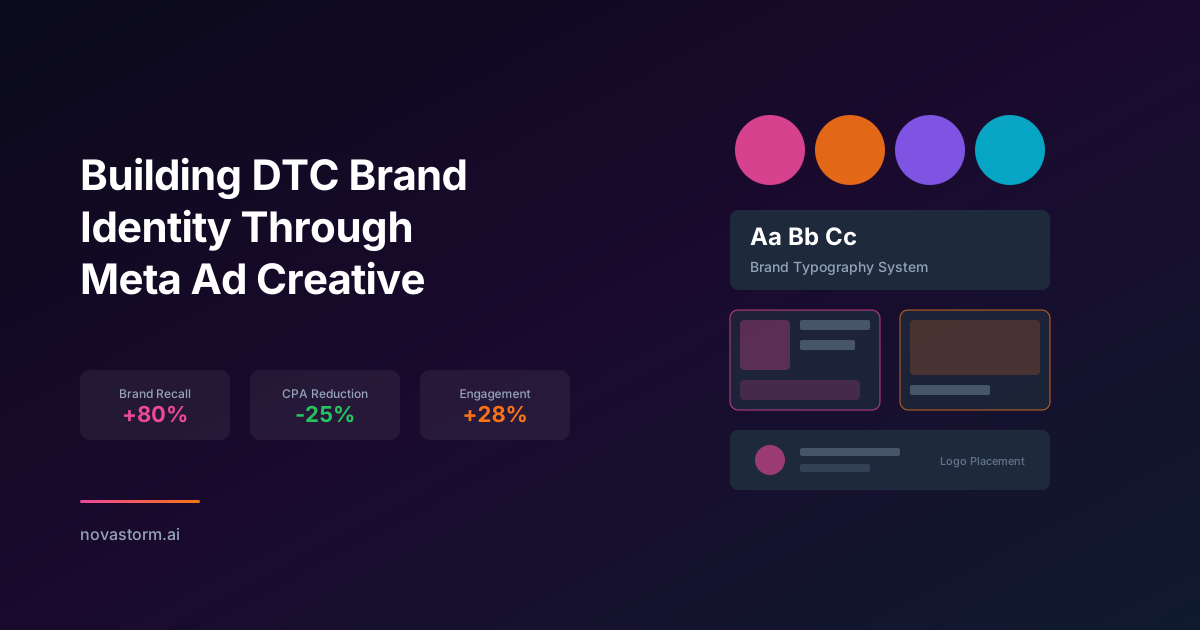
Building a DTC Brand Identity Through Meta Ad Creative
Discover how to build a strong DTC brand identity through Meta ad creative. Learn visual systems, messaging frameworks, and consistency strategies that convert.