

Bid Strategies Explained: Lowest Cost vs Cost Cap vs Bid Cap
Select an available bid strategy by commercial risk and underdelivery, distinguishing auction bid caps from mature acquisition cost.
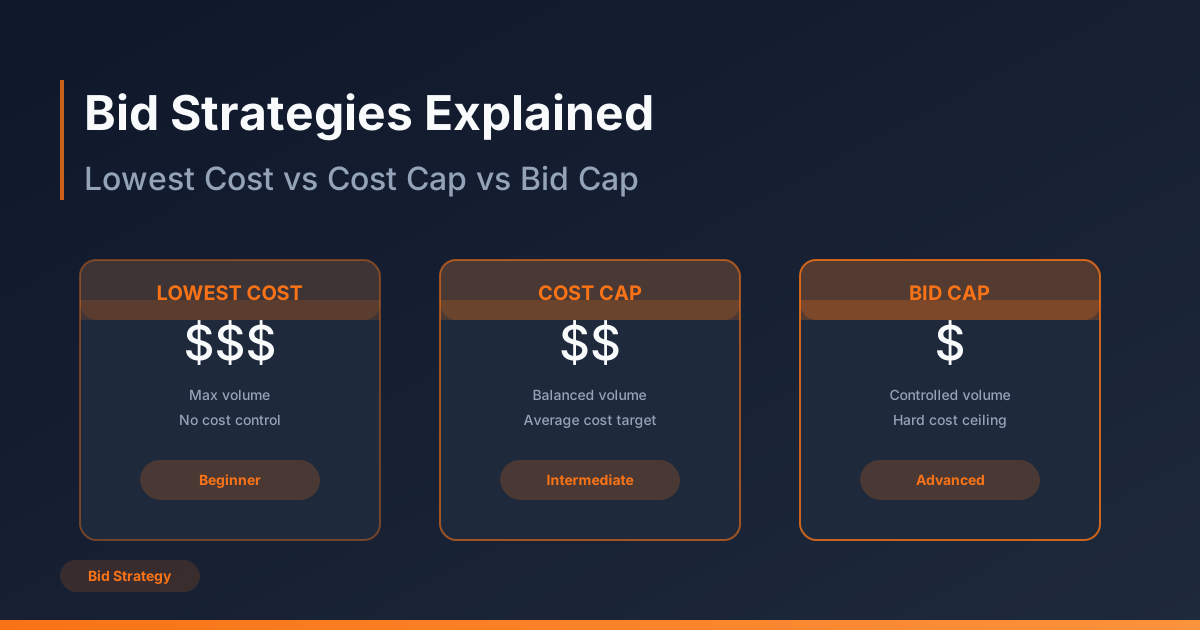
Budget controls cash exposure; bid strategy changes how delivery pursues available outcomes. Check the current strategy names and eligibility for the account/objective. None guarantees profitable customers or full spend.
Keep the control meanings separate
| Strategy family, where available | Planning intent | Limitation |
|---|---|---|
| Volume-oriented/Lowest Cost | Seek outcomes within available budget/opportunities | Full spending and a particular CPA are not guaranteed |
| Cost-goal/Cost Cap | Pursue outcomes around an average cost goal | Not a strict per-conversion or total-cash ceiling |
| Bid Cap | Constrain the auction bid | A bid amount is not a CPA guarantee; delivery may be limited |
Verify supported controls in the current Meta guidance and saved account settings. A cost goal or auction bid cap does not replace an approved cash-loss cap, and raising budget cannot create opportunities that the constraint prevents.
A $25 baseline versus a $15 goal
Hypothetical mature baseline CPA is $25, but the business needs $15. A proposed $15 cost goal may result in very little delivery; that is not proof of profitable acquisition. Do not use $15 as an auction bid cap merely because it is the desired CPA. These are illustrative figures, not observed account behavior.
Stop wasting ad budget
NovaStorm AI cuts Meta Ads CPA by 30% on average. No complex setup required.
| Underdelivery finding | What to inspect | Possible approved response |
|---|---|---|
| Little spend and few outcomes | Eligibility, creative review, event validity, saved strategy and available inventory | Fix a confirmed defect before loosening the cost goal |
| Valid setup but strict cost constraint | Whether the $15 commercial requirement can be met by the offer | Improve economics/offer or choose a capped test; do not spend at an unaffordable target |
| Low spend with delayed outcomes | Click-to-payment maturity and pending orders | Wait to the declared review within cash limits |
| Actual CPA above ceiling after maturity | Net customer contribution and total exposure | Reduce/stop affected spend; log uncertainty |
A bounded strategy test
- Save baseline strategy, budget, event, offer, creative, eligibility and actual outcomes.
- Change one declared strategy variable where supported; do not simultaneously increase budget and change the offer.
- Use a supported controlled design if causal comparison matters. Duplicating a campaign does not randomize users or remove cross-exposure.
- Set spend/cash-loss caps and a maturity review from the actual conversion cycle. No fixed three-to-five-conversion count makes the result reliable.
- Inspect underdelivery, mature paid-order CPA and contribution. Sparse evidence ends as inconclusive; absence of spending is not a performance win.
- The user approves a new goal/cap and cash allowance before application; preserve the documented previous setup for a reversible response.
Prepare the review, then inspect actual delivery
Use NovaStorm to prepare a paused campaign brief naming strategy intent and user-approved limits. Do not claim automatic bid control or that every strategy is exposed in the product. Verify the actual saved strategy in the supported advertising interface, then reconcile real spend after delivery. The bid-cap guide and cost-goal guide deepen the separate questions.
Published by NovaStorm AI. Planning examples are illustrative assumptions, not measured customer results.
Disclaimer: This article was generated with the assistance of AI and reviewed by the NovaStorm AI team. While we strive for accuracy, we recommend verifying specific data points and consulting official sources (linked where available) for critical business decisions.
Ready to automate your Meta Ads?
NovaStorm AI takes full responsibility for your campaigns — from monitoring to optimization.
Start NowMore on Scaling and bidding

Kill Criteria: When to Pause Meta Ads and When to Wait
Use a predeclared pause/wait tree with mature outcomes, a decision journal and an actual-spend check after campaign approval.
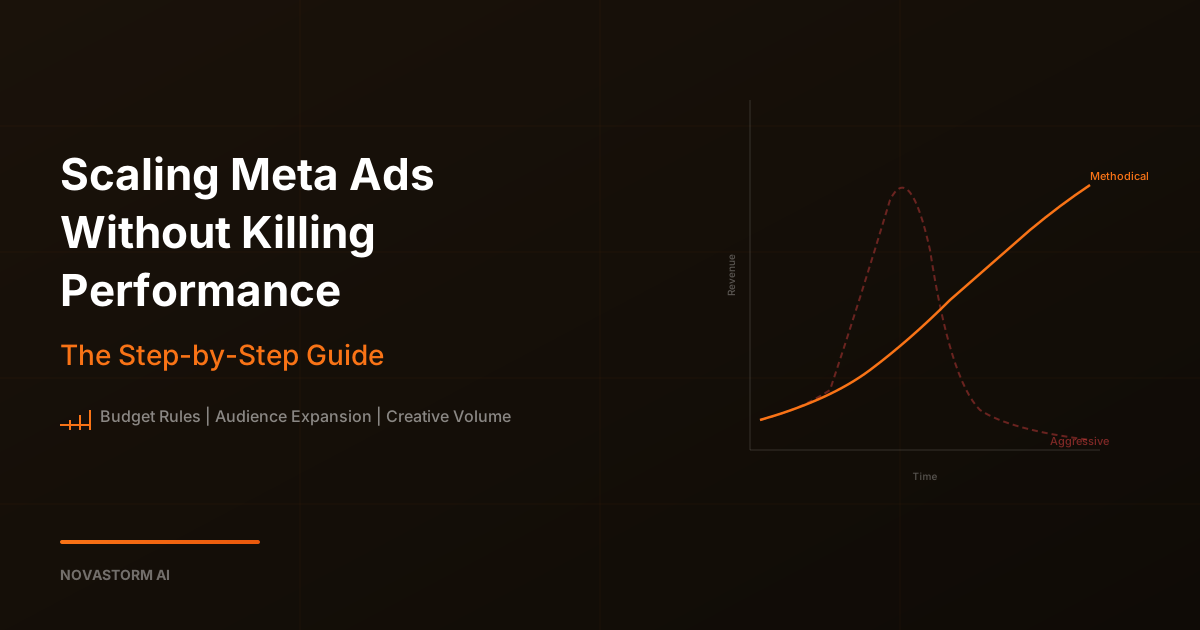
Scaling Meta Ads Without Killing Performance: The Step-by-Step Guide
Review a bounded Meta budget increase with actual spending, refunds, delayed orders, marginal cost and user-approved campaign fields.

Horizontal vs Vertical Scaling: Two Paths to Ad Growth
Separate an existing-budget increase from a new-market test, with incremental spend limits, a review date and a reversible response.
Dayparting in Meta Ads: Does Time-of-Day Targeting Still Work
Verify schedule availability and time-zone behavior, align ads with real contact handling, and test mature outcomes within a spending allowance.