

A/B Testing Landing Pages for Meta Ads Traffic
Set up consistent landing-page assignment, check revisit and event integrity, calculate sample and budget needs, and distinguish repairs from experiments.
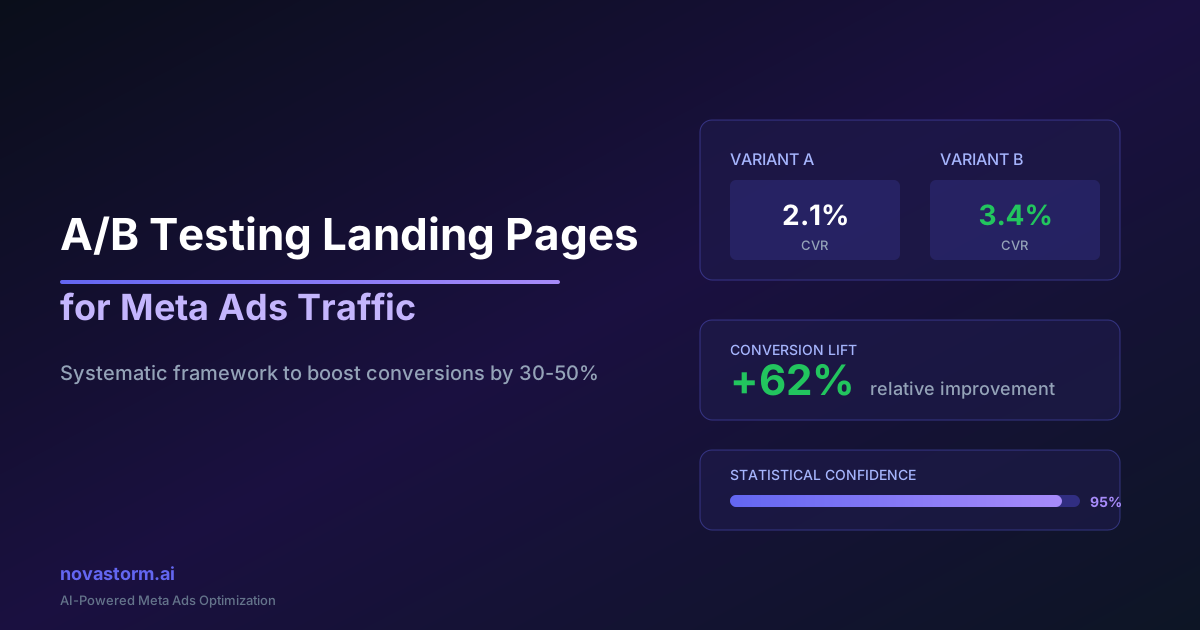
A landing-page test isolates a page change only when eligible visitors are assigned consistently and outcomes are measured under a defined design. Two ads pointing to different pages compare advertising packages as well as pages. Use one unchanged ad brief and destination entry route, then assign the page experience separately.
Implement assignment with a maintained tool
GrowthBook’s JavaScript SDK is one documented option. The following is an implementation plan, not a claim that this site has installed it:
- Install @growthbook/growthbook and configure the SDK connection with apiHost and clientKey.
- Provide attributes.id with the stable eligible visitor identifier. Evaluate a feature flag experiment with A/B page values and the intended equal allocation.
- Record experiment.key and result.key from trackingCallback with the assignment identifier in your permitted analytics store.
- Initialize features before rendering the tested content and explicitly handle a load failure.
- Read the page value with getFeatureValue and render the matching page. For an SPA, update the SDK URL on navigation.
- Use a supported sticky bucket service if your experiment supports it. Define consent, anonymous-to-login identity and storage behavior before enrollment.
The SDK documentation establishes those integration mechanisms. The experiment still needs an outcome join, valid identity handling, and QA; installing an SDK does not make the analysis valid.
Test enrollment, repeat visits and missing data
| QA case | Expected check | If it fails |
|---|---|---|
| Reload and revisit with the same permitted ID | Same assigned page; deduplicated unit in analysis | Fix identity or persistence before enrollment. |
| Return after login, consent change or storage deletion | Apply the documented identity/exclusion rule | Do not silently treat one person as independent new units. |
| No SDK payload or blocked tracker | Show the safe fallback and log the failure through permitted means | Do not count fallback visitors as successfully exposed B. |
| 50/50 allocation | Compare assigned eligible counts with the planned ratio | Investigate a sample-ratio mismatch; equal delivered page views are not sufficient. |
| Purchase and assignment join | One binary paid outcome per eligible assigned unit in the window | Reconcile unmatched orders, duplicate events and unknown outcomes. |
A filled planning card and budget
Illustrative assumptions: independent randomized visitors, baseline purchase rate 3%, meaningful alternative 3.5%, two-sided α = 0.05, power 80%, equal groups, one purchase indicator per visitor. The normal approximation described in the sample-size guide gives approximately 19,749 visitors per group when z values 1.96 and 0.842 are used.
At an assumed $0.80 per eligible visitor, 39,498 visitors cost $31,598.40 in media. At 2,000 eligible visitors per day, collection takes roughly 20 days; a chosen seven-day purchase follow-up makes the final review roughly day 27 after enrollment begins. These are planning inputs, not delivery promises. If the budget is $5,000, it purchases only about 6,250 eligible visitors at that assumed cost: reduce the decision scope or defer the test rather than promise the same detectable effect.
Stop wasting ad budget
NovaStorm AI cuts Meta Ads CPA by 30% on average. No complex setup required.
Read 60/2,000 versus 70/2,000 without forcing a winner
Illustrative result: rates are 3% and 3.5%, a 0.5 percentage-point or about 16.7% relative difference. The approximate 95% difference interval is −0.60 to +1.60 percentage points; the pooled two-sided test gives p about 0.37. This outcome is inconclusive under the planned conventional test. Report the interval, costs and guardrails rather than calling B a reliable winner.
Separate a repair log from an experiment
| Illustrative record | Action | How to interpret it |
|---|---|---|
| Repair R1: checkout button routes to a missing page | Fix the route, verify both variants, record deployment and affected times | A safety repair, not evidence that a marketing hypothesis won. |
| Experiment E1: explain delivery cost earlier | Freeze variant definitions and enrollment version; retain the comparison protocol | Estimate the effect only under the planned assignment and follow-up. |
| Repair occurs during E1 | Record the incident and apply the predeclared pause/restart rule | Do not remove unfavorable visitors post hoc to improve the result. |
Use confirmed paid outcomes and return or qualification guardrails. Stop operational failures immediately; use the chosen fixed-horizon or valid sequential rule for inferential stopping. ASA guidance explains why a p-value alone cannot determine business value.
Keep the campaign brief consistent
Prepare the unchanged audience, offer and ad message as a reviewable NovaStorm campaign draft. Page construction, GrowthBook assignment and experiment analysis remain separate work. Draft preparation does not create landing pages or randomize visitors.
Published by NovaStorm AI. Worked examples and proposed tests are labeled in the article.
Disclaimer: This article was generated with the assistance of AI and reviewed by the NovaStorm AI team. While we strive for accuracy, we recommend verifying specific data points and consulting official sources (linked where available) for critical business decisions.
Ready to automate your Meta Ads?
NovaStorm AI takes full responsibility for your campaigns — from monitoring to optimization.
Start NowMore on Landing pages and conversion
Thank You Page Optimization: Confirm Status and Prevent Duplicate Purchases
Design confirmation messages from verified lead and payment states; prevent duplicate purchases and make optional add-ons and surveys explicit.
Post-Click Conversion Optimization for Meta Ads
Reconcile explicit post-click IDs, consent and mature outcomes, repair routing and duplicates, and distinguish local attribution tests from commercial evidence.
Social Proof Widgets on Landing Pages: Boosting Meta Ad Conversions
Choose proof that answers an offer question, retain source and permission context, and inspect mobile widget behavior without invented conversion claims.
Mobile Landing Page Design for Meta Ads Traffic
Review the mobile route through keyboard, zoom, focus, errors and confirmation, with sticky-CTA repair acceptance and qualified-outcome limits.