

Price Comparison Ads on Meta: Positioning Against Competitors
Build fair comparison ads from current evidence and a complete cost model, with audience, trademark and market-specific review.
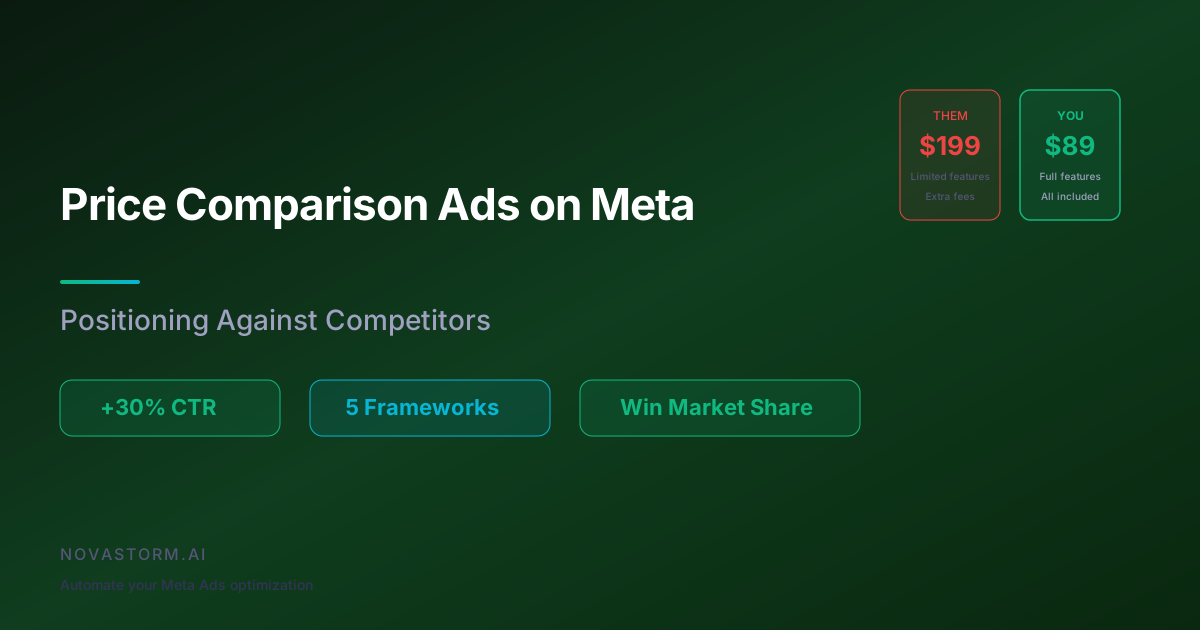
A comparison ad should answer a buyer’s specific question using current, comparable facts. Explain the product, plan, period and assumptions being compared. Naming no competitor does not make an unsupported “industry average” or savings claim accurate.
Create a dated evidence record
- Define the buyer task and comparable usage: seats, features, capacity, support, renewal and commitment. Compare products meeting that same need rather than their unrelated cheapest plans.
- Save each original public price/source URL, capture date, currency, region, plan version and tax treatment. Record whether a feature was actually tested, documented, unavailable or unknown; do not convert unknown into a red cross.
- For an average, define the population, selection method and weighting and show all included prices. A convenient example price is not an industry average. Recheck before launch and when an offer changes.
- Keep a change owner and expiration date for the creative. If sources no longer support the comparison, withdraw or revise it rather than leaving a stale savings message live.
A complete hypothetical first-year cost comparison
Plans A and B below are fictional, not named competitors or NovaStorm prices. Assume the same required capacity, currency, twelve-month use and nonrecoverable tax at 10% on every listed cost. Real tax treatment, deductibility, migration needs and usage must be verified for the buyer.
| Fictional first-year input | Plan A | Plan B |
|---|---|---|
| Subscription | USD 199 × 12 = 2,388 | USD 89 × 12 = 1,068 |
| Migration | 0 | 400 |
| Training/setup | 0 | 200 |
| Necessary add-on | 0 | 20 × 12 = 240 |
| Subtotal | 2,388 | 1,908 |
| Assumed nonrecoverable tax 10% | 238.80 | 190.80 |
| First-year payable cost | 2,626.80 | 2,098.80 |
Subscription-only difference = (199 − 89) × 12 = USD 1,320. Under all worksheet assumptions, first-year payable difference is 2,626.80 − 2,098.80 = USD 528. In year two, if one-off migration/training disappear and other assumptions stay fixed, Plan B costs (1,068 + 240) × 1.10 = 1,438.80 and the difference becomes USD 1,188. These calculations do not establish equivalence, unlimited usage or real savings. Add actual overages, contract overlap, switching downtime, exit charges and recoverable-tax treatment.
Review comparative claims and brand assets by market
Stop wasting ad budget
NovaStorm AI cuts Meta Ads CPA by 30% on average. No complex setup required.
In the US, the FTC comparative-advertising policy supports truthful comparisons with clear bases and necessary disclosures. It does not provide blanket approval for a particular creative. USPTO guidance on infringement explains that source/sponsorship confusion and, for famous marks, dilution can matter. Name/logo use requires a review of the actual context and rights; there is no universal Meta rule that every competitor logo is prohibited or permitted.
In the EU, Directive 2006/114/EC, Article 4 includes conditions concerning misleading claims, objective comparisons of relevant verifiable features for the same needs, confusion and unfair advantage of distinguishing marks. Check national implementation and the specific asset use with the responsible reviewer. An unnamed but identifiable alternative still needs a substantiated comparison; hiding its name is not a safe harbor.
Use audiences you can actually construct
A competitor’s followers, website visitors and search queries are not customer lists you possess. Do not promise a Meta audience of people who searched “competitor alternative” or visited a third-party site without a verified lawful mechanism. Consider broad delivery of relevant copy or eligible visitors to your own comparison page using authorized data. Available interests and expansion behavior must be checked in the actual account; an interest is not proof of competitor ownership.
Test the comparison against a clear product explanation
Hypothesis: a sourced comparison improves qualified paid acquisition for the defined buyer task. Compare it with a factual product creative using the same offer and supported random assignment where feasible. Record mature paid customers, net contribution, refunds, retention and uncertainty; do not infer a specific CTR uplift or higher lifetime value from the format. If a brand-lift study is available and appropriate, define its actual survey question and scope separately from sales.
Fictional copy exercise: “Compare first-year costs for this defined workflow. The worksheet includes setup and add-ons; actual costs depend on your requirements.” Replace it with real sourced facts before any public savings claim. Prepare the approved comparison in a NovaStorm campaign draft and review before publication; product plan management and legal review remain in their actual systems.
Published by NovaStorm AI. Worked examples and test fixtures in this article are illustrative, not observed customer results.
Disclaimer: This article was generated with the assistance of AI and reviewed by the NovaStorm AI team. While we strive for accuracy, we recommend verifying specific data points and consulting official sources (linked where available) for critical business decisions.
Ready to automate your Meta Ads?
NovaStorm AI takes full responsibility for your campaigns — from monitoring to optimization.
Start NowMore on E-commerce offers and retention

Limited-Time Offers on Meta: Creating Real Urgency Without Gimmicks
Run limited-time ads with real deadlines, coordinated coupon expiration and inventory checks, then measure contribution beyond the sale window.

Tiered Pricing in Meta Ads: Good-Better-Best Frameworks
Explain useful pricing tiers with verified popularity, clear billing terms and contribution measured through refunds and retention.
Bundle Pricing Psychology in Meta Ads: Perceived Value Tactics
Present bundle contents and savings honestly, calculate contribution including bonuses and returns, and test the offer using paid outcomes.
Welcome Email Sequence and Meta Ads: New Customer Onboarding
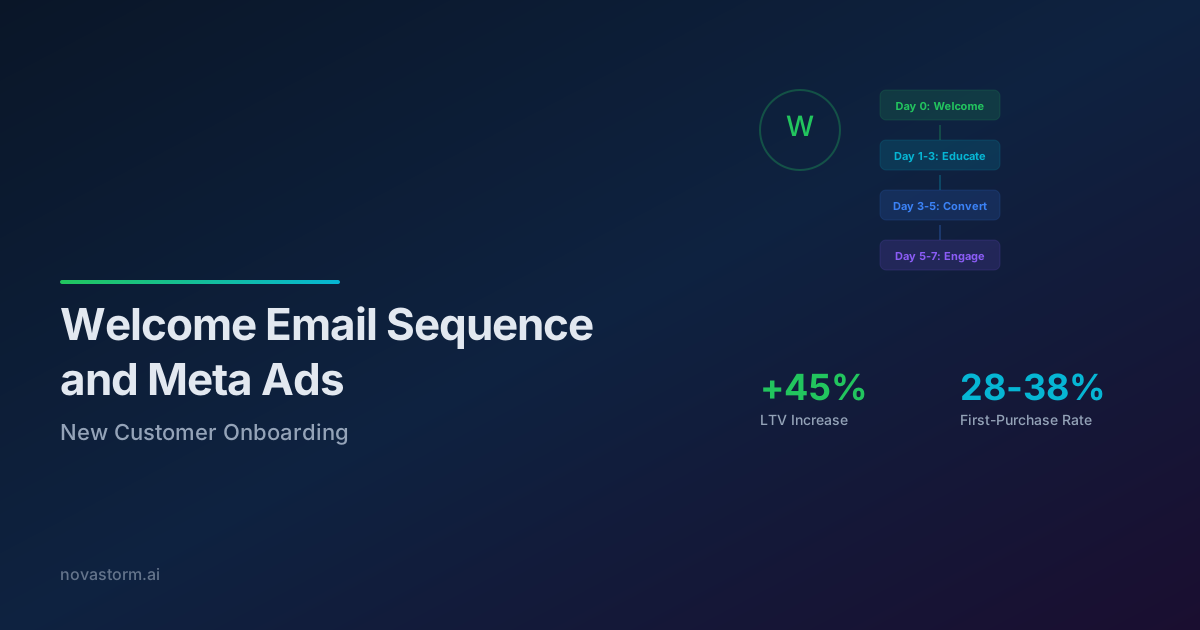
Design separate welcome paths for subscribers and buyers, verify delivery and permissions, and evaluate added Meta ads using mature useful actions.