

How to Read Meta Ads Metrics Without Getting Overwhelmed
Read Meta delivery and conversion metrics with exact denominators, mature orders, contribution economics and competing diagnostic hypotheses.
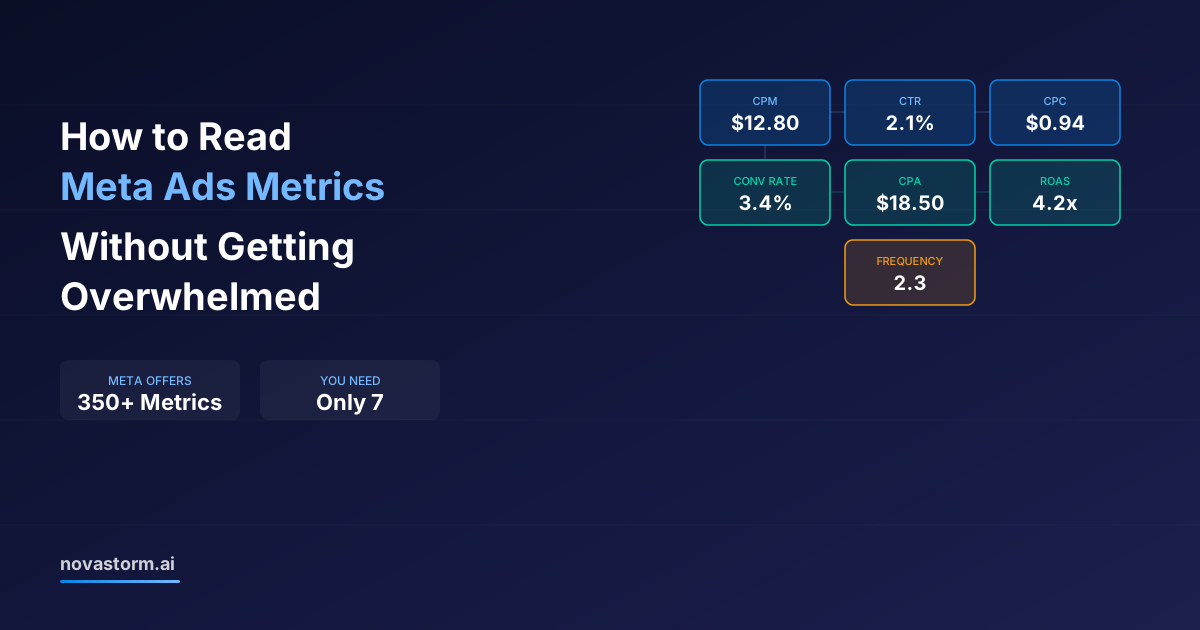
How to Read Meta Ads Metrics Without Getting Overwhelmed
A useful report connects delivery, response and mature business outcomes without declaring the first unusual number the cause. Start with one commercial question, the same dates/currency and exact denominators. Seven metrics can organize diagnosis; they are not a complete causal model or a universal definition of campaign health.
A seven-metric view with explicit definitions
| Metric | Definition to save | What it cannot establish alone |
|---|---|---|
| CPM | Spend / impressions × 1,000 | Why delivery price changed |
| Link CTR | Link clicks / impressions × 100% | Quality or purchase intent |
| Link CPC | Spend / link clicks | Profitability of acquired visits |
| CVR | Unique mature paid orders / eligible landing sessions × 100% | Cause of drop-off; match cohort/window and session definition |
| CPA | Spend / unique mature paid orders | Contribution after returns or incremental demand |
| Revenue ROAS | Attributed revenue / spend | Net profit or causal lift |
| Frequency | Impressions / reported unique reach over the same period | Every person’s exposure or proven fatigue |
The official Meta Insights SDK distinguishes click, link-click, action and value fields. Choose consistent available fields; create the defined session-based CVR in a reconciled worksheet if it is not available as a native column. Add raw spend, impressions, link clicks, eligible sessions, mature orders, pending orders and net contribution so each ratio can be checked.
A worked diagnostic report
Illustrative assumptions, not observed results: spend $300, impressions 30,000, link clicks 600, eligible landing sessions 500, ten mature paid orders and $900 attributed revenue. Calculations: CPM $10; link CTR 2%; link CPC $0.50; session-based CVR 2%; mature CPA $30; revenue ROAS 3.0. Frequency requires a separate unique-reach figure and cannot be inferred from this row.
If those orders contribute an assumed $25 each after goods, fulfillment and expected refunds, contribution is $250 and contribution less ad spend is−$50 before overhead. A ROAS of 3 is therefore not automatically healthy. Use actual margin, returns and mature order quality to set the ceiling rather than universal CPM $8–20 or CVR 2–5% bands.
Stop wasting ad budget
NovaStorm AI cuts Meta Ads CPA by 30% on average. No complex setup required.
Turn a pattern into competing hypotheses
| Pattern | Possible explanations | Next evidence |
|---|---|---|
| High link CTR, low CVR | Message mismatch, poor traffic fit, stock/price changes, slow or broken path, collection/consent gap | Test destination and reconcile sessions/orders before replacing it |
| Higher CPA after recent edit | Different market mix, delayed outcomes, changed offer or auction, sparse data | Preserve change log and wait for comparable maturity within cash cap |
| Frequency rises and CTR falls | Fatigue hypothesis, audience mix, changed placement, repeated impressions | Compare equivalent windows and approved creative experiment |
| ROAS falls at stable CPA | Lower order value, refunds, different customer mix or event values | Reconcile revenue and contribution ledger |
A seven-day average can still contain too few orders or immature conversions. A report with two orders is not equivalent evidence to one with twenty, and the latter is not automatically conclusive. Report counts, conversion delay, customer mix and uncertainty beside the trend; investigate confirmed technical failures immediately.
A reviewable notification instead of an automatic diagnosis
Proposed notification specification for a connected monitoring workflow, not an observed NovaStorm alert: “Window: the agreed mature cohort, same currency and attribution definition. Spend $300;10 mature orders; CPA $30 against the owner’s chosen $25 ceiling. Two recent orders remain pending. Hypotheses: order mix, collection, destination or delivery changed. Requested action: owner reviews order ledger and cash cap before changing budget.”
Prepare this report definition and proposed response alongside a NovaStorm campaign draft. Verify which metrics and notifications the actual connection supports; a monitoring signal does not authorize a budget change, prove the page is defective or guarantee that every important issue is caught.
Published by NovaStorm AI. Worked examples and proposed tests are labeled in the article.
Disclaimer: This article was generated with the assistance of AI and reviewed by the NovaStorm AI team. While we strive for accuracy, we recommend verifying specific data points and consulting official sources (linked where available) for critical business decisions.
Ready to automate your Meta Ads?
NovaStorm AI takes full responsibility for your campaigns — from monitoring to optimization.
Start NowMore on Campaign diagnostics
How to Recover a Declining Meta Ads Account: Turnaround Playbook
Diagnose a Meta Ads decline with reconciled paid results, a cash-risk limit and sequential creative or audience tests rather than a promised seven-day reset.
Meta Ads Not Spending Budget: Diagnosis and Fix Guide
Diagnose low Meta Ads spend using statuses, billing, schedule and allocation. Plan a reversible cap test with explicit spend and acquisition boundaries.
How to Audit a Meta Ads Account in 60 Minutes
Run a 60-minute Meta Ads triage with reconciled orders, a repair acceptance log, and explicit checks for percentages and acquisition-cost units.
High CPA Troubleshooting on Meta Ads: Step-by-Step Diagnosis
Reconcile units and mature outcomes, then decompose CPA into CPM, outbound CTR and conversion. Includes source counts, denominator errors and a documented demo boundary.