

Self-Reported Attribution: Asking Customers How They Found You
Use optional self-reported discovery answers with order-linked storage, unknown categories and honest nonresponse reporting.
A voluntary discovery question provides a customer’s recollection, not a complete exposure log or a causal estimate. Combine it with recorded source data while keeping unknown answers and nonrespondents visible. The useful outcome is a better hypothesis about discovery, not an automatic budget reallocation.
Ask one optional question
Illustrative prompt: “How did you first hear about us? Optional — you can skip this question.” Place it after a confirmed order and avoid making fulfillment depend on an answer. Open text and offered choices each have tradeoffs; neither guarantees unbiased recall. Use the same question version during a comparison.
A minimal response schema
| Field | Purpose |
|---|---|
| Opaque order ID | Join to the secured order ledger; no payment details in survey exports |
| Question version and response timestamp | Separate changes to wording and timing |
| Invitation presented / skipped / answered | Keep the full eligible population and nonresponse denominator |
| Original answer | Restricted text with retention and privacy rules |
| Category and confidence | Derived label without overwriting the original |
| Reviewer and rule version | Resolve disputed mappings consistently |
| Order state and net amount | Exclude failed orders; preserve refund handling in revenue summaries |
Keep the survey optional and collect only what is needed under the applicable privacy basis. Tell customers how responses will be used. Do not request sensitive personal details. Limit access, redact free text where necessary and define retention. A response with an order ID should not be uploaded to an advertising platform merely because it is technically joinable.
Categorize without manufacturing certainty
| Illustrative answer | Category | Rule |
|---|---|---|
| Google search | Google search — paid/organic unknown | Do not label organic without clarification |
| A sponsored Instagram post | Meta paid — self-reported | Preserve that this is remembered, not verified exposure |
| A friend sent an Instagram link | Referral/social sharing | Do not infer paid or organic source of the original post |
| Meta — paid/organic unknown | Ask optional clarification or retain unknown | |
| A podcast and then Google | Multiple mentioned sources | Keep both; do not silently force one |
| Cannot remember / blank | Unknown / unanswered respectively | Different states, both retained |
Stop wasting ad budget
NovaStorm AI cuts Meta Ads CPA by 30% on average. No complex setup required.
Use an adjudication rule for ambiguous answers: two reviewers inspect a sample independently; disagreements remain unknown unless a permitted clarification resolves them. AI can suggest labels, but it must not invent a channel or reinterpret “Google” as an organic visit.
Reconcile 200 platform purchases and 120 responses
Synthetic month: 300 eligible paid orders, 150 answered, and 120 respondents mention Meta. Meta reports 200 attributed purchases under recorded settings. Response rate is 150 / 300 = 50%; Meta mention share among respondents is 120 / 150 = 80%. Neither 120 nor 200 proves what would happen without advertising. They answer different questions and may cover different events, cohorts or recall periods.
The eighty-count difference is not “sales that would happen anyway.” Inspect duplicated purchase events, return handling, nonresponse, first-discovery versus later assistance, channel confusion and reporting lag. Do not fill the 150 unanswered orders with the respondent distribution without a clearly labeled modeling assumption.
Use the insight as a test brief
Compare both source perspectives over equal matured order cohorts and keep count-weighted and revenue-weighted views distinct. A customer’s larger order can dominate a revenue share without increasing the number of customers. A controlled incrementality study is needed when causal contribution is the decision requirement; survey agreement alone is insufficient.
Prepare a creative hypothesis and chosen spend limit as a NovaStorm campaign draft and review it against mature net contribution. For example, test a message addressing a repeatedly mentioned discovery need while retaining the same offer. Survey storage, categorization and causal measurement remain separate from campaign preparation.
Published by NovaStorm AI. Worked examples and test fixtures in this article are illustrative, not observed customer results.
Disclaimer: This article was generated with the assistance of AI and reviewed by the NovaStorm AI team. While we strive for accuracy, we recommend verifying specific data points and consulting official sources (linked where available) for critical business decisions.
Ready to automate your Meta Ads?
NovaStorm AI takes full responsibility for your campaigns — from monitoring to optimization.
Start NowMore on Attribution and incrementality
View-Through Conversions on Meta: How to Value Impressions
Compare view-through credit with click-only reports while keeping causal lift and mature contribution separate.
Holdout Testing for Meta Ads: Measuring Baseline Performance
Design a holdout with explicit scope, power and opportunity cost, then calculate consistent incremental outcomes with uncertainty.
Brand Lift Studies on Meta: Measuring Awareness and Recall
Plan a brand-lift survey with account eligibility, neutral questions, response denominators and properly interpreted uncertainty.
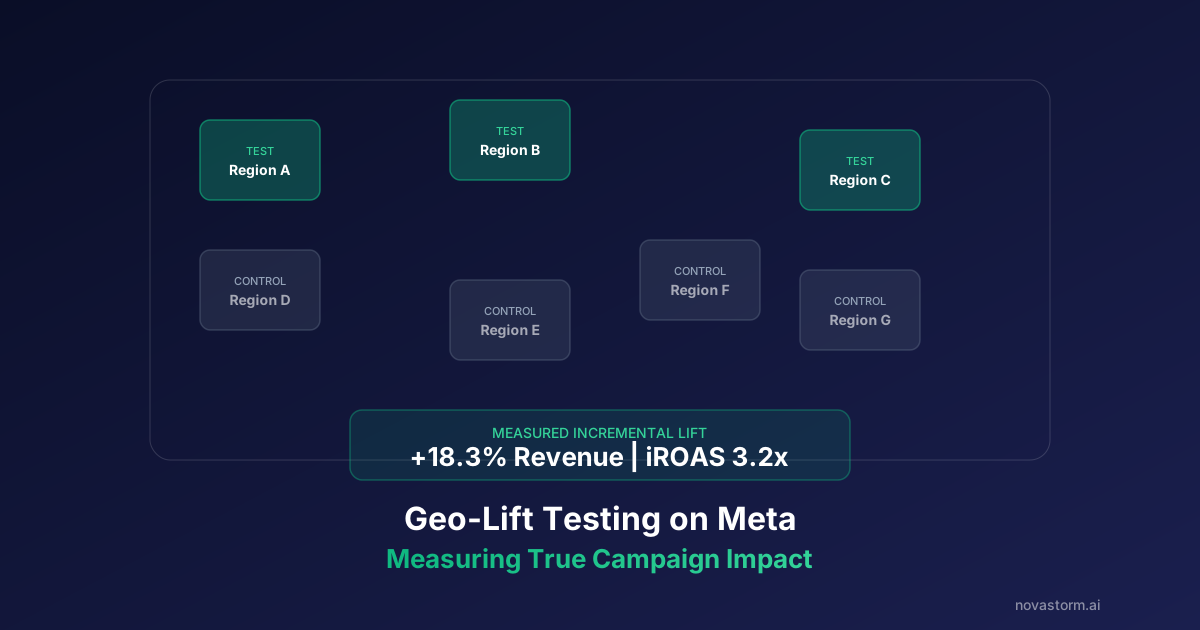
Geo-Lift Testing on Meta: Measuring True Campaign Impact
Design a geo-lift test with GeoLift tutorial data, pre-period checks, power planning and margin-based decisions that account for uncertainty.