

Meta Ads Pricing Models: How to Price Your Agency Services
Price Meta agency work from scoped hours and loaded costs, with inspectable bonus terms and measured campaign-preparation efficiency.
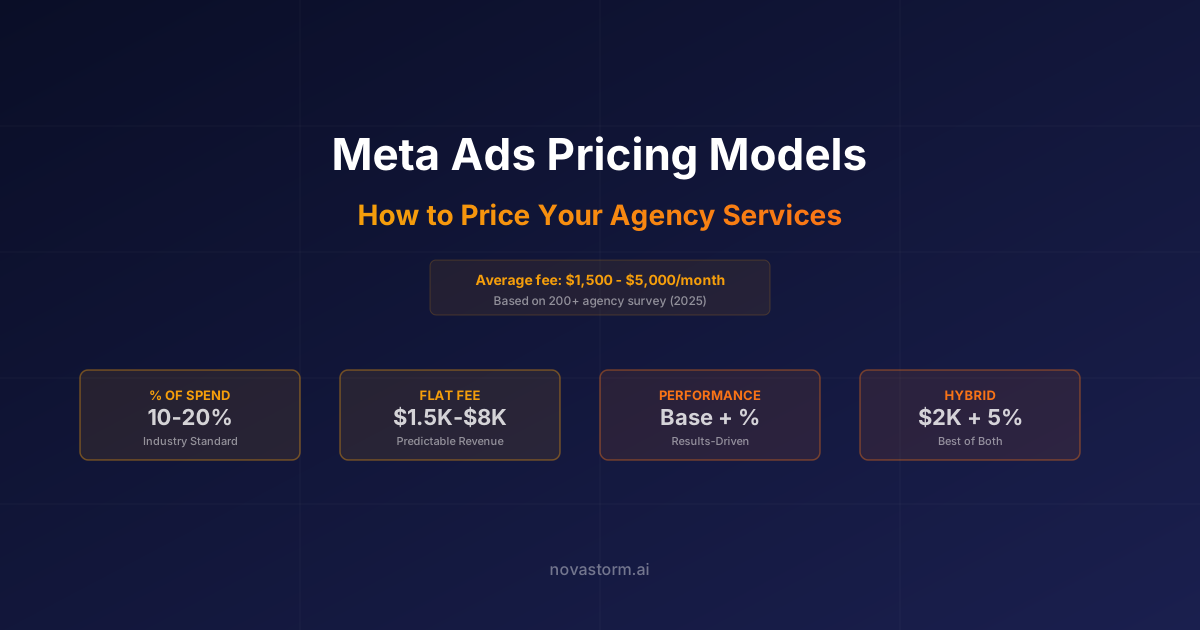
Price an agency service from its defined workload, delivery cost and risk before choosing a fee model. A retainer, spend percentage or bonus is sustainable only when the contract makes scope and the counting method clear.
A bounded service and cost worksheet
All amounts are hypothetical monthly values, not a survey of agencies. The scope is two campaigns for one offer/account, four creative variants, one revision round and one monthly report. Additional platforms, tracking rebuilds and unlimited revisions are separate work.
| Work | Hours | Loaded cost at $50/hour |
|---|---|---|
| Strategy and client communication | 6 | $300 |
| Campaign preparation and checks | 10 | $500 |
| Creative review and revisions | 8 | $400 |
| Reporting and review | 6 | $300 |
| Total labor | 30 | $1,500 |
Add $250 allocated tools/overhead and $250 rework allowance: service cost is $2,000. A $3,000 fee leaves $1,000 contribution, or 33.33% of fee, before any cost not included in that worksheet. A spend-based fee should have a floor consistent with this scope and cost; increasing ad spend does not necessarily increase client profit.
Define a bonus the parties can inspect
An example contract concept is a base fee plus a capped bonus on a jointly defined eligible outcome. Specify source ledger, attribution convention, measurement period, maturity, returns, discounts, production and fulfillment costs, exclusions, verification rights and dispute handling. Prefer a metric the agency can materially influence, while documenting stock, pricing and sales decisions outside its control.
Do not pay a bonus on platform revenue that overlaps another channel or open pipeline treated as sales. If the metric is contribution, state its included costs. A before-and-after change without a comparison is not automatically incremental contribution.
Stop wasting ad budget
NovaStorm AI cuts Meta Ads CPA by 30% on average. No complex setup required.
Revenue opportunity is not profit
Hypothetical $15,000 additional revenue divided by a $4,000 agency fee is 3.75, a gross revenue-to-fee coefficient. At an assumed 30% contribution margin, the revenue contributes $4,500 before the fee. Subtract $4,000 fee and $1,000 incremental creative: −$500 remains. The revenue increase itself is a forecast unless measured under a defensible design.
Measure preparation efficiency before changing the price
- Compare repeated comparable campaign-preparation tasks with and without the chosen workflow; record task start/end, approvals, corrections and rework.
- Include NovaStorm subscription cost, reviewer time and training, not just draft-generation time.
- Measure final accepted quality and saved field accuracy; a faster defective draft is not a saving.
- Use the measured distribution and task frequency to update the cost worksheet. No actual time study is supplied here, so no product-saving percentage is claimed.
For a teaching estimate only, saving 15 minutes on four accepted preparations is one hour, worth $50 at the stated loaded rate before tool/review costs. Validate it rather than advertising it as observed. Use the onboarding scope and approval artifacts to agree dependencies and included work.
Use NovaStorm to prepare an approved campaign draft and review saved fields before publication. Set or revise fees from measured costs and the client agreement; tier selection, utilization and close-rate thresholds are business-specific hypotheses.
Published by NovaStorm AI. Worked examples and proposed tests are labeled in the article.
Disclaimer: This article was generated with the assistance of AI and reviewed by the NovaStorm AI team. While we strive for accuracy, we recommend verifying specific data points and consulting official sources (linked where available) for critical business decisions.
Ready to automate your Meta Ads?
NovaStorm AI takes full responsibility for your campaigns — from monitoring to optimization.
Start NowMore on Agency operations and careers
Client Onboarding for Meta Ads Agencies: First 30 Days
Onboard Meta clients with filled discovery, task-based access and expectations documents, launching only after events and approvals are ready.
White-Label Meta Ads Management: Running Ads Under Client Brands
Structure white-label Meta delivery with authorized access, clear subcontracting rights, complete agency costs and an inspectable review and exit process.
Scaling an Ad Agency: From 5 to 50 Clients
Scale a Meta agency from measured client hours, payroll and cash runway, with bottleneck-based hiring and a defined second-review gate.
Client Retention for Meta Ads Agencies: Reducing Churn
Review agency client health with documented scores, correct monthly-to-annual churn arithmetic and a cost-limited conversation plan.