

Scaling an Ad Agency: From 5 to 50 Clients
Scale a Meta agency from measured client hours, payroll and cash runway, with bottleneck-based hiring and a defined second-review gate.
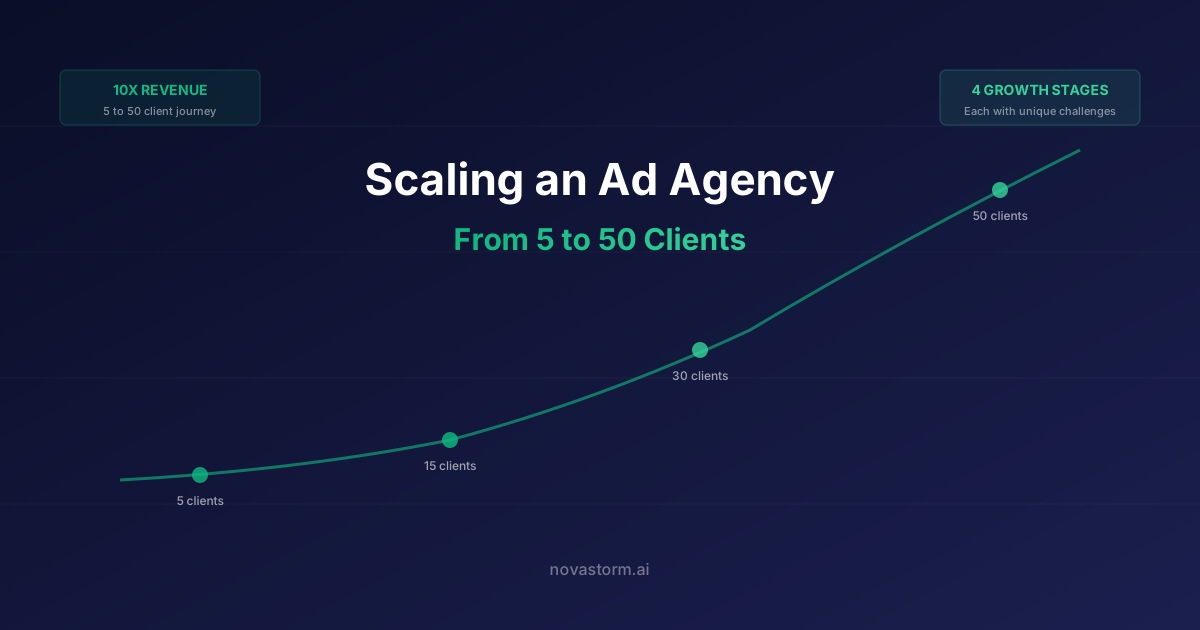
Agency capacity is measured in accepted work, review time and cash obligations, not simply client count. Before hiring, identify the task that delays delivery and calculate whether recurring fees support the additional cost.
A filled capacity model
This is a hypothetical monthly model for two delivery staff working 160 hours each. From 320 hours, reserve 96 for leave coverage, internal work, training and review. The remaining 224 hours support a stated 12-hour monthly client scope: floor(224 / 12) = 18 clients, before any additional unmodeled demand.
| Capacity item | Teaching amount |
|---|---|
| Execution per client | 8 hours |
| Communication/reporting per client | 3 hours |
| Second review per client | 1 hour |
| Total at 18 clients | 216 hours |
| Remaining delivery buffer | 8 hours |
Eight buffer hours may be too small when rework is variable. Use measured workload distributions, not just averages. A launch-heavy client can exceed the stated scope; one agency’s 18-client arithmetic is not an industry staffing rule.
Hire for the observed bottleneck
- If approval and reporting queues dominate, assign coordination/account work.
- If execution is late despite ready approvals, consider a buyer or technical specialist.
- If creative production or rights review blocks delivery, add that capacity instead.
- Price the full loaded cost, onboarding, supervision and leave coverage. Do not assume a fixed first-hire order from client count.
- Limit new client commitments until the new role passes a defined acceptance check.
Stop wasting ad budget
NovaStorm AI cuts Meta Ads CPA by 30% on average. No complex setup required.
Cash and review gates
Hypothetical new monthly fixed obligations are $12,000. A chosen three-month runway is $36,000, plus separately calculated variable commitments and delayed-payment exposure. This is a planning assumption, not a universal reserve rule. Invoice revenue is not immediately available cash; model client payment terms and a cancellation scenario.
Second-review acceptance: reviewer can reproduce the brief, confirm current offer/rights, inspect saved budget and destination, catch a deliberately incorrect field in a training draft and document a handoff. Larger independent budgets require the employer’s explicit authorization and escalation limits, not a calendar milestone.
Measure a team process
For campaign preparation, record accepted draft time, corrections, reviewer time and tool cost on comparable tasks. No measured 30–40% labor reduction or training-time study is supplied here. A hypothetical 20-minute reduction repeated on 12 tasks saves four hours before extra training/review costs; verify it before treating it as capacity.
Use the onboarding gates to assign dependencies. In a NovaStorm workflow, one person prepares the brief and campaign draft, and a second checks saved fields before publication. Tool use supports the process; it does not remove payroll, quality review or budget accountability.
Published by NovaStorm AI. Worked examples and proposed tests are labeled in the article.
Disclaimer: This article was generated with the assistance of AI and reviewed by the NovaStorm AI team. While we strive for accuracy, we recommend verifying specific data points and consulting official sources (linked where available) for critical business decisions.
Ready to automate your Meta Ads?
NovaStorm AI takes full responsibility for your campaigns — from monitoring to optimization.
Start NowMore on Agency operations and careers
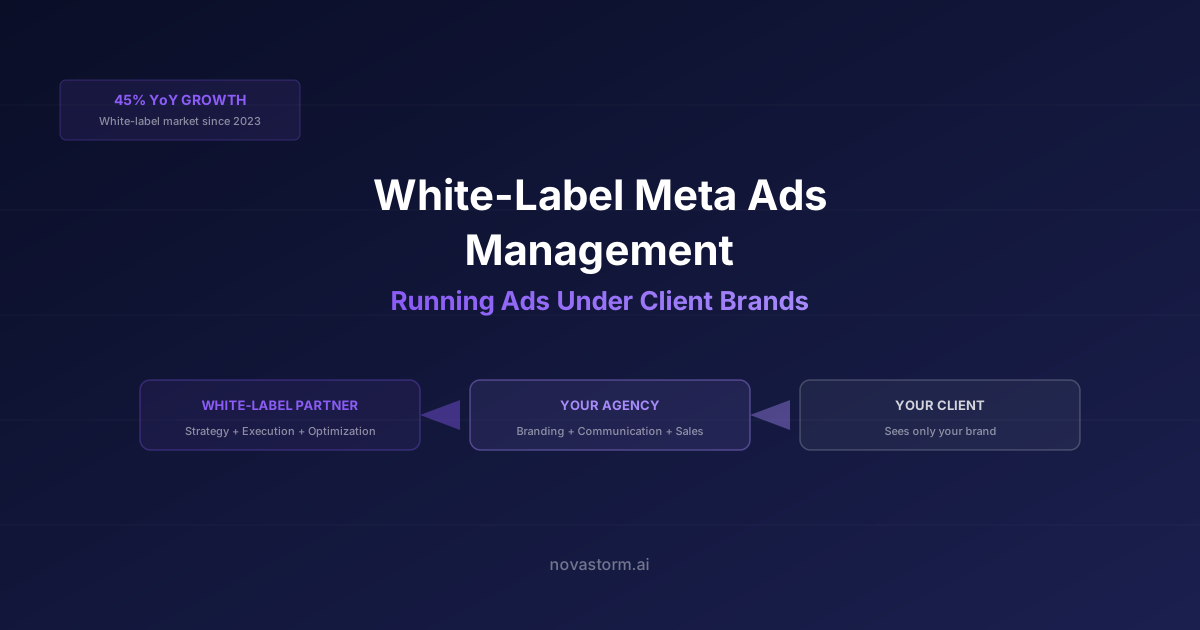
White-Label Meta Ads Management: Running Ads Under Client Brands
Structure white-label Meta delivery with authorized access, clear subcontracting rights, complete agency costs and an inspectable review and exit process.
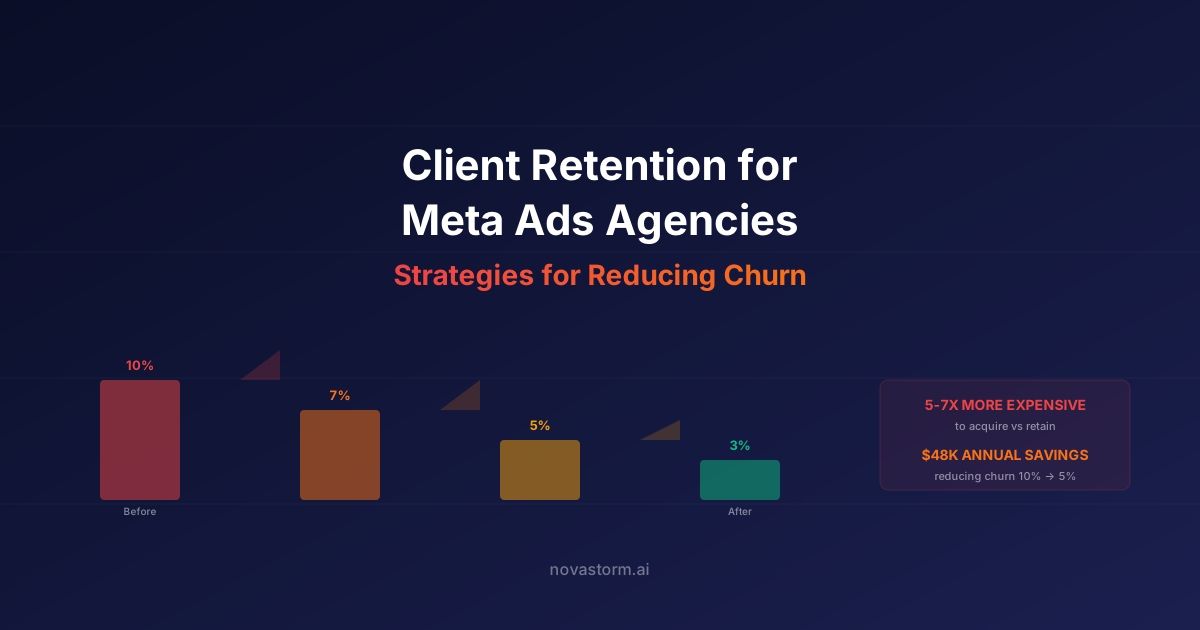
Client Retention for Meta Ads Agencies: Reducing Churn
Review agency client health with documented scores, correct monthly-to-annual churn arithmetic and a cost-limited conversation plan.
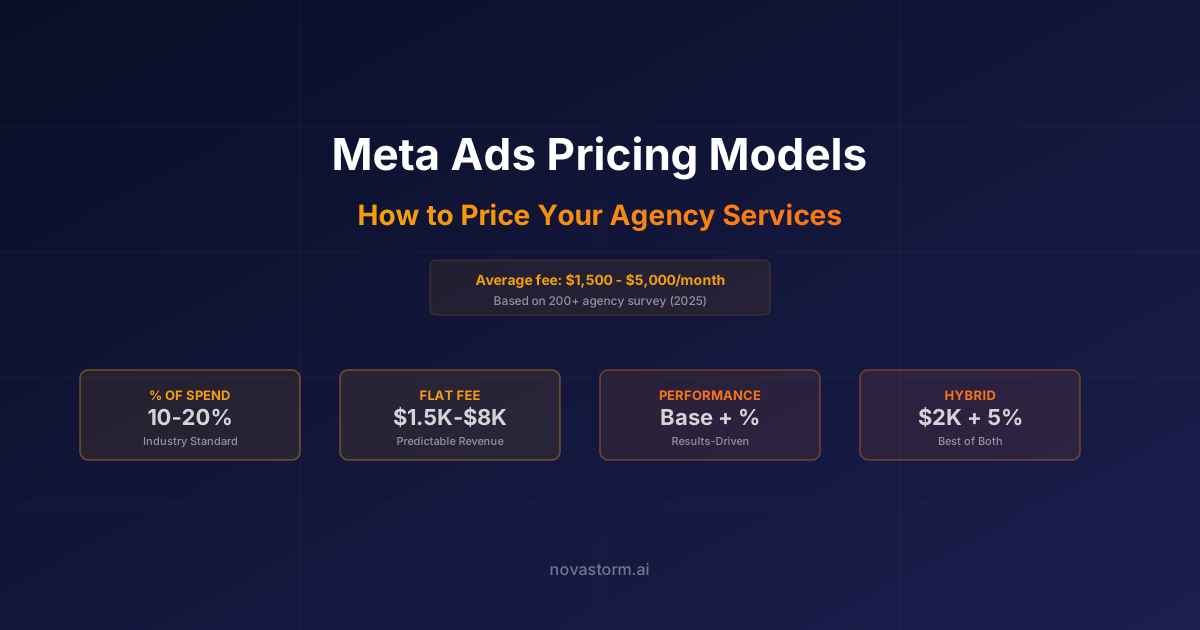
Meta Ads Pricing Models: How to Price Your Agency Services
Price Meta agency work from scoped hours and loaded costs, with inspectable bonus terms and measured campaign-preparation efficiency.
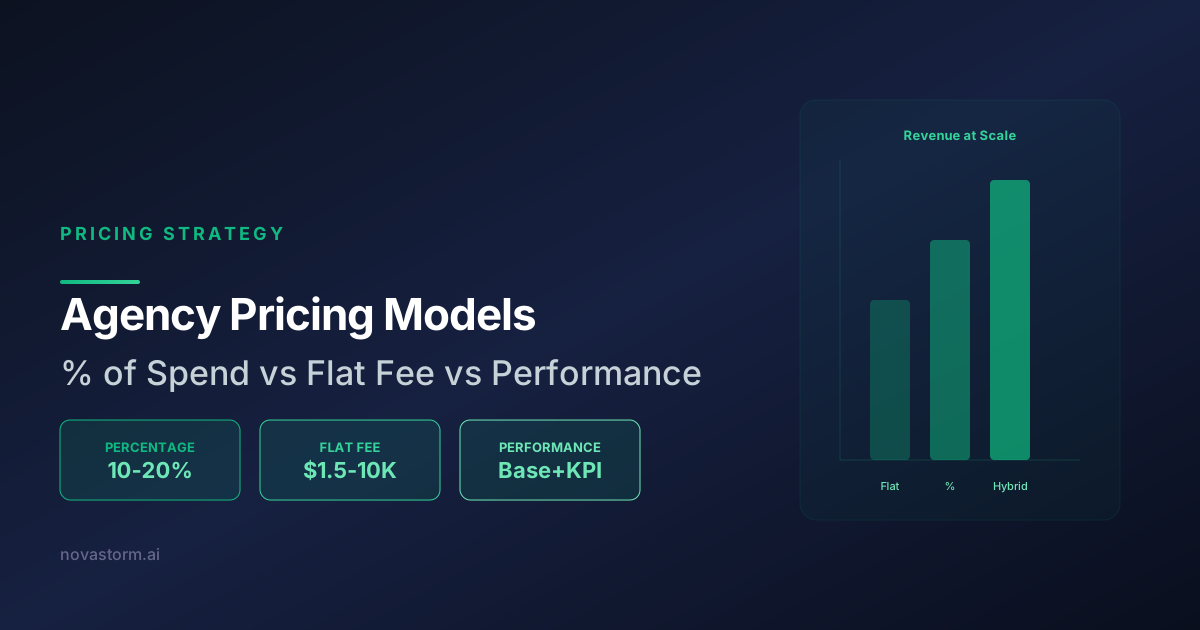
Agency Pricing: Percentage of Spend vs Flat Fee vs Performance-Based
Compare the three main agency pricing models for Meta Ads management. Learn which pricing structure maximizes revenue while keeping clients happy long-term.