

Client Retention for Meta Ads Agencies: Reducing Churn
Review agency client health with documented scores, correct monthly-to-annual churn arithmetic and a cost-limited conversation plan.
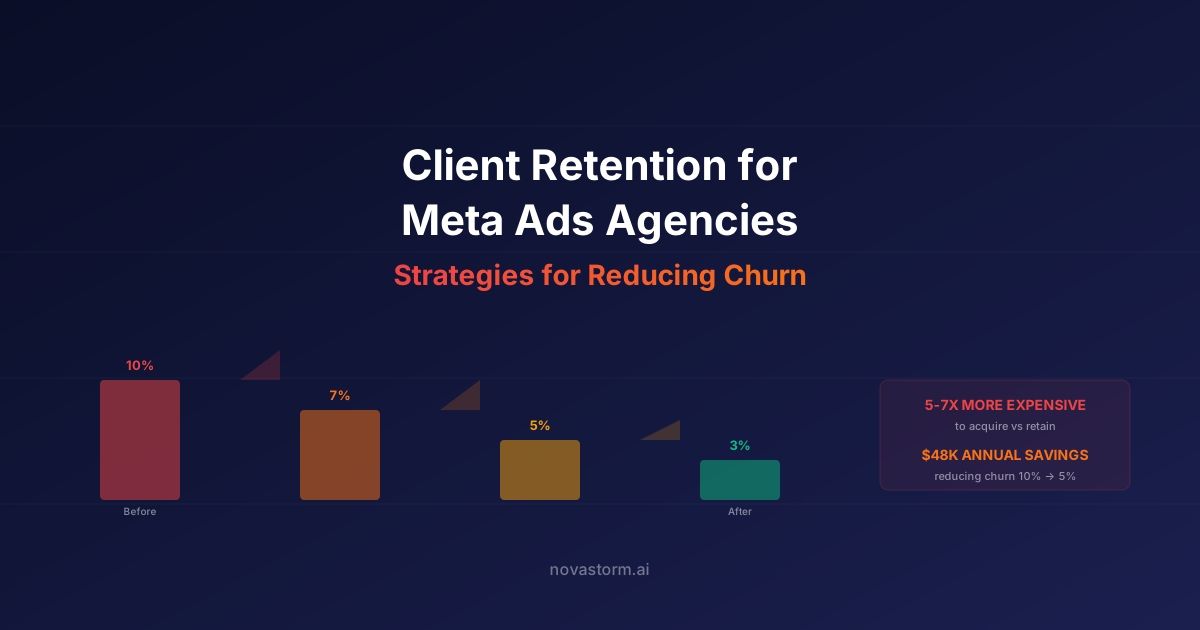
A client-health review helps the agency ask a timely, evidence-based question. It is not a predictor that guarantees renewal. Separate observed campaign facts, client feedback and the cost of any proposed retention concession.
Define scores and their evidence
The weights and scores below are hypothetical review choices, not validated churn probabilities. Record the period, source and reviewer for each score; missing information is unknown rather than an automatic penalty.
| Dimension | Weight | Teaching score | Weighted contribution |
|---|---|---|---|
| Performance against agreed mature goal | 30% | 80 | 24.00 |
| Communication against agreed service terms | 25% | 84 | 21.00 |
| Payment against contract terms | 15% | 70 | 10.50 |
| Participation in required approvals | 15% | 60 | 9.00 |
| Named stakeholder feedback | 15% | 85 | 12.75 |
| Total | 100% | Not a probability | 77.25 |
Use actual source records to justify each score: dated report and agreed target, response-time log, invoice terms, outstanding approvals and explicit stakeholder feedback. A quiet client may be satisfied or busy; do not infer disengagement from tone alone.
Keep departure reasons and denominators consistent
A synthetic coding exercise assigns one primary reason to each of 100 exits: communication 32, results 26, business/budget changes 18, alternative provider 14 and mistake/trust 10. These sum to 100%, not 85%. They are teaching categories, not interviews with 500 clients. A real study needs sample, dates, definitions and treatment of multiple reasons.
Monthly churn is not annual churn
Stop wasting ad budget
NovaStorm AI cuts Meta Ads CPA by 30% on average. No complex setup required.
For a closed hypothetical cohort of 20 clients with no replacements, constant 10% monthly churn leaves 20 × 0.90^12 = 5.65 expected clients after twelve months. At 4%, it leaves 20 × 0.96^12 = 12.25. Fractional counts are model expectations, not actual clients. Annual retention rates are 28.24% and 61.27%, not 90% and 96%.
If $4,000 monthly fees are charged at the beginning of each month for the surviving modeled cohort, twelve-month expected fee revenue is about $574,056 versus $774,580. This scenario difference is gross revenue, not profit or evidence that a retention program caused it. Delivery cost, concessions, payment failure, replacements and changing hazard rates require their own modeling.
Document the conversation and the limit
| Teaching conversation record | Completed example |
|---|---|
| Concern stated by client | Needs lower monthly cash outlay; do not assume hidden dissatisfaction |
| Evidence discussed | Mature campaign period and outstanding approval facts |
| Proposed response | Reduce scope and fee by an agreed amount |
| Cost/limit | No concession that makes the agreed scope loss-making |
| Owner/review | Account manager; client confirms plan and review date |
Respect a genuine decision to leave and complete the exit handoff. Avoid a performance guarantee to save the account. Use the expectations and access artifacts to reset scope or offboard cleanly.
Review actual saved campaign facts and prepare any approved message change in a NovaStorm draft. Campaign facts inform the conversation; they are not a client-churn score or a guarantee of retention.
Published by NovaStorm AI. Worked examples and proposed tests are labeled in the article.
Disclaimer: This article was generated with the assistance of AI and reviewed by the NovaStorm AI team. While we strive for accuracy, we recommend verifying specific data points and consulting official sources (linked where available) for critical business decisions.
Ready to automate your Meta Ads?
NovaStorm AI takes full responsibility for your campaigns — from monitoring to optimization.
Start NowMore on Agency operations and careers
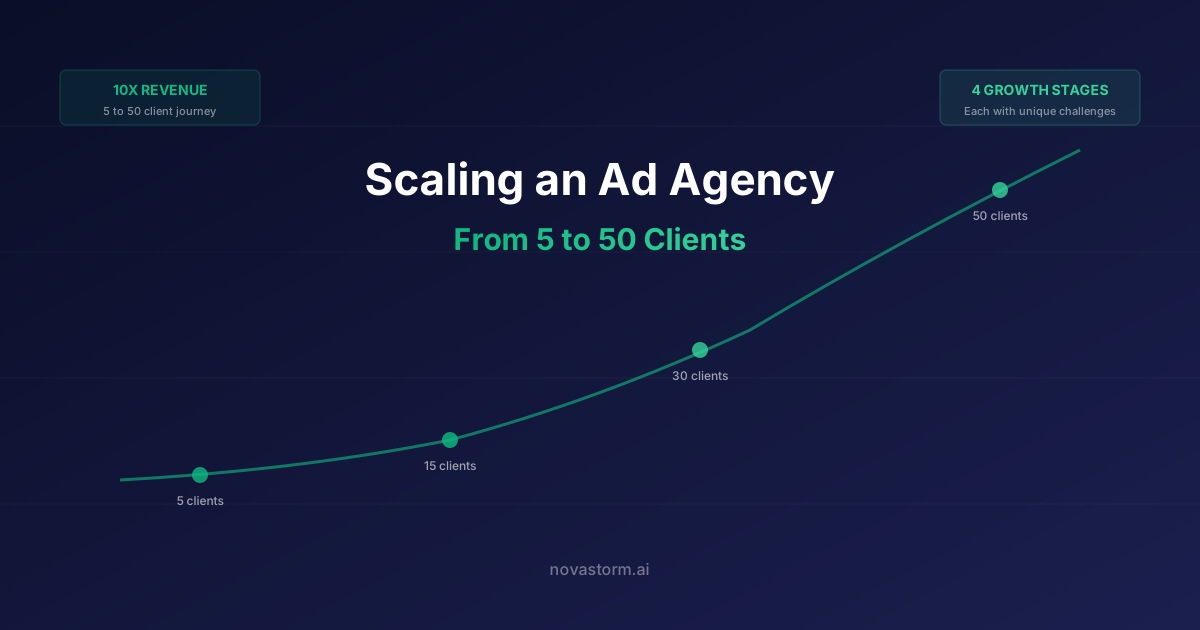
Scaling an Ad Agency: From 5 to 50 Clients
Scale a Meta agency from measured client hours, payroll and cash runway, with bottleneck-based hiring and a defined second-review gate.
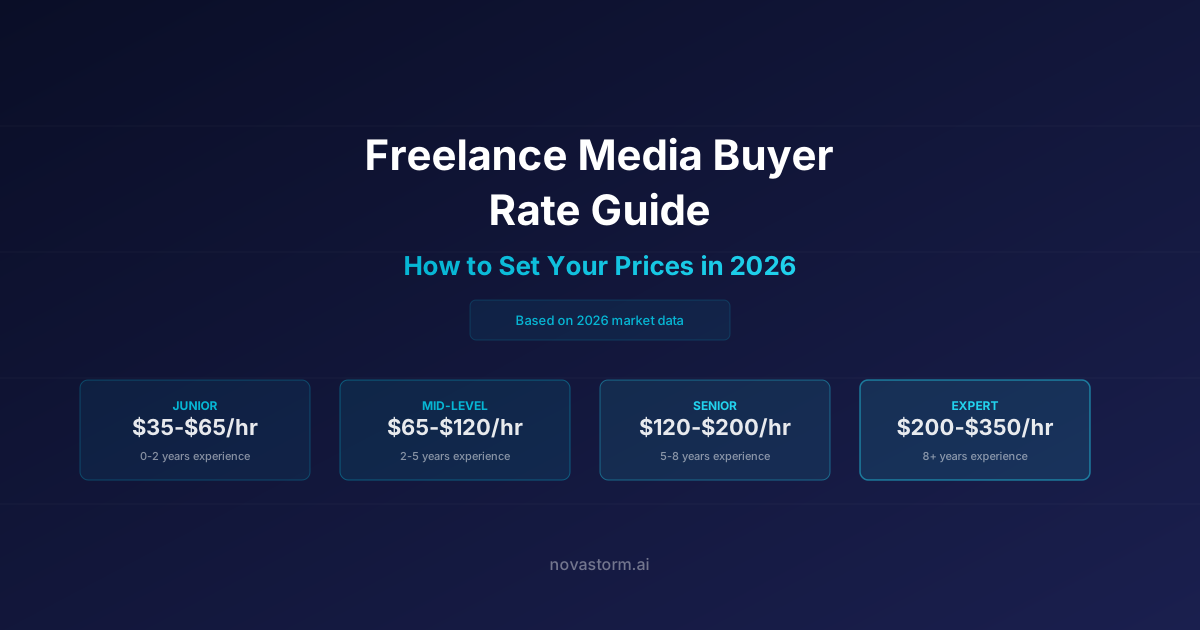
Freelance Media Buyer Rate Guide: How to Set Your Prices
Calculate a freelance media-buyer rate from leave-adjusted billable hours, your tax assumptions and retainer scope, then verify actual workload.
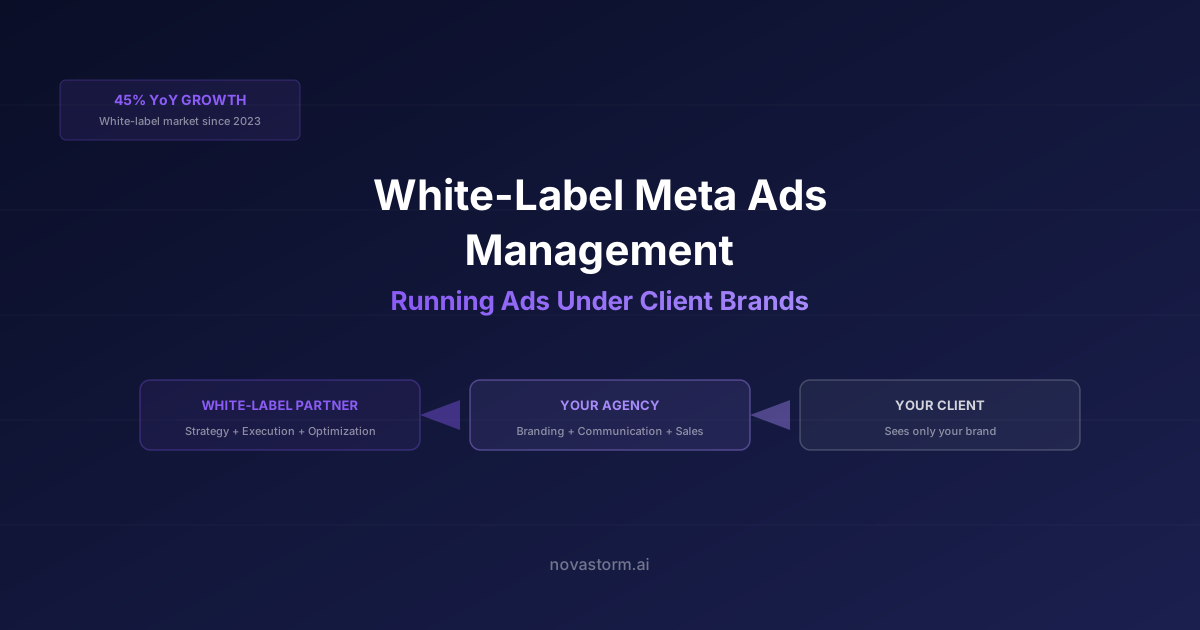
White-Label Meta Ads Management: Running Ads Under Client Brands
Structure white-label Meta delivery with authorized access, clear subcontracting rights, complete agency costs and an inspectable review and exit process.

Meta Ads Pricing Models: How to Price Your Agency Services
Price Meta agency work from scoped hours and loaded costs, with inspectable bonus terms and measured campaign-preparation efficiency.