

Benefit-Driven vs Feature-Driven Ad Copy on Meta
Translate features into supportable task benefits, draft three comparable versions and evaluate mature outcomes without guaranteed performance claims.
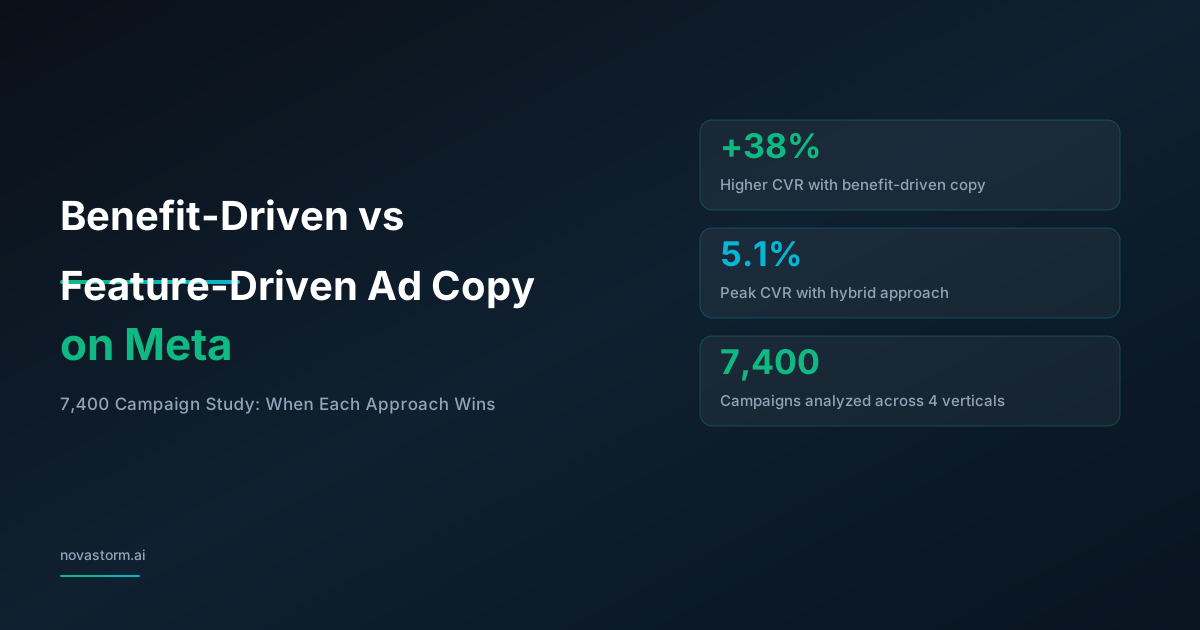
A feature states what a product does; a benefit explains why that action might matter to a buyer. Keep the reasoning chain, but stop before it turns a possible advantage into guaranteed performance. Neither benefits, features nor a hybrid wins every context.
Apply “so what?” without adding facts
Hypothetical teaching product: DeskTrail saves a desk-layout plan and lets its owner share a link, at $12/month without a free trial. These are invented scenario facts, not measured product results.
| Step | Concrete statement | Evidence boundary |
|---|---|---|
| Feature | A saved layout plan has a shareable link | Approved scenario capability |
| So what? | Two people can discuss the same plan | Reasonable proposed use, not a measured outcome |
| Possible benefit | Discuss a layout before choosing furniture | Task framing to test |
| Unsupported leap | Save hours or reduce buying mistakes by 30% | Reject without a defined study and substantiation |
For NovaStorm, a verified feature is preparation of an unpublished campaign structure as local drafts, with campaign creation defaulting to Paused. A proposed benefit is reviewing saved settings before approving publication. That does not prove instant anomaly detection, guaranteed spend protection or a 30% CPA reduction.
Three complete copy variants from the same brief
| Type | Illustrative draft | Hypothesis |
|---|---|---|
| Feature | Save your desk-layout plan and share its link. DeskTrail costs $12/month. | Specific mechanics may help readers comparing tools |
| Benefit | Discuss a desk layout before buying furniture. DeskTrail costs $12/month. | Task context may make the next step clearer |
| Hybrid | Save and share a desk-layout plan to discuss it before buying furniture. DeskTrail costs $12/month. | Capability plus task context may reduce uncertainty |
All variants must keep the actual offer, restrictions and destination consistent. A feature count, integration list, endorsement or numerical benefit requires a current record. Technical buyers may want specifications, but do not infer that all developers respond the same way or that one visit means a reader understands the brand.
Interpret comparison math correctly
Stop wasting ad budget
NovaStorm AI cuts Meta Ads CPA by 30% on average. No complex setup required.
Hypothetical rate calculation: 4.9% versus 3.6% is a 1.3 percentage-point difference and (4.9−3.6)/3.6 = 36.1% relative increase. It is not 38%. No observed campaign study or universal hybrid uplift is claimed; denominators, assignment and uncertainty are needed before comparing actual outcomes.
Behavioral evidence such as a visit or a video view can suggest which explanation to try, but it does not measure knowledge. Do not switch copy merely because a report says 60% interacted with a brand, or promise an automatic copy-type classifier without a documented implementation.
A bounded comparison plan
- Manual tags FEATURE, BENEFIT and HYBRID identify the approved complete drafts; preserve version IDs and the claim sheet.
- Use an eligible concurrent randomized three-arm design with common audience eligibility, image, headline, button, offer and destination. Adaptive delivery between ordinary ads is discovery evidence.
- Predeclare retained customers or contribution as the primary outcome, the useful detectable effect, sample and error adjustment for multiple comparisons. A three-arm test needs more funding than one two-arm contrast.
- Authorize total exposure and equal conversion/returns follow-up. If the planned sample cannot be funded, run a clearly exploratory pilot and allow an inconclusive result.
- Review outcome quality and full costs. A higher click rate without suitable paid customers may not justify scaling.
Illustrative mature pilot: each version costs $300 media plus $50 allocated production. Feature yields 10 retained customers, benefit 12 and hybrid 11. At assumed $40 contribution each, contribution less media/production is $50, $130 and $90. These small synthetic counts are not statistically established wins and do not identify the best method for another offer.
Carry the approved version into preparation
Use NovaStorm to prepare the campaign structure as a draft, compare saved fields with the manually tagged version and review Paused status before publication approval. Unpublished ad sets remain local drafts. Use the awareness guide to research what readers actually know before picking the next message hypothesis.
Published by NovaStorm AI. Worked examples and proposed tests are labeled in the article.
Disclaimer: This article was generated with the assistance of AI and reviewed by the NovaStorm AI team. While we strive for accuracy, we recommend verifying specific data points and consulting official sources (linked where available) for critical business decisions.
Ready to automate your Meta Ads?
NovaStorm AI takes full responsibility for your campaigns — from monitoring to optimization.
Start NowMore on Ad copy and messaging
Storytelling in Meta Ad Copy: Narrative Frameworks That Sell
Write traceable ad stories with fictional examples clearly labeled, real testimonial permission, accurate outcome arithmetic and a controlled test plan.
How to Write Meta Ad Copy for Different Awareness Levels
Research category and brand knowledge, draft five awareness message hypotheses and measure complete acquisition economics rather than assuming market shares.
Primary Text Best Practices for Meta Ads: Length and Format
Prepare three traceable primary-text lengths, check openings and previews, then compare approved copy with funded sampling and mature outcomes.
How to Write Headlines for Meta Ads That Stop the Scroll
Write supportable Meta ad headlines, preview their placement visibility and test one angle with an explicit sample and mature outcome plan.