

Checkout Page Optimization for Meta Ads E-commerce Traffic
Audit checkout states, countries, guest and wallet paths, and retries; reconcile unique paid orders and refunds before approving an ad destination.
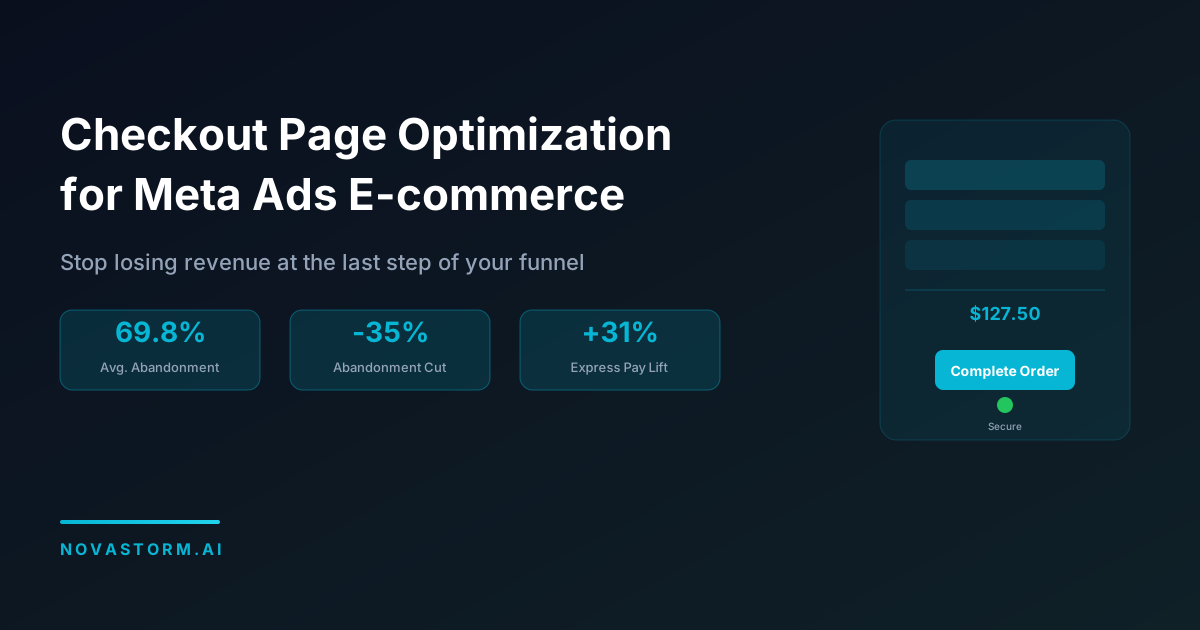
Before sending Meta traffic to a checkout, inspect the full payable total, guest path, supported country inputs, payment state and recovery route. A confirmation page is not authoritative proof of payment. Prioritize reproducible failures before treating a visual redesign as an experiment.
A state ledger that separates attempts from outcomes
Hypothetical 100-start cohort, followed through a chosen mature purchase window: 40 unique orders are paid and 60 remain unpaid. Ten declined attempts occur across the cohort; eight belong to later paid orders and two to unpaid starts. Attempts are not additional abandoned orders.
| Teaching start / order | Attempt sequence | Mature order state | How to count |
|---|---|---|---|
| X001 / O001 | A001 declined; A002 paid | Paid, later partially refunded | One paid order; refund affects contribution. |
| X002 / O002 | A003 paid; same request retried | Paid once | One order and charge, despite two submissions. |
| X003 / none | A004 declined; no later success | Unpaid at follow-up | One unpaid start, not an extra abandonment. |
| X004 / O004 | A005 paid; reload confirmation | Paid once | Page reload is not another purchase. |
| X005 / O005 | A006 paid; full refund later succeeds | Paid then refunded | Retain payment history; net revenue and retained orders differ. |
The excerpt illustrates states; the aggregate assumptions define the full teaching cohort. Start-to-paid ratio is 40/100 = 40%. It is incorrect to add ten declines to 60 unpaid starts: eight already led to paid orders and two are inside the unpaid population.
Capture the route states for each supported country
The following is a screenshot capture plan and expected-state specification, not screenshots from a verified store. Use a payment-provider sandbox and permitted test data. Do not include real card, customer or token details in the capture.
| Route / market | Capture and inspect | Reload and recovery acceptance |
|---|---|---|
| Guest checkout / United States | Guest selection, address labels, state selection, full shipping/tax total | Safe address fields preserved; total remains correct; no forced account surprise. |
| Guest checkout / United Kingdom | Alphanumeric postcode, supported address layout, delivery availability | Postcode not corrupted by numeric-only rules; errors point to the field. |
| Guest checkout / chosen actual wallet market | Wallet shown only when provider, country and device support it; card fallback visible | Cancellation returns to a usable checkout; recovery does not double-charge. |
| Authenticated checkout / each supported market | Saved address choice, consent and authoritative amount | Correct account and order state after interruption. |
| Payment requiring extra authentication | Challenge, cancel and timeout states | Order stays pending until the authoritative provider state is reconciled. |
Record browser, device, locale, provider configuration and capture time. A country name does not establish wallet eligibility. Preserve the form validation and accessible error checks throughout the flow.
Verify idempotency at the business boundary
Stop wasting ad budget
NovaStorm AI cuts Meta Ads CPA by 30% on average. No complex setup required.
For a Stripe integration, its documented idempotent request mechanism supports safely retrying an operation using the same key and matching parameters within its contract. The store must also reconcile a stable business order ID and authoritative payment state. An idempotency key alone does not deduplicate arbitrary browser analytics or every different operation.
- In the sandbox, simulate decline, success after a new valid attempt, lost connection, double submit and confirmation reload. Inspect provider and store records, not just the displayed message.
- For a retry of the same operation, preserve the required operation identity and parameters. A genuinely new payment attempt must follow the provider’s documented state flow.
- Test refund pending, success and failure; update the business ledger from authoritative state. Keep original transaction and refund IDs separate.
- Accept the repair only when the intended order has the expected charge, state, currency and amount, with no accidental duplicate order. Check event destination deduplication separately.
A repair priority based on failure and contribution
| Illustrative finding | Evidence needed | Priority decision |
|---|---|---|
| Duplicate charge after retry | Reproduced in sandbox with stable order/attempt IDs | Repair before increasing traffic; verify both retry and new-attempt behavior. |
| Valid postcode blocked | Reproduced in a supported market | Fix validation and retest affected routes. |
| Button color preference | No reproduced functional defect | Treat as an optional hypothesis after route acceptance. |
Hypothetical economics: repairing a blocked path recovers ten retained orders at assumed $25 contribution each, with $200 implementation cost, yielding an estimated $50 contribution after implementation. This is a planning scenario, not a measured recovery. Include refund/support changes and compare equally mature cohorts if evaluating an outcome.
Approve the destination before the campaign
Use the confirmation-page checks and record route approval alongside a NovaStorm campaign draft. NovaStorm draft preparation does not implement payment processing or verify idempotency. Increase advertising only after the store’s checkout owner accepts the route.
Published by NovaStorm AI. Worked examples and proposed tests are labeled in the article.
Disclaimer: This article was generated with the assistance of AI and reviewed by the NovaStorm AI team. While we strive for accuracy, we recommend verifying specific data points and consulting official sources (linked where available) for critical business decisions.
Ready to automate your Meta Ads?
NovaStorm AI takes full responsibility for your campaigns — from monitoring to optimization.
Start NowMore on Landing pages and conversion
Post-Click Conversion Optimization for Meta Ads
Reconcile explicit post-click IDs, consent and mature outcomes, repair routing and duplicates, and distinguish local attribution tests from commercial evidence.
Form Optimization for Meta Ads Lead Generation
Audit form purposes, mobile error states and submission boundaries, then compare qualified leads and mature sales with consistent costs.

Heatmap Analysis for Meta Ads Landing Pages: Where Users Click
Use landing-page heatmaps as aggregate interaction evidence, with compatible segments and page versions, then validate a specific issue before changing the page.
A/B Testing Landing Pages for Meta Ads Traffic
Set up consistent landing-page assignment, check revisit and event integrity, calculate sample and budget needs, and distinguish repairs from experiments.