

Advantage+ Shopping Campaigns vs Manual: Complete Comparison
Compare actual Advantage+ and manual campaign controls using mature new-customer contribution, saved settings and a capped experiment.
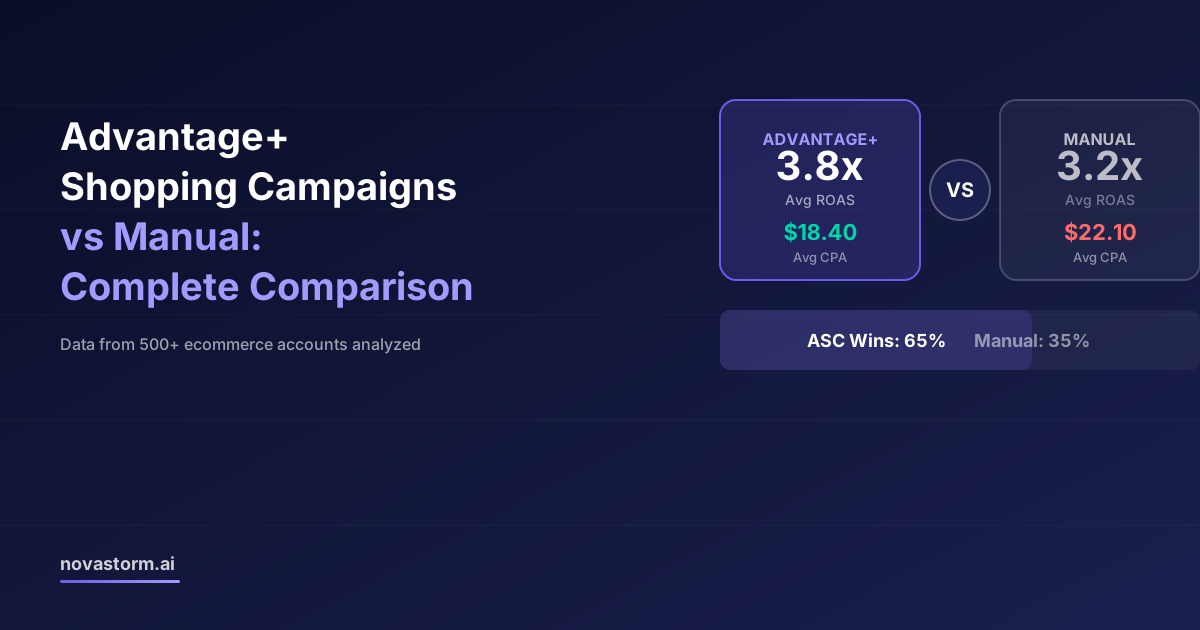
Advantage+ Shopping Campaigns vs Manual: Complete Comparison
Choose the degree of automation around the controls your store needs and the commercial question you can measure. Older “Advantage+ Shopping” terminology and configuration limits may differ from the current setup in your account. Save what is actually available before comparing an automated configuration with a manually configured alternative.
Compare actual controls rather than old feature lists
| Decision | What to save for each configuration | Why it matters |
|---|---|---|
| Eligible market and customer boundary | Actual geography, permitted exclusions and expansion behavior | A suggestion is different from a hard restriction |
| Budget and bidding | Saved budget level, strategy, dates and any allowed limits | Comparable cash limits do not randomize exposure |
| Creative/catalog | Approved assets and eligible product set | Changing offer/assets alongside automation confounds the result |
| Optimization and attribution | Event, value source, reporting window | Different event definitions can create a false winner |
| New versus repeat buyers | Business-ledger customer identity and net contribution | Revenue from existing customers can obscure acquisition cost |
The official Meta campaign SDK exposes outcome, budget and status fields. Verify available Advantage+ controls in the current account and objective. Do not rely on a guaranteed 150 combinations, a fixed existing-customer cap, a20-SKU minimum or a universal $3,000 monthly threshold. Those limits do not establish suitability without current eligibility and evidence.
Set a commercial ceiling before defining a stop rule
Hypothetical store economics: a new customer’s order produces $30 contribution after goods, fulfillment and expected returns. Reserve $5 for overhead/risk, leaving a chosen $25 acquisition ceiling. A repeat-customer order has different economics and must be recorded separately. This is an assumed planning example, not a platform benchmark.
Use unique mature paid orders, refunds and new/repeat status to judge that ceiling. Spending twice a target CPA without a reported conversion is a risk signal, not automatic proof of failure: delayed payment, attribution or collection can explain it. Set an approved cash cap and escalation action for incomplete data rather than letting an unverified event counter authorize repeated increases.
Stop wasting ad budget
NovaStorm AI cuts Meta Ads CPA by 30% on average. No complex setup required.
A controlled automated-versus-manual comparison
- Write the hypothesis: “The available automated configuration improves contribution per dollar for this offer within the approved risk allowance.” Select one primary metric and the smallest difference worth acting on.
- Use a supported randomized experiment where available, with comparable offer, assets, eligibility, dates and all-stage cost limits. If only a before/after comparison is possible, label confounding and avoid a causal winner.
- Save the actual differences in controls. Do not make the manual arm artificially worse by supplying fewer approved assets or a different offer.
- Wait for the planned order/refund maturity window. Record spend, unique new/returning customers, contribution and uncertainty for both arms; finish inconclusive if evidence is too sparse.
| Hypothetical record | Automated configuration | Manual configuration |
|---|---|---|
| Ad spend | $500 | $500 |
| Mature new customers | 16 | 18 |
| Calculated acquisition cost | $31.25 | $27.78 |
| Contribution at assumed $30 per new customer | $480 | $540 |
| Contribution less spend, before overhead | −$20 | $40 |
These constructed rows are arithmetic examples, not measured campaign results or proof that manual delivery wins. Either arm could change with actual costs, returns and uncertainty.
Use a hybrid only when each part has an accountable job
A hybrid may serve separate acquisition, launch or repeat-purchase needs. Assign a capped allowance to each justified job rather than a universal 60–70% split. Shared audience eligibility is not proof of a20–30% auction penalty; preserve customer-level order accounting and investigate overlapping attribution before claiming waste.
Prepare the selected configuration and approved creative brief in NovaStorm as a paused campaign draft, then have the user accept the saved budget/event/customer boundaries. Monitoring observations, if available through the actual connection, need human review and data-lag context. Neither a draft nor an alert guarantees prevention of profit loss or measured creative-fatigue prediction.
Published by NovaStorm AI. Worked examples and proposed tests are labeled in the article.
Disclaimer: This article was generated with the assistance of AI and reviewed by the NovaStorm AI team. While we strive for accuracy, we recommend verifying specific data points and consulting official sources (linked where available) for critical business decisions.
Ready to automate your Meta Ads?
NovaStorm AI takes full responsibility for your campaigns — from monitoring to optimization.
Start NowMore on E-commerce catalogs and channels

Catalog Sales Optimization: Advanced DPA Strategies for E-commerce
Review catalog data, stock, product contribution and mature orders before changing Meta catalog campaigns or setting a ROAS target.

Product Feed Optimization for Meta Dynamic Ads
Validate a stable-ID product feed, price and stock updates, then isolate title testing on the same products with mature contribution reporting.
Advantage+ Catalog Ads: Smart Product Recommendations at Scale
Validate catalog variant IDs, inventory freshness and price diagnostics before testing creative overlays and product-set profitability.

Dynamic Product Ads Troubleshooting: Fixing Common DPA Issues
Trace a catalog ad issue from feed identity to received product events, record upload history and verify fixes without assuming instant updates.