

Tattoo Studio Advertising on Meta: Portfolio-Based Campaigns
Build tattoo portfolio campaigns around artist capacity, permissioned work, consultation records and completed-session contribution.
A portfolio campaign should connect a specific artist’s work with consultations they can accept and sessions they can deliver. Organize the portfolio by style, but measure completed contribution rather than clicks or an assumed booking rate. A premium portfolio is not evidence that a lookalike audience has a particular income.
Show work the studio can actually deliver
- Select permissioned examples by the artist who will take the booking. Confirm rights to display the artwork and the client’s agreement to advertising use.
- Include healed work when available to show the finished appearance; identify the stage accurately. Do not prescribe a healing timeline or promise that healed photos always outperform fresh work.
- Avoid misleading retouching, graphic process imagery and unsupported safety claims. Check the actual reason and policy if an ad is rejected.
- State the consultation process, service area, approximate session commitment and genuine available slots. Avoid artificial scarcity.
Hypothesis to test: a style-specific portfolio produces more suitable consultations than a generic studio introduction. Neither a carousel nor a process video guarantees a CTR or booking rate. Use the carousel planning guide to give each image a distinct job rather than filling cards with unrelated work.
Consultation, deposit, session and payment are separate
| Stage | Source for a verifiable record | Boundary |
|---|---|---|
| Consultation | Accepted appointment record in the studio scheduler | Enquiry is not an attended consultation |
| Deposit | Captured payment and refund terms | Deposit is not a completed session |
| Session | Artist-confirmed completed-session ledger | A calendar booking does not prove delivery |
| Payment | Reconciled invoice, captured balance and refunds | Do not count deposit again in total revenue |
For a studio using Square appointments, the Bookings API describes consultation or appointment records and booking notifications. Its Payments documentation distinguishes approved authorization from completed capture. The artist must still record delivery and reconcile the invoice. Installing Pixel alone does not transmit an offline session or establish the join between these records. Any Meta event transfer needs a permitted, verified implementation with its own tests.
Plan by artist capacity and session margin
Stop wasting ad budget
NovaStorm AI cuts Meta Ads CPA by 30% on average. No complex setup required.
Hypothetical pilot, not observed studio results: an artist has four available sessions. Media spend is USD 300 and portfolio production costs USD 60. Twelve consultation requests yield eight attended consultations, four deposits and three completed sessions during the review window. One deposited session remains pending. Media-only cost per completed session is USD 300 ÷ 3 = USD 100; including USD 60 portfolio production, completed-session acquisition cost is USD 360 ÷ 3 = USD 120. The pending session must not yet enter that denominator.
Assume each completed session has USD 400 total revenue, including its USD 100 deposit. For three sessions, total revenue is USD 1,200. If artist compensation, materials, payment costs and allocated overhead total USD 250 per session, contribution before acquisition is 3 × (USD 400 − USD 250) = USD 450. After media and creative, contribution is USD 90. The pending USD 100 deposit is tracked separately with its liability and refund treatment; adding it to delivered-session revenue would misstate this comparison.
Accept an audience without inferring wealth
A customer-list or lookalike proposal requires permitted data and account eligibility. High historical ticket size can reflect session length, style or customer circumstances; it does not guarantee the wealth or disposable income of new people. Compare suitable consultations and completed-session contribution in the actual service area. Check audience recognition and exclusion limitations before uploading booking history.
Approve a small, deliverable plan
Prepare a paused NovaStorm draft with the artist, selected portfolio, consent record, consultation destination and session-capacity limit. A human reviewer should approve the budget and booking terms before publishing. Reconcile late sessions before scaling, and stop acquiring appointments the artist cannot fulfill. Draft preparation does not establish automatic budget reallocation, booking integration or a measured improvement.
Published by NovaStorm AI. Worked examples and test fixtures in this article are illustrative, not observed customer results.
Disclaimer: This article was generated with the assistance of AI and reviewed by the NovaStorm AI team. While we strive for accuracy, we recommend verifying specific data points and consulting official sources (linked where available) for critical business decisions.
Ready to automate your Meta Ads?
NovaStorm AI takes full responsibility for your campaigns — from monitoring to optimization.
Start NowMore on Local business advertising
Hair Salon and Barbershop Ads on Meta: Appointment Booking Strategy
Measure salon ads using stylist capacity, attended paid services and contribution; distinguish annual revenue from ROI and verify booking records.
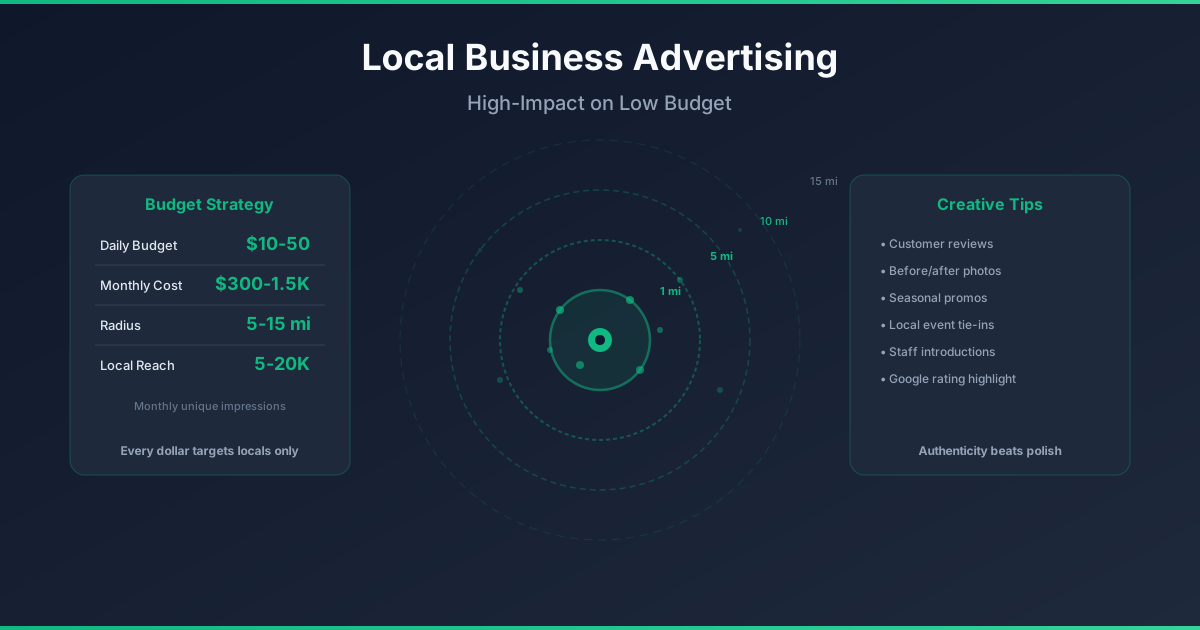
Local Business Advertising on Meta: Coverage and Small-Budget Plan
Prepare a local Meta brief from actual service coverage, booking economics and approved creative, then evaluate mature appointments within a small budget.
Yoga Studio Advertising on Meta: Class Booking and Membership Campaigns
Plan yoga studio ads around available places, verified booking records, attendance, membership contribution and a truthful local creative brief.
Local Business Review Generation Through Meta Ad Campaigns
Invite honest local-business reviews without satisfaction gating, using platform rules and consent-aware completion measurement.