

Meta Ads vs Google Ads: Where to Spend Your Marketing Budget
Assign Meta and Google clear channel tasks, reconcile shared orders and test a bounded budget change using contribution and demand limits.
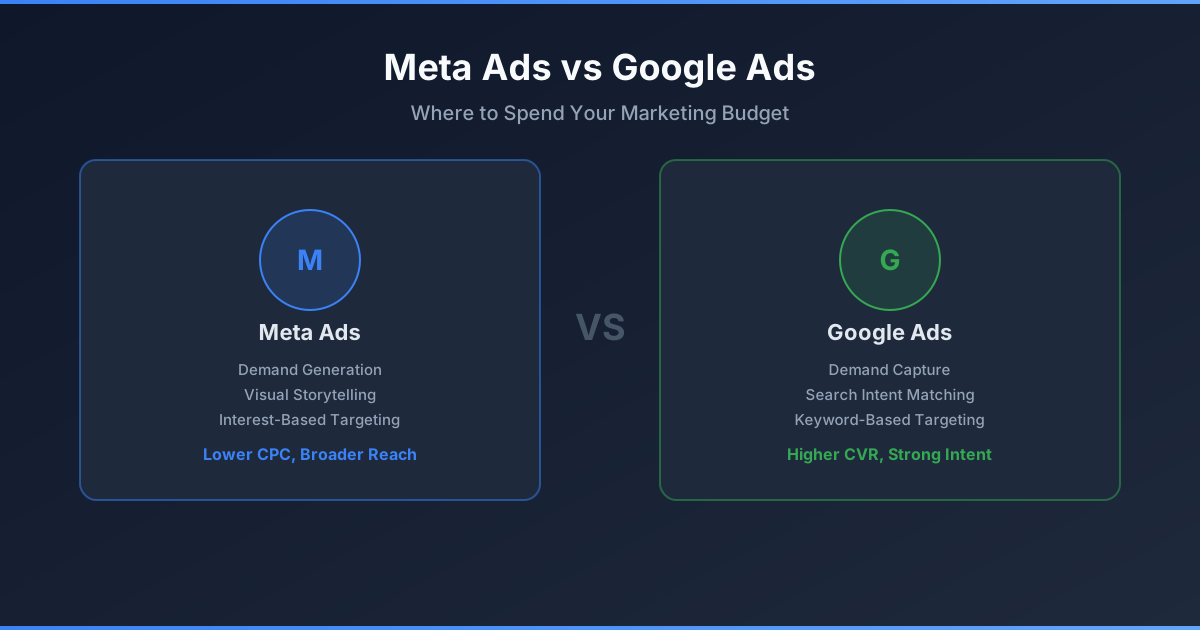
Compare specific campaign roles rather than treating either platform as one uniform channel. Google Search can address expressed queries; other Google campaign types also reach people outside search. Meta creative can introduce an offer or follow up with eligible visitors. These are candidate tasks, not proof that one platform creates demand and the other only captures it.
Google’s campaign-type documentation distinguishes Search from Display, Video and other inventory. Define the actual types being compared before using cost data.
Build the initial allocation from demand and economics
Illustrative order economics: $100 net revenue minus $65 variable costs leaves $35. Reserving $10 gives a $25 full acquisition allowance; if $5 per customer is reserved for non-media acquisition costs, the media ceiling is $20. A lower CPC alone does not demonstrate profitable customers.
| Candidate task | Synthetic planning assumptions | Candidate budget |
|---|---|---|
| Search capture | 400 eligible clicks available at $1; assumed 5% paid-order rate | At most $400 for this scenario: 20 expected orders, $20 media CPA |
| Meta offer discovery | Truthful demonstration; assumed $20 media CPA | A bounded $300 test: 15 expected orders |
| Uncommitted reserve | Total affordable media envelope $1,000 | Retain $300 until evidence justifies further spend |
These are assumptions, not observed demand, CPC or conversion benchmarks. Search click availability and conversion must be checked in the actual market. Meta demand and delivery are unknown until tested. Record market, dates, campaign type, currency, click definition, attribution and conversion maturity for any real comparison. Allocate nothing beyond stock, service capacity or available cash.
Reconcile shared orders before comparing reports
Stop wasting ad budget
NovaStorm AI cuts Meta Ads CPA by 30% on average. No complex setup required.
| Synthetic record | Count | Interpretation |
|---|---|---|
| Meta-attributed orders | 12 | Platform credit under its selected rules |
| Google-attributed orders | 10 | Platform credit under its selected rules |
| Orders present in both | 4 | Shared identity, not four extra orders |
| Unique union | 12 + 10 − 4 = 18 | Only if IDs, windows and order definitions align |
| Actual mature business orders | 20 | Two orders lack either credit; reconcile refunds and customer status |
With $700 combined spend and 20 confirmed new customers, media CAC is $35. Adding 12 and ten would falsely suggest 22 customers. At $35 contribution each, those 20 orders leave zero after media spend in this synthetic example, before other acquisition costs. Aggregated or modeled reports may not expose order-level IDs; record the reconciliation limit instead of manufacturing a join.
Google’s attribution overview defines attribution as assigning credit. A chosen credit model does not make shared reported orders additional sales. More branded searches alongside Meta spend could reflect PR, seasonality or other marketing; it is not causal evidence of Meta lift.
Test one bounded change with an inconclusive outcome
- Declare the question and baseline allocation: for example, whether shifting an assumed $100 from Meta discovery to Search improves total mature contribution at the same total spend. Verify Search has useful remaining demand first.
- Use a feasible supported controlled design, such as comparable assigned market groups with low spillover, if an incremental conclusion matters. Document assignment, baseline comparability and concurrent marketing. If no valid control is feasible, label the exercise a monitored budget change.
- Keep offer, stock, customer eligibility and measurement consistent. Measure unique net customers and total contribution across both channels, not the receiving platform’s attribution alone.
- Approve cash-loss/spend caps, conversion maturity and a review date. Reject scaling from immature outcomes, broken tracking or a sparse/inconclusive comparison.
- Check that a better short-run result does not simply exhaust existing demand. Reassess marginal economics before another increase.
NovaStorm can prepare the Meta brief as paused campaign and local ad-set drafts for user approval. Google campaign management, shared-order integration and controlled experiment execution are separate responsibilities; this workflow does not claim NovaStorm manages Google Ads.
Published by NovaStorm AI. Planning examples are illustrative assumptions, not measured customer results.
Disclaimer: This article was generated with the assistance of AI and reviewed by the NovaStorm AI team. While we strive for accuracy, we recommend verifying specific data points and consulting official sources (linked where available) for critical business decisions.
Ready to automate your Meta Ads?
NovaStorm AI takes full responsibility for your campaigns — from monitoring to optimization.
Start NowMore on Competitive research

Competitive Intelligence for Meta Ads: Monitoring Rival Campaigns
Archive public rival creatives, distinguish vendor estimates from evidence, and prepare an original campaign hypothesis with a contribution-based decision.
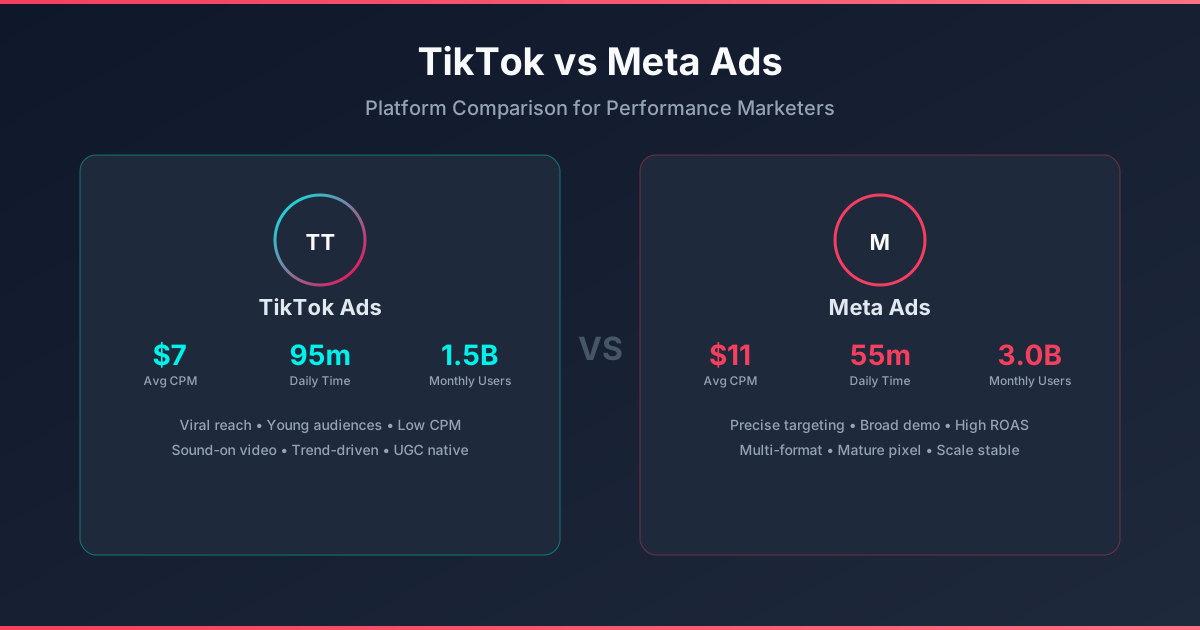
TikTok vs Meta Ads: Platform Comparison for Performance Marketers
Adapt one truthful offer for TikTok and Meta Reels, reconcile paid orders and plan a valid bounded cross-platform comparison.
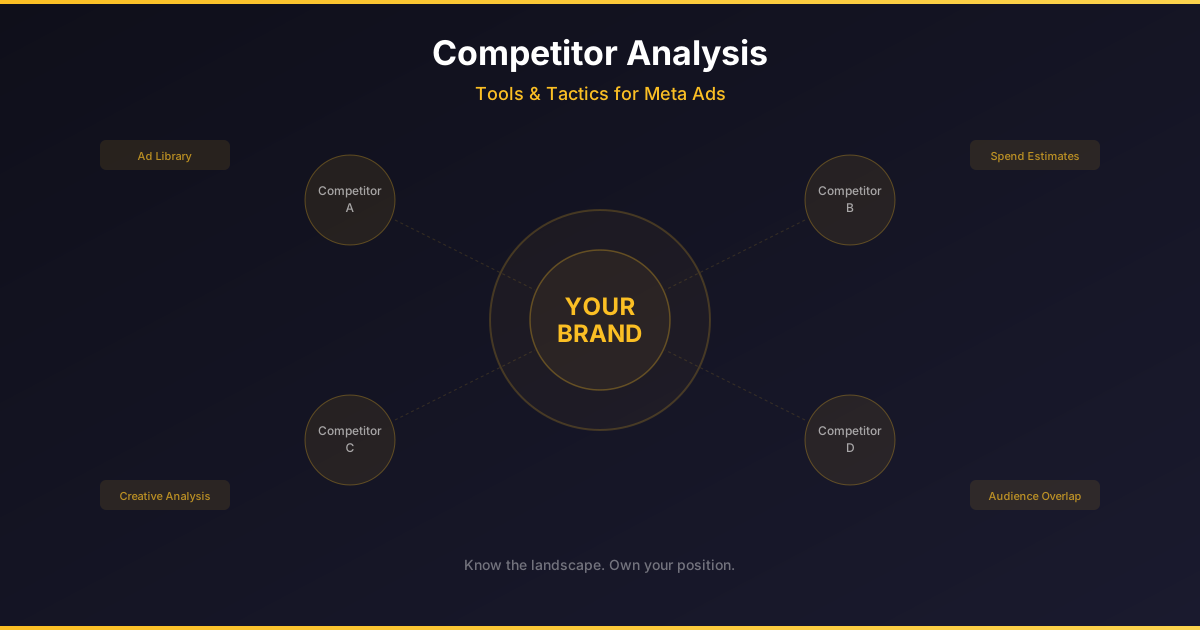
Competitor Analysis for Meta Ads: Tools and Tactics
Record observable competitor messages, keep spend and performance unknown, and turn a sourced public promotion into an original creative brief.

How to Use Meta Ad Library for Competitive Research
Reproduce a dated Meta Ad Library research log, troubleshoot blocked or empty searches and turn a verifiable observation into your own test brief.