

Emotional Triggers in Ad Copy: Fear, FOMO, Joy, and Trust
Build truthful emotional copy variants with verified urgency and testimonial permissions, then evaluate qualified outcomes rather than CTR alone.
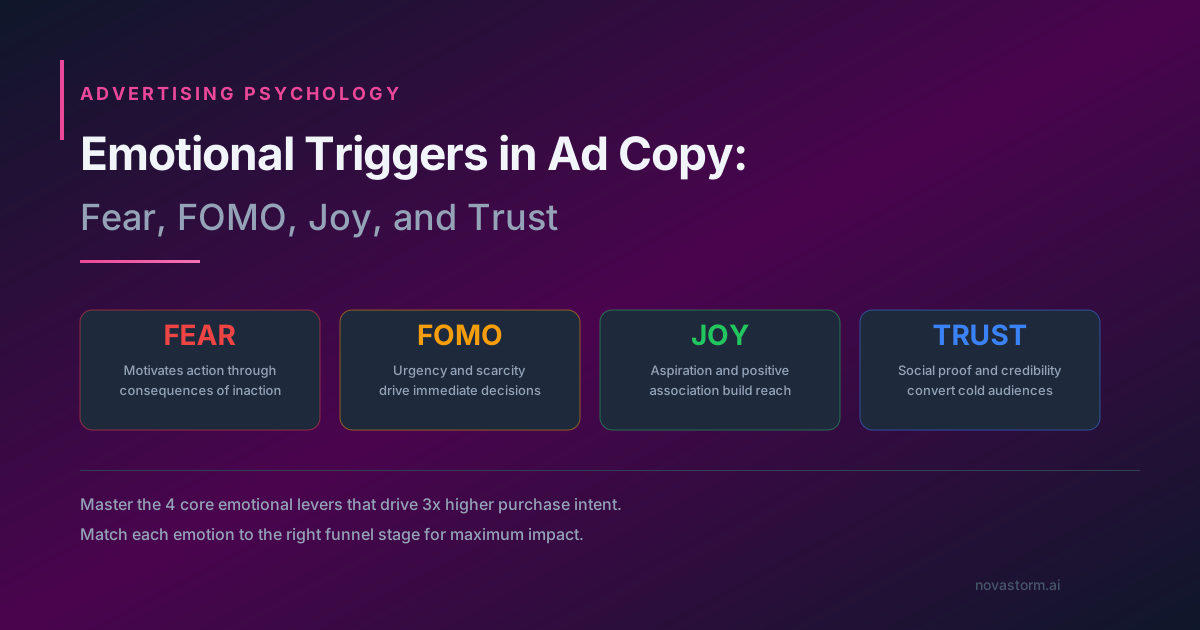
Fear, urgency, joy and trust are possible framing choices, not guaranteed conversion mechanisms. There is no supplied neuroscience study proving a universal emotional advantage or dataset supporting fixed CTR/CPA lifts. Start with one real offer and compare honest variants.
One offer, four framing hypotheses
Hypothetical storage-tray example. Verify the actual product, dimensions, shipping and returns before use. These copy lines are proposed creative, not customer quotes or measured outcomes.
| Frame | Illustrative English copy | Truth check |
|---|---|---|
| Practical concern | “Keep your daily items in one place.” | Do not invent a loss statistic or imply personal vulnerability |
| Real urgency | “Review the offer before its stated closing date.” | Use only a real approved date, timezone and terms; otherwise remove urgency |
| Joy | “Make room for your everyday setup.” | Show an actual feasible product use, not a guaranteed emotional outcome |
| Trust | “See dimensions, materials and return terms.” | Destination contains the exact verified information |
Hold product, price, offer, destination, event and eligible audience constant. A new deadline or discount changes the offer as well as emotion; label that as a package comparison rather than a pure wording test.
Check scarcity and proof at their source
- For a deadline, record its actual date/timezone, who approved it and whether the ad will stop or change when it ends. A reset-on-visit countdown is not a genuine deadline.
- For limited stock or slots, reconcile availability with the source and choose an update/removal trigger. Do not invent 12 remaining places.
- For a rating, testimonial or logo, keep its source, date, permission, accurate scope and usage rights. Never fabricate a named customer or popularity total.
- Sarah K., if used in a training storyboard, must be explicitly labeled a fictional character and must not be presented as a customer endorsement. A real quote requires real evidence and consent.
- Check any personal-attribute or sensitive-topic implications with the responsible reviewer before approval.
Stop wasting ad budget
NovaStorm AI cuts Meta Ads CPA by 30% on average. No complex setup required.
Evaluate qualified outcomes
Synthetic example: variant A spends $100 and generates twenty submissions, four qualified leads and one mature paid customer. Variant B spends $100 and generates ten submissions, five qualified leads and two customers. CPL is $5 versus $10, qualified CPL $25 versus $20, and paid-customer CPA $100 versus $50. These invented inputs illustrate why a cheaper click or raw lead is not the business decision; they do not establish a winner from small counts.
- Use one written qualification definition and comparable sales follow-up. Reconcile duplicates, cancellations and service costs.
- Predeclare assignment, spend/cash-loss caps and the conversion-maturity review. Ordinary unequal ad delivery is not randomization.
- Keep CTR as an attention diagnostic. Investigate message match when clicks rise but useful outcomes fall.
- When evidence is sparse, report inconclusive rather than declare an emotion universally best. No predetermined funnel stage requires fear or pressure.
Approve emotional copy in NovaStorm
Prepare the variants as briefs and paused campaign materials in NovaStorm. The user approves the facts, source permissions, deadlines and destination match before delivery. Preparation does not establish emotional lift or supply customer testimony. See the benefit-versus-feature guide for another controlled wording question.
Published by NovaStorm AI. Planning examples are illustrative assumptions, not measured customer results.
Disclaimer: This article was generated with the assistance of AI and reviewed by the NovaStorm AI team. While we strive for accuracy, we recommend verifying specific data points and consulting official sources (linked where available) for critical business decisions.
Ready to automate your Meta Ads?
NovaStorm AI takes full responsibility for your campaigns — from monitoring to optimization.
Start NowMore on Ad copy and messaging

The Curiosity Gap in Meta Ad Headlines: Intrigue Without Clickbait
Write curiosity headlines with an answer the page actually delivers, verify claims, and compare useful actions and customer costs rather than clicks alone.
Social Proof in Meta Ads: Verify Reviews and Test the Treatment
Turn genuine reviews into a documented Meta ad brief, preserve permissions and claim evidence, and compare proof formats against mature retained sales.
How to Write Headlines for Meta Ads That Stop the Scroll
Write supportable Meta ad headlines, preview their placement visibility and test one angle with an explicit sample and mature outcome plan.
Primary Text Best Practices for Meta Ads: Length and Format
Prepare three traceable primary-text lengths, check openings and previews, then compare approved copy with funded sampling and mature outcomes.