

Email Segmentation Data for Meta Ad Targeting: CRM to Custom Audiences
Maintain a CRM-derived Meta audience with additions, removals, permission checks and a transparent repeat-purchase cost ledger.
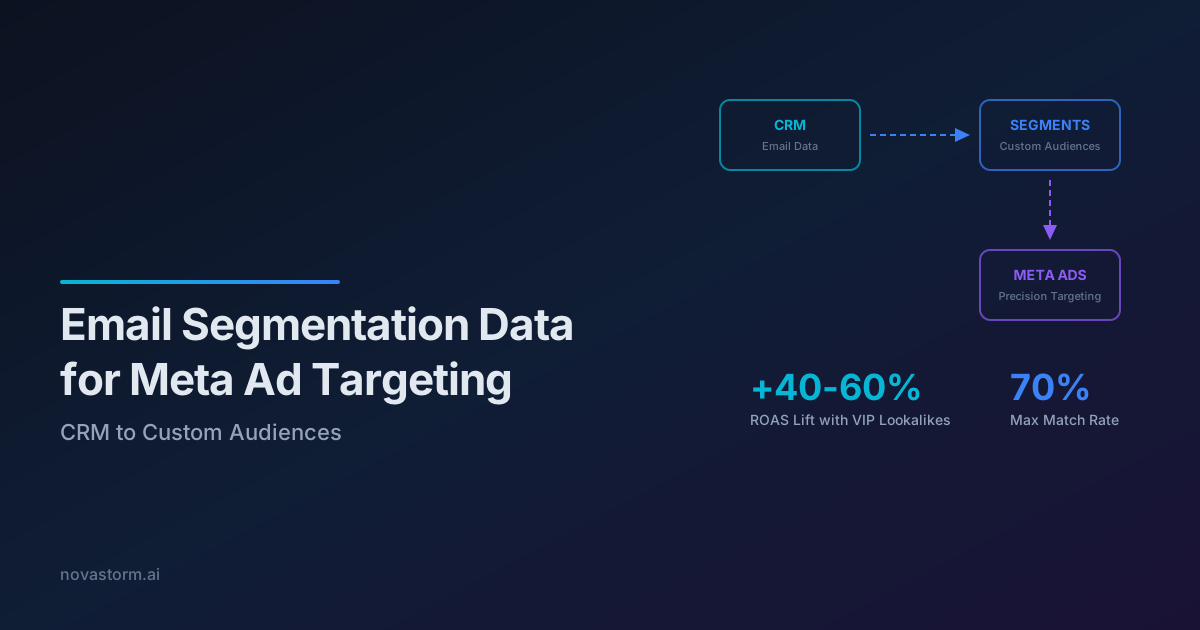
CRM segments can describe who needs a message and who should stop receiving it. Moving them into Meta requires a maintained permission-aware audience process. This article works through one segment update, removal after withdrawn permission and a campaign cost ledger. It does not present a measured ROAS uplift or a deployed CRM connector.
Define one segment with a defensible signal
Illustrative segment “Accessory interest”: people who completed a voluntary accessory comparison on an authenticated account in the chosen recent window, have a documented basis for this advertising use and have not bought the advertised accessory. Retain only needed identifiers in the export. A raw email open is not this signal: Apple’s Mail Privacy Protection can fetch remote content without a person engaging. Security scanners can also follow links; require a meaningful downstream action where feasible.
| CRM fact | Suggested use | Condition |
|---|---|---|
| Confirmed category choice | Candidate product message | Purpose and advertising permission checked |
| First purchase of the advertised accessory | Stop that first-purchase reminder | Purchase confirmed, not merely a cart event |
| Repeat purchase due | Separate replenishment hypothesis | Product economics and permitted use reviewed |
| Withdrawn advertising permission | Remove from advertising datasets | No inferred re-permission from later email opening |
An update that includes removals
Hypothetical internal IDs below are fictional and contain no contact details. Initial eligible set is {A, B, C}. A remains eligible, B buys the advertised accessory, C withdraws advertising permission, and D completes the qualifying action with permission. The new eligible set is {A, D}. Delta: add D; remove B and C. A system that only uploads additions keeps stale people indefinitely.
- Calculate the segment from current consent, purchase and behavior records in the CRM; record its version and calculation time.
- Check permission again before dispatching the delta. A withdrawal received after export must override a queued addition.
- Use an authorized connector or versioned API integration with credentials kept outside exports. Record additions and removals separately, including provider response and errors.
- Retry failed changes with stable identifiers and deduplicate local jobs. Recalculate eligibility before retrying old additions; never resurrect C from yesterday’s snapshot.
- Inspect provider processing status and campaign targeting/exclusions where available. A successful request is not proof that an identified person immediately stopped receiving every impression.
Meta’s public CustomAudience SDK exposes creation and deletion operations on the users edge plus audience operation/delivery status fields. That is a technical reference for an integrator, not proof of your permissions, a particular connector’s deletion behavior or a guaranteed processing deadline. Check the actual API version and provider contract before implementing. This worked delta is a design example, not a completed upload.
Separate email withdrawal from advertising withdrawal
A marketing-email unsubscribe and withdrawal of advertising permission may have different scopes; store the preference the person actually expressed and honor broader objections. Do not assume permission for advertising because email permission exists. European Commission guidance emphasizes lawful marketing use and objections. Choose and verify the applicable basis, notices and local requirements with the responsible owner. Hashing identifiers is a data-handling measure; it does not create permission or make matching anonymous.
Stop wasting ad budget
NovaStorm AI cuts Meta Ads CPA by 30% on average. No complex setup required.
Maintain a withdrawal queue with received time, affected destinations, attempted and acknowledged removal, last failure and escalation owner. Apply local suppression immediately under your policy while downstream removal is processed. If removal cannot be verified and the affected advertising use cannot safely continue, stop that use or pause the dependent campaign. Do not substitute an unsupported universal 48-hour deadline for actual obligations.
Matching and exclusions have limits
Evaluate accepted records, usable audience status and delivery in your own account; match rate and name-field improvements have no fixed percentage here. Send additional identifiers only when necessary, permitted and supported. An excluded customer who cannot be matched may still receive acquisition ads. Review stale exclusions and accidental audience expansion; customer spend is not automatically wasted, because repeat purchases can be valuable. See retargeting exclusions for separating those objectives.
Include repeat purchases and removal delay in economics
Hypothetical replenishment campaign: media costs USD 200, connector allocation USD 30 and operations USD 20. Ten settled repeat orders contribute USD 30 each after product costs, returns and discounts: USD 300. Apparent cohort contribution after campaign costs is USD 300 − USD 250 = USD 50. If a comparable valid holdout would have produced eight orders, the estimated added contribution is only (10 − 8) × USD 30 − USD 250 = −USD 190. This interpretation requires a properly randomized eligible comparison and uncertainty analysis; a platform ROAS report alone cannot supply the counterfactual.
Separately suppose USD 15 of the USD 200 media was spent during a documented exclusion delay. It is already inside the USD 200 total, so do not subtract it again. Mark whether those impressions were to confirmed buyers or contacts whose permission was withdrawn; the latter require remediation regardless of profitability. Aggregate reporting may not identify each individual impression, so report only delay and spend you can actually substantiate.
Review the campaign with external evidence
Use the CRM ledger to explain why an audience changed, then manually review a related campaign draft in NovaStorm. Keep segment creation, permission processing, matching evidence and experiment assignment in the external systems that implement them. No automatic CRM connection, per-person match inspection or guaranteed improvement is established by this article.
Published by NovaStorm AI. Worked examples and test fixtures in this article are illustrative, not observed customer results.
Disclaimer: This article was generated with the assistance of AI and reviewed by the NovaStorm AI team. While we strive for accuracy, we recommend verifying specific data points and consulting official sources (linked where available) for critical business decisions.
Ready to automate your Meta Ads?
NovaStorm AI takes full responsibility for your campaigns — from monitoring to optimization.
Start NowMore on B2B and lead generation
Email List Building Through Meta Ads: Subscriber Acquisition Funnels
Build a confirmation and welcome delivery checklist, measure useful subscriber actions, and compare Meta targeting with explicit illustrative costs.
Sales and Marketing Alignment Through Meta Lead Ads
Design a Lead Ads handoff with CRM fields, safe retries, overnight SLA ownership, all-lead reconciliation and paid-outcome reporting.
Lead Form Extensions in Meta Ads: Pre-Filled Data Capture
Compare lead forms using confirmed delivery, contact validity and mature cost per qualified lead; correct denominators before scaling.
Account-Based Marketing With Meta Ads: Enterprise Targeting
Plan Meta ABM with permitted individual contacts, a clear company/deal mapping and verified delivery limits instead of unsupported domain or IP targeting.