CCPA and Meta Ads: California Privacy Law for Advertisers
Master CCPA compliance for Meta Ads campaigns. Complete guide to California Consumer Privacy Act requirements for audience targeting and data collection.
California's Consumer Privacy Act has become one of the most influential data privacy regulations for digital advertisers in the United States. If you are running Meta Ads campaigns that target California residents — and with nearly 40 million residents, you almost certainly are — CCPA Meta Ads compliance must be part of your advertising strategy.
Amended by the California Privacy Rights Act (CPRA) in 2023, the CCPA grants consumers sweeping rights over their personal information. For Meta advertisers, this means rethinking how you collect data through pixels, build Custom Audiences, and process conversion events from California-based users.
Who Must Comply with CCPA for Meta Advertising
CCPA applies to for-profit businesses that meet any one of three thresholds: annual gross revenue exceeding $25 million, buying or selling personal information of 100,000 or more California consumers or households, or deriving 50% or more of annual revenue from selling or sharing personal information. Most businesses running significant Meta Ads campaigns will meet at least one of these criteria.
The CPRA amendment introduced the concept of "sharing" personal information, which specifically covers cross-context behavioral advertising. When you use the Meta Pixel or Conversions API to send user data to Meta for ad targeting, you are likely "sharing" personal information under this definition, triggering CCPA Meta Ads compliance requirements.
| Threshold | Criteria | Typical Meta Advertiser |
|---|---|---|
| Revenue | $25M+ annual gross revenue | Mid-size to enterprise businesses |
| Data Volume | 100K+ CA consumers' data processed | Most e-commerce advertisers |
| Revenue Source | 50%+ revenue from data selling/sharing | Data brokers, ad-tech companies |
| Service Providers | Process data on behalf of qualifying businesses | Marketing agencies |
Consumer Rights That Affect Meta Ads Campaigns
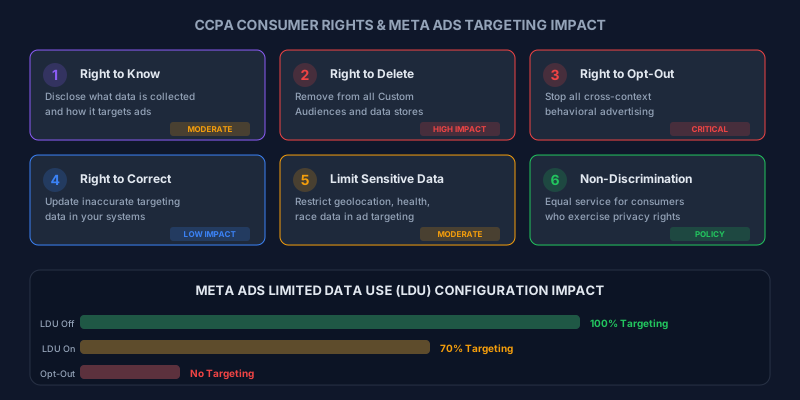
CCPA grants California consumers specific rights that directly impact how you run Meta Ads. The right to opt out of the sale or sharing of personal information is the most significant for advertisers. When a consumer exercises this right, you must stop using their data for cross-context behavioral advertising, including Meta Ads targeting.
- Right to Know: Consumers can request what personal information you have collected and how it is used in advertising
- Right to Delete: Consumers can demand deletion of their personal information from your systems and ad audiences
- Right to Opt-Out: Consumers can stop the sale or sharing of their data for targeted advertising
- Right to Correct: Consumers can request corrections to inaccurate personal information
- Right to Limit Use of Sensitive Information: Restricts use of precise geolocation, race, health data in targeting
- Right to Non-Discrimination: You cannot penalize consumers who exercise their privacy rights
Implementing CCPA Meta Ads Compliance on Your Website
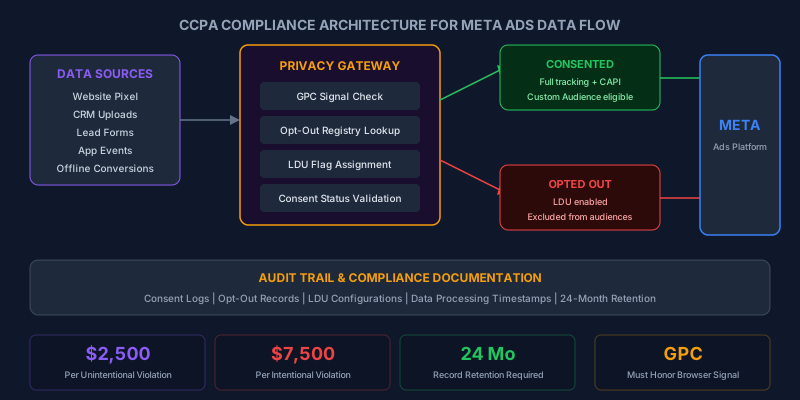
The foundation of CCPA Meta Ads compliance begins on your website. You must display a clear and conspicuous "Do Not Sell or Share My Personal Information" link on every page. This link must be functional and lead to a mechanism where consumers can exercise their opt-out rights.
Additionally, you must honor the Global Privacy Control (GPC) browser signal. When a user's browser sends a GPC signal, your website must treat it as a valid opt-out request. This means your Meta Pixel should not fire for users with GPC enabled, and no conversion events should be sent through CAPI for these users.
Important: The California Privacy Protection Agency has confirmed that failure to honor GPC signals constitutes a CCPA violation. Fines start at $2,500 per unintentional violation and $7,500 per intentional violation — calculated per consumer affected.
Configure your tag management system to respect opt-out signals. This requires conditional pixel firing logic that checks both explicit opt-out status and GPC signals before any tracking code executes. Many consent management platforms now include CCPA-specific modules that automate this process.
Meta's Limited Data Use Feature and CCPA
Meta provides a Limited Data Use (LDU) flag specifically designed for CCPA Meta Ads compliance. When enabled, this flag restricts how Meta processes data from California users. LDU limits Meta's ability to use the data for ad optimization, measurement, and audience building.
You can implement LDU through the Meta Pixel by adding the appropriate data processing options to your pixel code, or through the Conversions API by including the data_processing_options parameter in your event payloads. Both methods allow you to specify geographic restrictions at the country and state level.
Stop wasting ad budget
NovaStorm AI cuts Meta Ads CPA by 30% on average. No complex setup required.
| LDU Configuration | Data Processing | Impact on Campaigns |
|---|---|---|
| LDU Disabled | Full processing for optimization | Maximum ad performance |
| LDU Enabled (State: 0) | Meta determines geographic restriction | Moderate performance impact |
| LDU Enabled (State: CA) | California-specific restrictions | CA audience optimization limited |
| LDU + Opt-Out | Minimal processing, no targeting | User excluded from targeting |
Custom Audiences and Data Sharing Under CCPA
Uploading customer lists to Meta for Custom Audience targeting constitutes "sharing" personal information under CCPA. This means you must provide California consumers the opportunity to opt out before including their data in any Custom Audience uploads.
Before each Custom Audience upload, scrub your list against your opt-out registry. Remove any California residents who have exercised their right to opt out of data sharing. Maintain detailed records of these scrubbing activities as evidence of your CCPA Meta Ads compliance efforts.
- Maintain a centralized opt-out registry updated in real-time
- Cross-reference all audience lists against the opt-out registry before upload
- Implement automated scrubbing in your CRM-to-Meta data pipeline
- Document each audience upload with compliance verification timestamps
- Retain records for at least 24 months as required by CCPA
- Audit third-party data sources to ensure CCPA compliance upstream
Enforcement Landscape and Financial Penalties
CCPA enforcement has escalated significantly since the California Privacy Protection Agency (CPPA) took over enforcement from the Attorney General. The agency has pursued actions against businesses of all sizes, with particular focus on improper data sharing with advertising platforms.
Penalties under CCPA are substantial. Unintentional violations carry fines of $2,500 per incident, while intentional violations face $7,500 per incident. The per-incident calculation is applied per consumer, meaning a single campaign error affecting thousands of California users can result in millions of dollars in fines.
Pro Tip: Conduct a CCPA compliance audit quarterly. Document your Meta Pixel configuration, LDU implementation, opt-out mechanisms, and audience upload procedures. This documentation demonstrates good faith compliance efforts and can mitigate penalties in enforcement actions.
Building a CCPA-Compliant Meta Ads Strategy
Achieving CCPA Meta Ads compliance does not mean sacrificing campaign performance. Advertisers who implement proper privacy controls often see improved data quality from their consenting audience segments. Focus on first-party data strategies, contextual targeting, and broad audience approaches to complement your privacy-compliant targeting.
Invest in server-side tracking through the Conversions API with proper CCPA controls. Server-side implementations give you granular control over what data is sent to Meta and when, allowing you to enforce opt-out preferences consistently. This approach also future-proofs your campaigns against browser-level tracking restrictions.
The investment in CCPA Meta Ads compliance pays dividends beyond regulatory protection. It demonstrates respect for consumer privacy, strengthens brand trust, and positions your business favorably as additional states adopt similar privacy legislation. With over a dozen states now enacting comprehensive privacy laws, the framework you build for CCPA compliance will serve as a template for nationwide privacy compliance.
Novastorm AI automates Meta Ads routine — from monitoring to optimization. Learn more at novastorm.ai
Disclaimer: This article was generated with the assistance of AI and reviewed by the NovaStorm AI team. While we strive for accuracy, we recommend verifying specific data points and consulting official sources (linked where available) for critical business decisions.
Ready to automate your Meta Ads?
NovaStorm AI takes full responsibility for your campaigns — from monitoring to optimization.
Start NowRelated Articles
GDPR and Meta Ads: European Data Privacy Compliance Guide
Learn how to run Meta Ads campaigns that comply with GDPR. Complete guide to European data privacy for advertisers, consent management, and audience targeting.
Meta Ads Special Ad Categories: Housing, Credit, and Employment Rules
Complete guide to Meta Ads Special Ad Categories for housing, credit, and employment. Learn targeting restrictions, compliance requirements, and best practices.

Insurance Ads on Meta: Compliance and Performance Balance
Learn how to run insurance ads on Meta that balance regulatory compliance with high performance. Proven strategies for life, auto, health, and property insurance campaigns.