

App Store Optimization and Meta Ads: A Combined Strategy
Align Meta app ads with custom store pages, verify destination behavior, and distinguish store conversion from hypothetical organic acquisition lift.
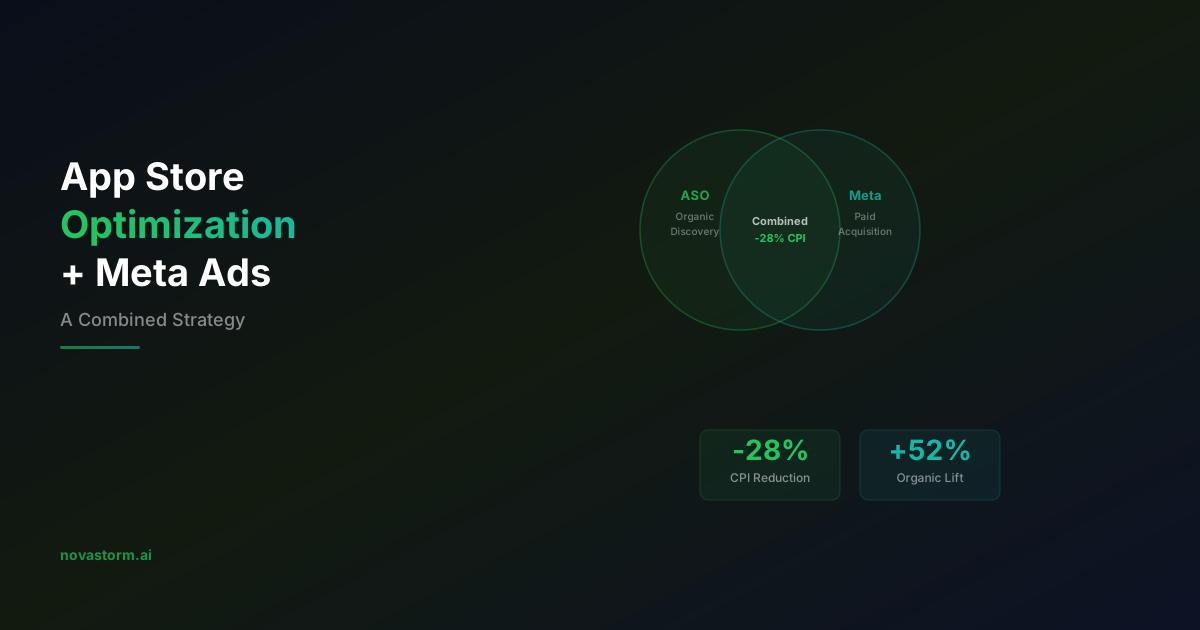
Coordinate the promise in your Meta ad with the store page that receives the click. A message that earns an ad click is a candidate for store testing, not proof that it improves downloads or search ranking. Keep paid acquisition, store conversion and organic discovery as separate measured outcomes.
Create a specific store destination
Apple’s custom product page documentation currently allows up to 70 pages per app. Pages have their own generated URLs and require approval. They support tailored screenshots, previews and promotional text. Copy the approved page’s URL from App Store Connect rather than constructing an identifier by guesswork.
Google’s custom store listing documentation currently permits up to 50 listings and documents a unique URL parameter: https://play.google.com/store/apps/details?id=[packageName]&listing=[parameter]. Create the listing and its parameter in Play Console; replace these illustrative brackets with your actual published values. Google Ads campaign selection and a unique URL are different targeting routes.
For a Meta campaign, first select the intended app and a destination field that accepts the relevant approved store URL in that configuration. Paste the generated URL only where supported, preserve its identifying parameters, then preview the actual ad click on the target OS. Confirm app identity, country availability, language and the custom screenshots after all redirects. Do not assume every app-promotion configuration exposes an editable custom destination.
An app deep link and a custom store page URL serve different steps. Apple separately permits an approved app deep link on a custom page for its supported OS versions when someone selects Open. This does not mean a product page URL automatically restores install context. See deep-link setup and fallback testing before promising an in-app destination.
Three fitness pages with testable message match
Hypothetical design brief for the fictional MoveWell app, not a shipped app or observed campaign. Assume the released product contains all three functions below. Use genuine captures of those functions and disclose any subscription requirements. These pages propose relevance tests; none promises weight loss or improved health.
| Ad angle and example copy | Custom page first screen | Acceptance and conversion question |
|---|---|---|
| Short sessions: “Try a 10-minute guided routine.” | Actual routine duration, start control and equipment requirements | Does the advertised routine exist and start after onboarding? |
| Strength planning: “Plan your next strength session.” | Actual session planner with sets, equipment and editable schedule | Can a new user create the promised plan without an undisclosed upgrade? |
| Activity history: “Keep your workouts in one place.” | Actual history screen and supported recording method | Does import/manual tracking work for the advertised device? |
Keep the icon and brand recognizable, but change the first screenshot and sequence to show the advertised job. “Better match improves qualified activation” is a hypothesis. Do not infer health outcomes, organic rank gains or install lifts from a persuasive screenshot.
A test plan for destination consistency
- Choose one ad angle. Keep its creative, audience, offer and optimization configuration fixed while comparing the default store page against the corresponding custom page through an eligible controlled design.
- Prespecify a store conversion definition and a downstream activation event. Record unique eligible store visitors, first-time downloads where available, activated users, refunds/cancellations and measurement maturity.
- Capture each approved page URL and version; test signed-out/signed-in store states, supported OS, locale, unavailable market and disabled-page fallback. These are expected checks, not completed device-test results.
- Check source dimensions and privacy/reporting thresholds before comparing stores or Meta. Do not expect their download, install or attribution counts to match one-to-one.
- After choosing a destination, test a new message separately. Avoid simultaneously changing ad copy, screenshots, price and acquisition audience: that makes the cause of a change ambiguous.
Stop wasting ad budget
NovaStorm AI cuts Meta Ads CPA by 30% on average. No complex setup required.
A successful ad headline may fail in a store where users compare ratings, price or subscription conditions. Adapt it into a feature claim that the app can prove, then test it there. Search metadata and review constraints require their own store review; no keyword weighting or guaranteed ranking factor is asserted here.
The $2.02 calculation is descriptive unless lift is identified
Hypothetical inputs: $2,500 media spend, 1,000 attributed paid installs and 240 installs classified as organic in the same defined period. Attributed paid CPI is $2,500 / 1,000 = $2.50. A descriptive media-spend-to-all-counted-installs ratio is $2,500 / (1,000 + 240) ≈ $2.02, assuming the classifications are exclusive and counts comparable. It is not the cost of 1,240 incremental installs.
The 240 organic installs could include demand that would have existed without advertising, delayed attribution, brand publicity or another campaign. A before/after rise alone does not identify paid-driven organic lift. Counts classified as organic are not automatically free or caused by Meta.
| Hypothetical counterfactual scenario | Extra organic installs | Conditional ratio |
|---|---|---|
| Without this campaign, organic installs would have been 240 | 240 − 240 = 0 | $2,500 / 1,000 = $2.50 |
| Without this campaign, organic installs would have been 200 | 240 − 200 = 40 | $2,500 / 1,040 ≈ $2.40 |
| Without this campaign, organic installs would have been 0 | 240 − 0 = 240 | $2,500 / 1,240 ≈ $2.02 |
These sensitivity calculations also assume the 1,000 attributed paid installs are incremental, which attribution alone does not establish. To estimate combined causal acquisition cost, divide campaign cost by the experimental difference in total installs, rather than adding attributed paid installs to an assumed organic uplift.
Separate store-page effects from advertising spillover
For page relevance, compare destination variants within a controlled paid audience. For advertising’s effect on total acquisition, use a separately designed holdout or eligible randomized geographic experiment, account for contamination and pre-existing regional differences, and keep other promotions stable. Track total first-time installs and activated/retained cohorts in treatment and control over matched windows. Search positions and organic classifications can be supporting diagnostics, not causal proof.
Record the source, time zone, first-time-versus-redownload rule and reporting lag for every metric. Defer a decision until the selected cohort outcome matures and the planned sample is reached. If no valid control is available, report the trend with its confounders rather than naming an organic multiplier.
NovaStorm can help prepare Meta campaign drafts while your app team owns store-page approval, destination verification and store analytics. It does not replace App Store Connect or Play Console or establish organic ranking lift.
Published by NovaStorm AI. Worked examples and proposed tests are labeled in the article.
Disclaimer: This article was generated with the assistance of AI and reviewed by the NovaStorm AI team. While we strive for accuracy, we recommend verifying specific data points and consulting official sources (linked where available) for critical business decisions.
Ready to automate your Meta Ads?
NovaStorm AI takes full responsibility for your campaigns — from monitoring to optimization.
Start NowMore on SaaS and app growth
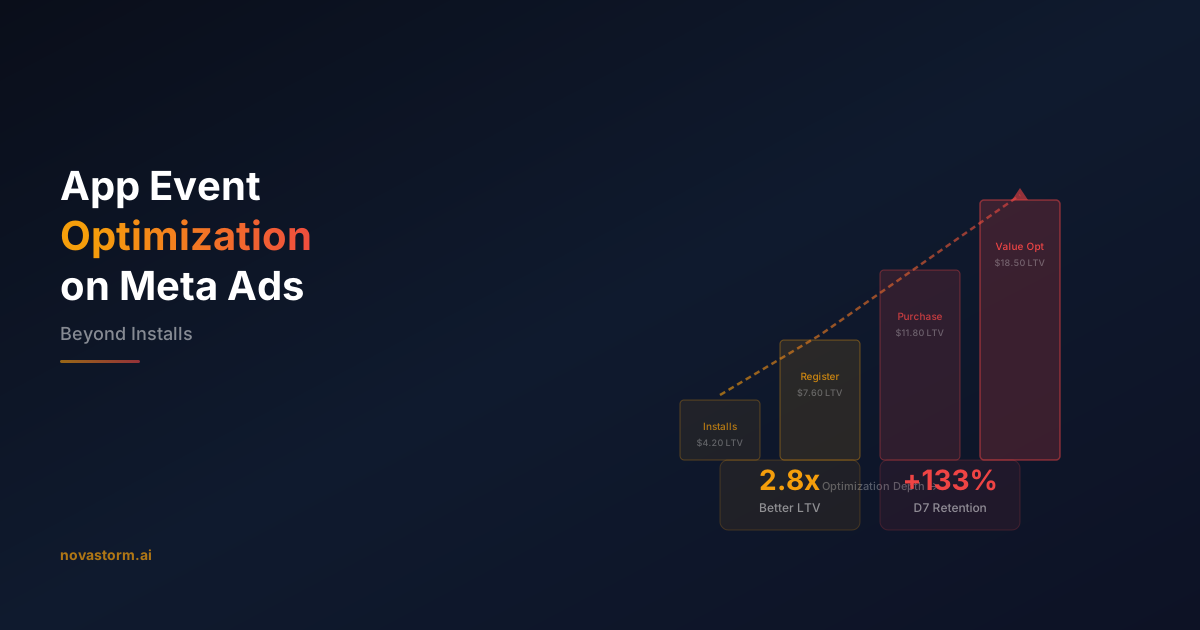
App Event Optimization on Meta Ads: Beyond Installs
Choose a reliable available app event, reconcile purchase value, consent and duplicates, and compare mature contribution rather than unsupported LTV promises.

Cloud Service Advertising on Meta: AWS and Azure Alternative Marketing
Advertise a cloud alternative with reproducible workload comparisons, migration costs and mature paid-adoption economics.
Advantage+ App Campaigns on Meta: Automated App Install Strategy
Evaluate Advantage+ app campaigns with SDK and ATT readiness checks, meaningful creative questions and mature-cohort unit economics.

Mobile App Deep Linking From Meta Ads: Setup and Optimization
Configure explicit Universal and Android App Link associations, validate route and authorization states, and separate deferred routing from privacy-aware attribution.