

App Event Optimization on Meta Ads: Beyond Installs
Choose a reliable available app event, reconcile purchase value, consent and duplicates, and compare mature contribution rather than unsupported LTV promises.
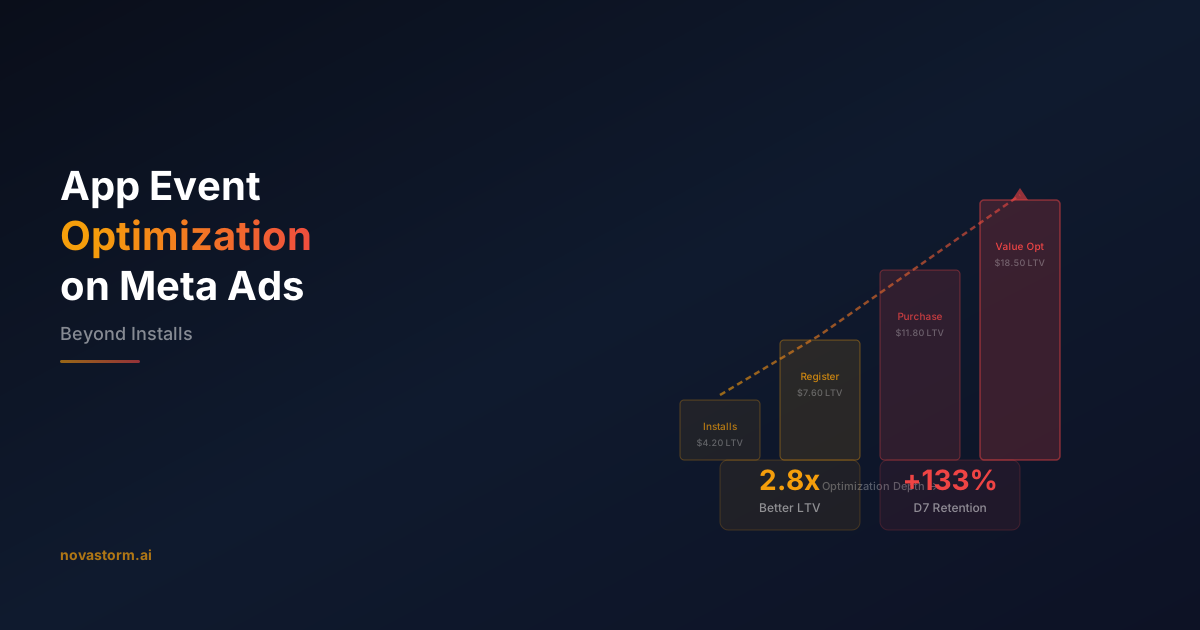
Choose an app optimization event because it represents a useful business action, is measured reliably, and is available in the actual campaign configuration. Installs can be a valid acquisition goal; a deeper event is not automatically more profitable. Verify the signal and mature contribution before changing the target.
Correct the LTV and acquisition-cost comparison
Hypothetical 90-day revenue per acquired install: install-focused cohort $4.20 at CPI $1.80, event-focused cohort $11.80 at CPI $3.40. Revenue per install rises by $11.80/$4.20 ≈ 2.81 times, while revenue/spend rises from $4.20/$1.80 ≈ 2.33 to $11.80/$3.40 ≈ 3.47, about 48.7% relative. These are distinct quantities, and 90-day receipts are not lifetime contribution.
| Illustrative unit economics | Install-focused | Event-focused |
|---|---|---|
| 90-day revenue per install | $4.20 | $11.80 |
| Assumed contribution margin before advertising | 50% | 50% |
| Contribution before acquisition | $2.10 | $5.90 |
| CPI | $1.80 | $3.40 |
| Contribution after acquisition | $0.30 | $2.50 |
These calculations depend on assumed equal margins and omit unlisted fixed or production costs. Different acquired cohorts can differ for reasons other than optimization strategy; this table is not an observed causal AEO improvement.
Select an available event and verify eligibility
| Candidate action | Business definition | Signal check |
|---|---|---|
| Registration | Server-accepted account, not button tap | Duplicate accounts, consent and later qualification |
| Purchase | Authoritative paid transaction | Amount/currency, refunds, delayed settlement and duplicates |
| Subscription | Defined paid subscription state | Trial signup versus paid activation and cancellations |
| Other meaningful action | App-specific value-bearing action | Connection to mature contribution, not mere frequency |
Meta’s SDK schema defines app-related optimization goals including APP_INSTALLS and IN_APP_VALUE. It does not establish eligibility for a specific app or universal 50/100-weekly-event rules. Inspect the accepted campaign objective, event, app connection and value-optimization options. If value optimization is unavailable or event quality is inadequate, do not allocate 30% to an unsupported VO configuration. Use an eligible measured goal or defer the change.
A concrete Android SDK boundary
Meta’s Android AppEventsLogger source exposes logPurchase with a BigDecimal amount and Currency, optionally with a parameters bundle. For a hypothetical $19.99 USD purchase, the API shape is logger.logPurchase(BigDecimal("19.99"), Currency.getInstance("USD")). This illustrates the method contract, not a complete integration or an executed SDK test.
Stop wasting ad budget
NovaStorm AI cuts Meta Ads CPA by 30% on average. No complex setup required.
Call the selected event path only after the defined paid state and required consent/permission checks. The SDK call is not a payment processor and does not validate the purchase. Check installed-release documentation, automatic purchase logging, manual logging and every destination’s deduplication rules before sending both paths.
| Teaching business record | Event decision | Acceptance |
|---|---|---|
| P001: payment pending | Do not report a confirmed paid purchase yet | Late settlement can update the record. |
| P001: payment confirmed $19.99 USD | Emit once through the approved event path | Correct decimal amount and currency; stable internal transaction mapping. |
| P001: receipt replay or reload | Do not create a second business purchase | Verify deduplication for actual SDK/analytics destinations, not a made-up shared event-ID contract. |
| P002: advertising consent denied | Apply the documented permitted collection behavior | No unauthorized advertising data sent; unknown marketing coverage reported. |
| P001: later refund | Update authoritative net revenue and cohort | Keep purchase and refund states; do not count a forecast as retained revenue. |
Maturity and learning-state decisions
Record install enrollment, payment timing, event delivery delay and the chosen 90-day follow-up separately. Compare cohorts only after equivalent maturity. Use the SDK measurement audit to review implementation boundaries and the design-specific uncertainty method for an experiment.
Learning status is a diagnostic, not an independent pause instruction. Review actual delivery, cash limits, signal quality and mature contribution. Repair consent, duplicate and broken payment signals promptly; change an economic strategy under a documented decision rule instead of automatically pausing every group that remains in learning.
Prepare the proposed strategy for review
Prepare the selected event goal and approved app message as a NovaStorm campaign draft where supported. App SDK integration, value-optimization eligibility, event deduplication and LTV prediction must be handled by systems that implement them; draft preparation does not establish those capabilities.
Sources: Meta Android AppEventsLogger source; Meta ad-set schema. All cohort figures are hypothetical, not observed results.
Published by NovaStorm AI. Worked examples and proposed tests are labeled in the article.
Disclaimer: This article was generated with the assistance of AI and reviewed by the NovaStorm AI team. While we strive for accuracy, we recommend verifying specific data points and consulting official sources (linked where available) for critical business decisions.
Ready to automate your Meta Ads?
NovaStorm AI takes full responsibility for your campaigns — from monitoring to optimization.
Start NowMore on SaaS and app growth

Mobile App Deep Linking From Meta Ads: Setup and Optimization
Configure explicit Universal and Android App Link associations, validate route and authorization states, and separate deferred routing from privacy-aware attribution.
App Store Optimization and Meta Ads: A Combined Strategy
Align Meta app ads with custom store pages, verify destination behavior, and distinguish store conversion from hypothetical organic acquisition lift.
Advantage+ App Campaigns on Meta: Automated App Install Strategy
Evaluate Advantage+ app campaigns with SDK and ATT readiness checks, meaningful creative questions and mature-cohort unit economics.
SaaS Free Trial Campaigns on Meta: Signup to Activation
Evaluate SaaS trial ads with verified activation events, retained paid cohorts, complete CAC and contribution-based payback instead of signup benchmarks.