

Subscription Box Advertising on Meta: Trial Conversion Strategies
Set a subscription-box acquisition ceiling from mature payment contribution, renewal uncertainty and cash delay, with truthful recurring offer terms.
A low-priced first box can lose money before the first renewal arrives. Set an acquisition allowance from retained payment contribution, renewal uncertainty and cash available during that delay. This guide gives a subscription cohort ledger, a clear trial creative brief and a way to compare offers without treating forecast lifetime value as a real payment.
Revenue LTV is not contribution LTV
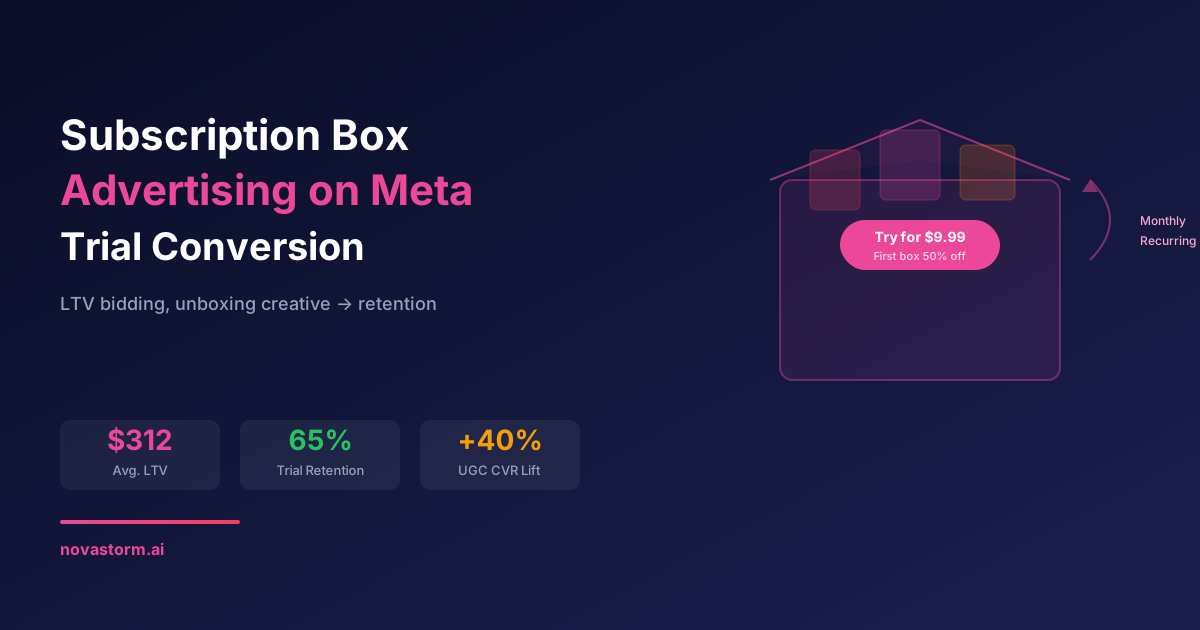
Illustrative arithmetic only: $39 × eight paid months = $312 gross billed revenue. If product cost alone is $15 per box, $24 × eight = $192 is contribution after product cost only, not monthly revenue or final margin. Thirty percent of those different quantities gives $93.60 versus $57.60; neither is an acquisition ceiling without delivery, fees, returns, trial cost and renewal probability. Do not label the two as interchangeable CPA targets.
Model expected contribution per acquired trial as first-box contribution plus the sum of each later payment’s probability × net contribution for that payment. Subtract other acquisition costs and required surplus to obtain a media ceiling. Use mature cohorts with refunds and failed renewals resolved; younger subscribers who have not reached month 12 are not month-12 churners. Show uncertainty around renewal probabilities instead of borrowing market retention rates.
A mature cohort ledger with separate renewals
Hypothetical fully followed 100-trial cohort, not customer data: first box charges $9.99; each full-price box charges $39. Assume $25 variable cost per fulfilled box including product, delivery, fees and expected returns. First-box contribution is −$15.01 per trial; each retained full-price payment contributes $14. Assume unique retained paid subscribers by billing month are 100, 60, 50, 40, 32, 25, 21, 18, 15, 13, 11 and ten. These are separate monthly payments, not additional acquired customers.
| Cohort age reached by all 100 trials | Retained payment count in that month | Cumulative full-price payments after trial | Cumulative contribution before acquisition |
|---|---|---|---|
| Month 3 | 50 | 110 | 110 × $14 − $1,501 = $39 |
| Month 6 | 25 | 207 | 207 × $14 − $1,501 = $1,397 |
| Month 12 | 10 | 295 | 295 × $14 − $1,501 = $2,629 |
The hypothetical 12-month contribution is $26.29 per trial. Reserving $6 per trial for other acquisition costs and surplus gives a media ceiling of $20.29, not a revenue-derived $94. This conclusion depends on the assumed full cohort and costs; if expected renewals fall, recalculate before committing cash. Do not count the same renewal again at month-three, month-six and month-12 milestones.
Cash delay can constrain a positive forecast
With an illustrative $20 media CPA, acquisition plus the $15.01 first-box loss consumes $35.01 per trial before other costs. If the additional $6 reserve is cash required up front, initial exposure is $41.01 each. An assumed $1,000 cash-risk allowance funds at most 24 such trials without relying on future renewals. At month six, $13.97 contribution per initial trial still does not recover $26 media plus other acquisition cash; even the modeled month-12 surplus is just $0.29 per trial. A positive long-horizon forecast is not immediate cash payback.
Stop wasting ad budget
NovaStorm AI cuts Meta Ads CPA by 30% on average. No complex setup required.
Separate transaction events from model scores
Record each actual captured payment with its transaction identity, timestamp, currency, amount, refund status and subscription/cohort identity in the authorized business system. Send only events and values supported by the approved integration, applicable permissions and current contract. The Meta server Event object contains event identity/time and data fields; it does not authorize inventing a payment value from predicted LTV. Keep forecasts as separately labeled model outputs; do not overwrite a $9.99 transaction with a hypothetical $312 Purchase.
A clear first-box creative brief
Hypothetical box concept: demonstrate the actual contents, size and packing; explain the use of each item; show the offer; state the recurring terms. Proposed copy: “First box $9.99. Then $39 per monthly box, plus any disclosed applicable delivery/tax. Review contents, renewal date and cancellation terms before subscribing.” These prices are assumptions, not a live offer. Do not hide a multi-month commitment or processing charge to discourage cancellation.
Use licensed creator footage with any required sponsorship disclosure and truthful experience. A staged product demonstration must not impersonate a real subscriber reaction or promise improved retention. The FTC’s dark-pattern guidance discusses buried subscription terms and obstructed cancellation; the responsible owner checks the current applicable market rules before use. The operational brief should make payment, renewal, skipping and cancellation understandable, with a tested cancellation route.
Compare offers on mature contribution
- Hypothesis: showing complete contents and recurring terms may attract subscribers whose retained contribution covers acquisition. Compare a clearly priced trial with an alternative offer using the same product quality, eligibility and reporting age.
- Primary outcome: contribution per acquired trial at a prespecified mature age, with separate first-renewal, month-three, month-six and month-12 payment/retention ledgers. Track delivery cost, refunds, failed collections and production/media cost in both arms.
- Use eligible randomized assignment where available, with a planned sample and uncertainty. If follow-up is incomplete, mark future months pending; do not claim a forecast uplift or call the early signup winner a long-term winner.
- Approve both a cash-risk cap and a total acquisition allowance. Stop for misleading terms, payment/cancellation failures or exhausted cash exposure; extending spend requires a fresh approval based on the updated cohort assumptions.
Prepare the approved box creative, terms and commercial allowance in a NovaStorm campaign draft and inspect the actual saved fields before publication. The subscription system owner maintains the separate payment/renewal ledger. This does not assume NovaStorm has a subscription connector or automatically changes bids from retention data. Use lifetime-value planning to distinguish an observed cohort from a forecast.
Published by NovaStorm AI. Worked examples and proposed tests are labeled in the article.
Disclaimer: This article was generated with the assistance of AI and reviewed by the NovaStorm AI team. While we strive for accuracy, we recommend verifying specific data points and consulting official sources (linked where available) for critical business decisions.
Ready to automate your Meta Ads?
NovaStorm AI takes full responsibility for your campaigns — from monitoring to optimization.
Start NowMore on E-commerce offers and retention

Flash Sale Campaigns on Meta: Urgency-Driven E-commerce Ads
Plan a flash sale with genuine deadlines, verified stock and checkout terms, a hard allowance and contribution after displaced full-price demand.

Luxury Brand Advertising on Meta: Premium Positioning Tactics
Prepare truthful premium creative, review available placement controls and brand acceptance, and set acquisition limits from mature contribution.
Average Order Value Optimization Through Meta Ads
Calculate AOV and contribution separately, price bundles and shipping thresholds, and compare mature offer results without assuming profit guarantees.
Customer Retention Campaigns on Meta: Keeping Buyers Coming Back
Plan customer retention ads using category purchase cycles, verified audience boundaries and incremental repeat-purchase measurement.