

Story Ads Best Practices: Vertical Creative That Converts
Prepare Story creative with placement-specific preview checks, truthful claims and a controlled static-versus-video comparison on mature orders.
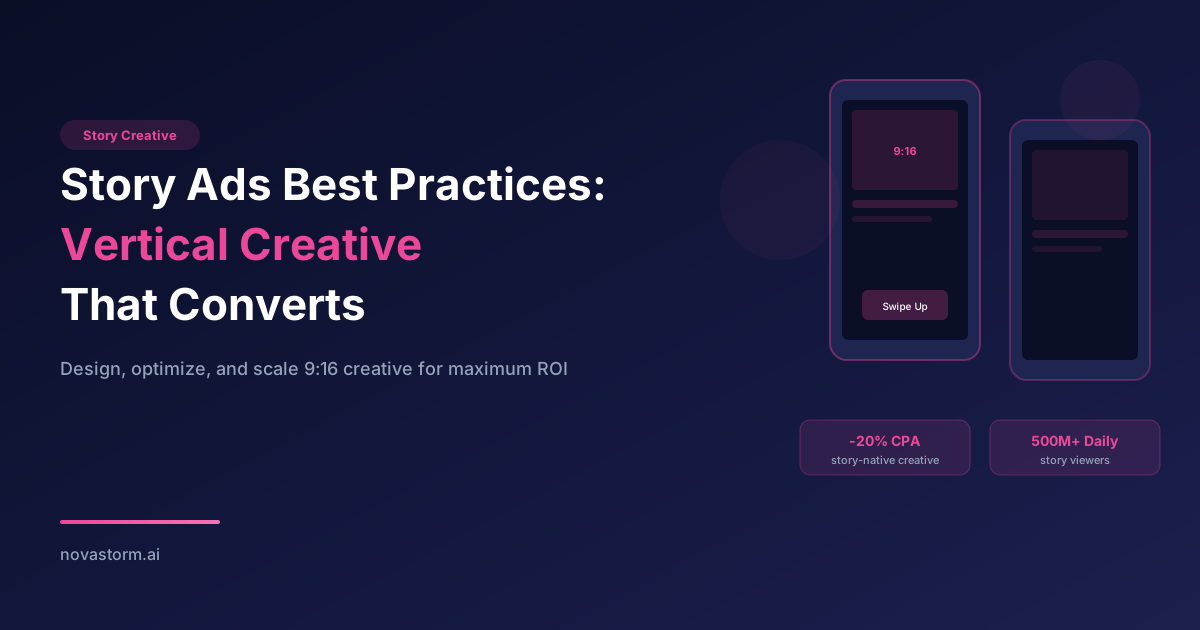
Story Ads Best Practices: Vertical Creative That Converts
A Story creative needs to communicate inside the placement’s interface and still lead to a truthful usable destination. Design the asset for the actual preview, then test its commercial role. Neither a fixed viewing-time statistic nor a universal image-versus-video ranking can replace that acceptance check.
Prepare a vertical layout and verify placement requirements
Hypothetical layout plan: a9:16 working canvas with the product demonstration in the center, a concise offer above it and captions below the demonstration. Canvas size is an editing choice; check the current accepted dimensions, file formats, duration and upload limits separately for each selected Facebook/Instagram Story placement. Do not treat a center 1080×1420 rectangle or a30MB video limit as universally valid.
- Upload the correct crop and inspect the actual placement preview with account identity, caption and CTA overlays. Preview each selected placement separately; one safe-zone template does not certify them all.
- Keep the product, key terms and essential captions away from covered edges. Adjust against the rendered interface rather than claiming that one pixel margin always protects the message.
- Watch with sound off and on. Captions must carry the core information and audio must be licensed; do not assume every viewer listens.
- Verify the mobile destination, accurate offer, stock and booking/purchase path. A CTA preview is not a completed commercial action.
A finished hypothetical first-frame and body brief
| Frame | Proposed content | Quality check |
|---|---|---|
| Opening | Show an actual reusable bottle lid closing; “See how the lock works.” | Product visible and claim demonstrated |
| Body | Close shot of the lock followed by normal carrying use | No exaggerated durability or edited before/after outcome |
| Offer | “Choose your size. See the current price.” | Exact available product and matching destination |
| Caption/CTA | Short readable text in verified preview | No covered price, disclosure or essential instruction |
Stop wasting ad budget
NovaStorm AI cuts Meta Ads CPA by 30% on average. No complex setup required.
This is a creative plan, not a delivered ad or a measured brand result. Static product images are a valid comparison hypothesis; do not reject them categorically. For beauty, health or transformation messages, check the current policy and evidence for each visual/claim before use rather than recommending before/after pictures by default.
Compare image and video using one denominator
Illustrative test inputs: each arm spends $150 and receives 200 eligible landing sessions. The static arm has six unique mature paid orders; the video arm has eight. Session-based CVR is 3% versus4%, and ad-only CPA is $25 versus $18.75. These assumed numbers do not establish a winner; production cost, returns and uncertainty still matter.
Use the same offer, eligible population, window, customer outcome and session definition in a supported controlled design. Define the smallest worthwhile difference and budget before launch. One thousand impressions is not a guarantee of statistical reliability, especially with few purchases. If the affordable sample cannot answer the question, close as inconclusive.
Prepare the placement-specific crop, caption and acceptance card alongside a NovaStorm campaign draft. Have the user inspect the actual output and saved destination before publication. Asset preparation is distinct from a guaranteed Stories CPA improvement, live vertical preview or policy approval.
Published by NovaStorm AI. Worked examples and proposed tests are labeled in the article.
Disclaimer: This article was generated with the assistance of AI and reviewed by the NovaStorm AI team. While we strive for accuracy, we recommend verifying specific data points and consulting official sources (linked where available) for critical business decisions.
Ready to automate your Meta Ads?
NovaStorm AI takes full responsibility for your campaigns — from monitoring to optimization.
Start NowMore on Ad formats and placements

Instagram Explore Ads: Reaching Users in Discovery Mode
Verify the Instagram discovery placements available to your campaign, inspect actual thumbnail scale and test commercial outcomes with a bounded plan.
Animated vs Static Meta Ads: Performance Data and Best Practices
Build matched static and motion creatives, compare full production and acquisition costs, and plan evidence without universal performance benchmarks.
Collection Ads on Meta: The Immersive Shopping Experience Guide
Check the Collection-to-Instant-Experience-to-website journey, product IDs and mobile checkout before evaluating mature orders and margin.
Collection Ads for E-commerce: Instant Storefront Experience
Build and preview a catalog-backed Collection ad, distinguish storefront clicks from retained orders, and compare the full-cost journey.