

How to Repurpose Content Into Meta Ad Creatives at Scale
Turn a traceable source into self-contained Meta ad copy and video briefs, verify rights and numbers, and account for production and test costs.
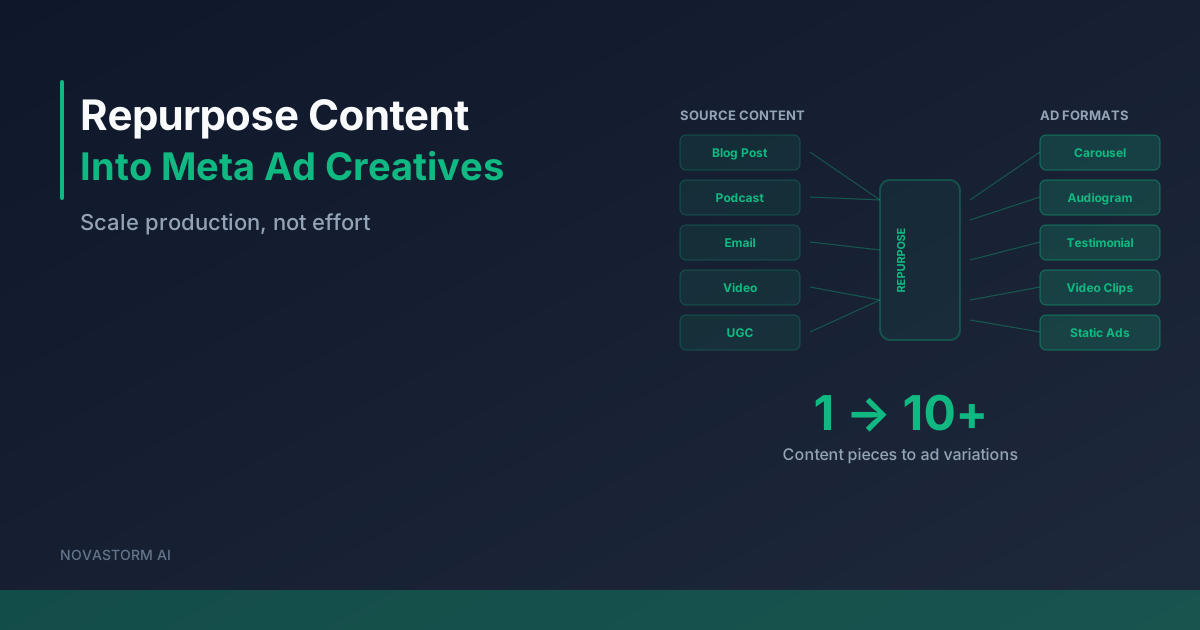
Repurposing changes the format of a message; it does not prove the message is a profitable ad. A useful article, podcast segment or popular organic post can be a source, but paid acquisition also needs an accurate offer, an appropriate destination and a measurable business outcome.
Start with one source and preserve its meaning
Here is an original teaching source written for this article: “Media CPA is ad spend divided by retained paid orders. In an illustrative example, $120 in media spend and six retained orders produce a media CPA of $20. A cheaper video play does not necessarily mean a cheaper order.” These numbers are hypothetical. They are arithmetic inputs, not customer evidence.
Production brief: explain the difference between attention cost and acquisition cost to a small advertising team. The source is this article’s own teaching text; no customer quotation, portrait or commercial result is supplied. Before using an outside source, record the author, date, original passage, permitted paid-ad use and any editing restrictions. Recheck every number and preserve the “illustrative” qualification in the derivative asset.
| Ready-to-use teaching copy | Context that must stay visible |
|---|---|
| Card 1: “Cheap views are not cheap orders.” | Headline expresses a question about measurement, not a claim that all view campaigns fail. |
| Card 2: “Illustrative example: $120 media spend ÷ 6 retained orders = $20 media CPA.” | Keep “illustrative,” currency and retained-order definition on the card. |
| Card 3: “Compare mature outcomes before changing spend.” | CTA may link to the full methodology; this is education, not a promise of savings. |
These are complete copy fragments for proposed cards, not uploaded image files or a measured campaign. Each card must make sense if shown alone. A final carousel order is not proof that every viewer reads all cards. Check any reordered version for a missing qualification or a misleading isolated number.
Organic interest and an advertising offer are separate gates
| Source signal | What to verify before paid use |
|---|---|
| High organic engagement | Whether the audience includes eligible buyers and the message connects to a concrete product job. |
| Customer email or review | Permission for paid use, accurate wording, material connections and substantiation of any result claim. |
| Podcast clip | Speaker permission, licensed music and a standalone statement that preserves context. |
| Research statistic | Original source, period, population, denominator and permitted reuse; omit if verification fails. |
An organic winner is a candidate, not validated paid-ad economics. Do not invent a review, star rating or outcome to fill a production quota. A plan to make five to fifteen assets is a capacity hypothesis that should be revised after measuring usable outputs.
Stop wasting ad budget
NovaStorm AI cuts Meta Ads CPA by 30% on average. No complex setup required.
Three durations times three crops is a production plan
Fifteen-, thirty- and sixty-second edits across three aspect ratios produce nine planned exports: 3 × 3 = 9. They are not nine distinct ideas, approved placement combinations or independent experiments. Confirm the selected placement’s current specifications before exporting.
- Make each duration self-contained: opening identifies the task, the middle carries necessary context, and the ending states the same accurate next step. Record information removed from a shorter cut.
- For the teaching source, a short version can show the illustrative CPA equation; a longer version can explain why a qualifying-play count is a different denominator. Do not erase the hypothetical label to save time.
- Review each crop for cut-off products, captions, numbers and CTA. Inspect the actual placement preview, including interface overlays, then record pass/fail per export.
- Reject duplicates that add no useful coverage or exports that cannot carry their own limitations. Count approved usable assets separately from files generated.
Record production cost and bound the commercial test
Track briefing, rights clearance, writing, design, editing and review time by batch, plus license and outsourcing costs. Hypothetical budget: three labor hours at an assumed $30/hour plus a $15 license total $105. If only five of nine exports pass review, production cost per approved asset is $21, not $11.67. This is planning arithmetic, not a measured efficiency improvement.
Set a cash-loss limit for media separately from production cost. For example, an assumed $150 media cap plus the $105 production budget exposes up to $255 of cash cost, before any additional variable business costs. Define whether the decision uses media CPA or total production-plus-media cost per mature customer. If no customer qualifies, the latter cost per customer is undefined, not zero.
- Choose one offer, destination and mature outcome, such as retained orders or qualified leads. State the conversion-lag and refund treatment.
- Use a controlled comparison where eligible; otherwise document observational delivery and confounders. Avoid treating nine adaptive-delivery exports as nine equally tested winners.
- Stop at the declared loss limit or failed tracking, and assess mature outcomes before ordering another production batch. Keep untested variants labeled untested.
Use the creative testing framework for asset traceability. NovaStorm can support proposed campaign and variant preparation as paused campaign and local ad-set drafts, followed by human review. Verify any automatic editing or export capability separately; this workflow does not establish automatic rights clearance or publication.
Published by NovaStorm AI. Planning examples are illustrative assumptions, not measured customer results.
Disclaimer: This article was generated with the assistance of AI and reviewed by the NovaStorm AI team. While we strive for accuracy, we recommend verifying specific data points and consulting official sources (linked where available) for critical business decisions.
Ready to automate your Meta Ads?
NovaStorm AI takes full responsibility for your campaigns — from monitoring to optimization.
Start NowMore on Creative production and UGC
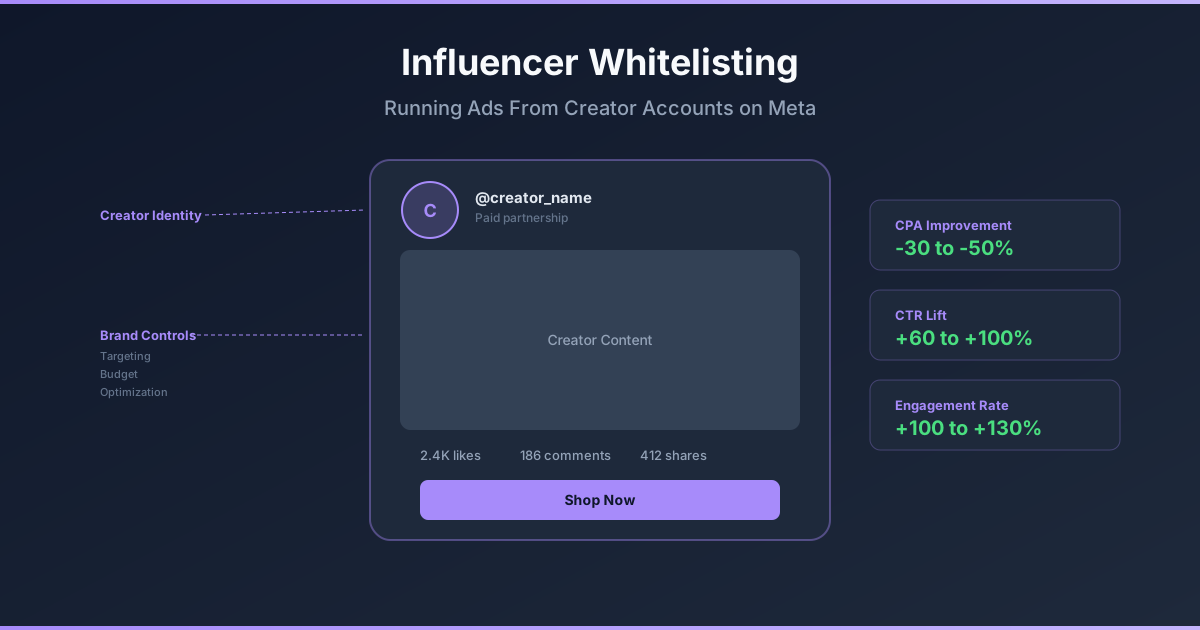
Influencer Whitelisting: Running Ads From Creator Accounts on Meta
Prepare creator-ad permissions, rights and disclosures, verify expiry and revocation, and compare creator versus brand identity without assuming performance gains.

Branded Content Ads on Meta: Partnering With Creators at Scale
Check partnership-ad permissions and license expiry, compare brand and creator identity under a controlled plan, and include creator fees in acquisition cost.
UGC Ads on Meta: How to Source and Scale User-Generated Content
Build a licensed creator-content pipeline with truthful briefs, a rights and quality card, all-in acquisition costs and a budgeted testing queue.
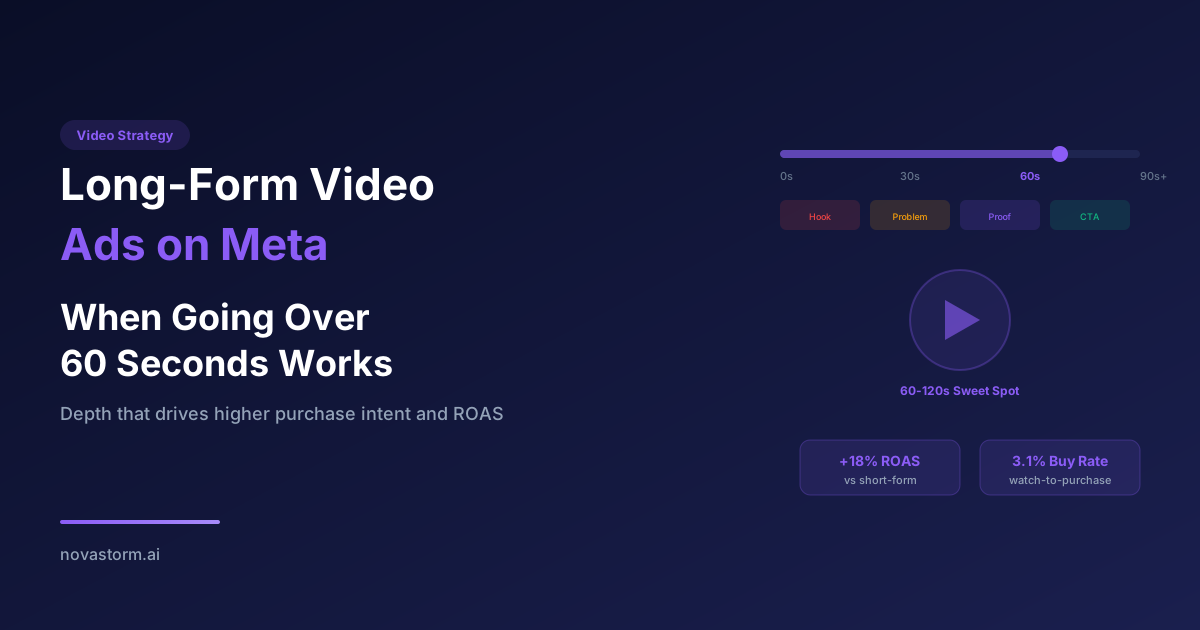
Long-Form Video Ads on Meta: When Going Over 60 Seconds Works
Plan a truthful modular long-form ad and short cuts, account for rights and production costs, and evaluate mature purchases rather than viewing thresholds.